



 Front-end
 Back-end
 Full Stack Developer
 Mobile
 Other
Other


 Company
 Contact Us
SaaS Application Development A Remote Dedicated Developer Hourly or Monthly
A remote mid-to-senior developer who works only on your SaaS product, 160 to 172 hours a month, in your repository and your cloud account. Billing, permissions, integrations, AI features and the next release, with a senior team lead who reviews and tests every release. Start with a 7-day risk-free trial.

Years of Experience
Talented IT Professionals
Successful Projects
Clients
SaaS Application Development From Empiric Infotech LLP
Empiric Infotech LLP provides SaaS application development services through a remote dedicated developer: one mid-to-senior engineer, or a small dedicated team, working full time and only on your product. Most of the SaaS work we do is on products that already have paying customers, where the job is less about a launch and more about the next twelve releases: a pricing change that touches billing, a permission model that has to survive the first enterprise customer, an integration a large account asked for, an AI feature that has to respect each tenant's data. That work needs someone who knows the codebase in month six as well as in month one. Your developer works in your GitHub or GitLab organisation and your cloud account from the first day, joins your standups and sends a work update at the end of every day, and a senior team lead reviews and tests each release before it reaches your customers. Our SaaS builds include EndoDNA, a multi-tenant platform for clinics in the United States, and BizBoost, which automates Google Business Profile work for local businesses.
What a SaaS development engagement delivers
Shipped releases on the product your customers already use, from a developer who stays on it. Not a prototype handed over at the end of a fixed bid.
Billing and subscriptions
Stripe subscriptions, plans and trials, usage-based pricing, upgrades and downgrades, invoices, failed-payment recovery and tax settings, plus the admin screens your support team needs when a customer asks why they were charged. Billing is where small mistakes cost real money, so every change ships behind a test that covers it.
Multi-tenancy, roles and permissions
Tenant isolation that holds up when one account grows to hundreds of users, role-based access your customers can manage themselves, single sign-on through SAML or OIDC for larger accounts, and an audit log of who changed what. These decisions are easy at the start and expensive to retrofit.
Integrations and a public API
Connections to the CRM, accounting, calendar, messaging and storage tools your customers already run, OAuth flows with Google and Microsoft, webhooks, and a documented REST API that customers can build on. Integrations are often what closes the larger deals, and they need to keep working after the other side changes its API.
AI features inside the product
Assistants, search over each customer's own data, document processing and agents that take actions inside your app. Built with the parts a demo skips: which data the model may see per tenant, what each call costs, and what the product does when the answer is wrong.
Releases that do not break paying customers
Staging that matches production, feature flags for anything risky, database migrations that run without downtime, and regression checks on the flows customers pay for. The senior team lead reviews and tests each release before it goes out.
Performance and the next scale step
Query tuning on PostgreSQL or MySQL, caching, background jobs and queues, monitoring and alerts, so the product stays fast as accounts and data grow. We fix the bottleneck you have now, not one you might have in three years.
How a SaaS engagement starts
No long discovery phase. The goal is a developer shipping on your real backlog inside the first week.
A 30-minute call
You walk us through the product, the stack, the customers and the next three things on the roadmap. We ask where the code lives, how releases happen today and what has broken before.
A written scope and one developer who fits
Within 24 hours you get a short written scope, the skills it needs and an introduction to one developer who fits the stack. You meet them before anything starts.
A 7-day risk-free trial
NDA and IP assignment are signed first. Your developer starts within 48 hours on a real backlog item. Day 7 is a real decision point, with a full refund if it is not a fit.
A monthly rhythm
Standups with your team, a work update at the end of every day, and a senior team lead who reviews and tests each release. Add a developer when the roadmap needs one, or stop with seven days' notice.
SaaS development pricing: hourly or monthly
Both plans give you a mid-to-senior developer who works only on your product, with a senior team lead reviewing and testing every release. Monthly is for an ongoing roadmap: 160 to 172 hours of full-time work, billed monthly upfront. Hourly suits a defined piece of work, such as one integration or a billing change. No setup fee and no recruitment fee.
Hourly plan
- A dedicated developer, exclusive to you while you have hours booked
- Pay as you go - billed by the hour, time tracked, a weekly report
- Best for short, defined work; no monthly commitment
- Code review and pre-delivery testing by a senior lead, built in

Monthly plan
- A dedicated developer, full-time and exclusive - 160-172 hours a month
- The best value for an ongoing engagement
- Your repo, your cloud account, your tools
- Code review and pre-delivery testing by a senior lead on every release
- 7-day risk-free trial, monthly billing, cancel with 7 days notice
Dedicated team
- A dedicated team - developers plus a senior team lead who reviews and tests every release
- Add a developer (and a designer where the build needs UI/UX work) at the same rate
- Best for long-term, multi-track work; add a developer in 48 hours, no re-contracting
The first 90 days on a SaaS product
A dedicated engagement is ongoing work, not a fixed project. This is the usual shape of the first three months on a live product.
- Week 1
Access, setup and a first merged change
Repository and cloud access, a working local environment, a map of how deployments and environments work today, and a first pull request reviewed and merged. Day 7 is the decision point on the trial.
- Month 1
The first roadmap item in production
The highest-priority item shipped to production, behind a feature flag where it touches paying customers. Staging, CI and the release checklist are agreed with your team.
- Month 2
The harder parts of the roadmap
The work that usually waits: a billing change, a permissions overhaul, the integration a large account asked for, or the first AI feature. Each one ships with tests that cover the paid flows around it.
- Month 3
Ahead of the backlog
By month three your developer knows the codebase well enough to suggest work, not just take tickets: slow queries, fragile jobs, a refactor that unblocks the next quarter. You plan the next quarter together.
A dedicated developer vs a SaaS development agency, a contractor marketplace, or an in-house hire
| Empiric Infotech (dedicated developer) | SaaS development agency (fixed price) | Contractor marketplace | In-house hire | |
|---|---|---|---|---|
| How you pay | A flat monthly fee per developer, or hourly for defined work | A fixed bid per phase; anything new is a change order | Hourly rates that vary by contractor; you track the hours | Salary, benefits, payroll tax, equipment and hiring time |
| Who works on your product | One mid-to-senior developer, only on your product, plus a senior team lead | A project team that moves on when the phase ends | Whoever you hire, with nobody reviewing their work | Your employee |
| Time to start | 48 hours | Weeks: proposal, statement of work, kickoff | Days to weeks | 3 to 5 months to hire |
| When the roadmap changes | Re-prioritise the backlog, no change order | Change order, new quote, new signature | Renegotiate the hours or the rate | Reassign internally, if you have the people |
| After a release | The same developer keeps shipping | A separate maintenance retainer | The contract ends and the knowledge leaves | The team stays, if they stay |
| Code and accounts | Your repository and your cloud account from day one; IP assigned to you | Yours on final payment | Yours if the contract says so; check the IP clause | Yours |
| Invoicing | One monthly invoice | Per agency terms | Per contractor or per platform | Payroll |
The comparison describes how each option usually works, not any one provider. Ask us for a written comparison against a quote you already have.
Working hours and meeting availability
Our team works 09:30 AM - 07:30 PM IST and a project manager is on call 07:30 AM - 11:00 PM IST, Monday to Friday. Here is exactly when that lands for clients in the US, Europe and Australia, your region first.
US Eastern (New York, Boston, Atlanta) - full team online 12:00 AM - 10:00 AM, project manager 10:00 PM - 1:30 PM (next day).
US Pacific (Los Angeles, San Francisco, Seattle) - full team online 9:00 PM - 7:00 AM (next day), project manager 7:00 PM - 10:30 AM (next day).
UK & Ireland (London, Dublin) - full team online 4:00 AM - 2:00 PM, project manager 2:00 AM - 5:30 PM.
Central Europe (Berlin, Paris, Amsterdam, Madrid) - full team online 5:00 AM - 3:00 PM, project manager 3:00 AM - 6:30 PM.
Australia East (Sydney, Melbourne, Brisbane) - full team online 3:00 PM - 1:00 AM (next day), project manager 1:00 PM - 4:30 AM (next day).
Want it to the half-hour in your own time? Slide through your day and book a slot below.
Why SaaS teams choose a dedicated developer over a project agency
A SaaS product is never finished. The first release is the small part; the cost sits in the next two years of changes, each made by someone who has to understand why the code looks the way it does. A fixed-price agency is built for the first release. It scopes a phase, delivers it and moves its people to the next client, so every later change starts with someone new reading your codebase from scratch.
A dedicated developer works the other way round. The same person carries what they learned about your billing edge cases, your largest customer's integration and last quarter's migration into every release after it. That is why our longest client relationships have run past two years, and why most clients start with one developer and keep that developer.
What you get is one engineer who works only on your product, inside your tools, with a senior team lead who reviews and tests each release. What you do not get is a lock-in: you own the code and the accounts from the first day, and you can stop with seven days' notice.
Recent work for product teams across the USA, Europe, and Australia
EndoDNA - a multi-tenant SaaS for clinics
A HIPAA-compliant multi-tenant platform that brings lab results, genetic data and an AI health assistant into one workspace for each clinic, with user permissions and subscription billing. Built and extended by a single dedicated developer from Empiric Infotech.
Read case studyBizBoost - Google Business Profile automation
A SaaS platform that automates Google Business Profile posting, writes AI replies to reviews and runs them through an approval workflow before anything is published.
Read case studyMarketPlace Monitor - real-time deal alerts for resellers
A cross-platform product that scans marketplaces in real time and sends instant alerts for new listings, sold on subscription tiers.
Read case studyArchitecture CRM - tasks, email and contacts in one place
A CRM that brings tasks, email, calendars and contacts into one place, with Google and Microsoft integrations so the team keeps the tools it already uses.
Read case study“The team was professional, responsive, and kept everything on track with both time and cost.”
- Fredrik Hagen, Founder, Skapasaga
Our Hiring and Engagement Model
Dedicated Resources
Hourly Basis

How to Hire Developer from Empiric Infotech LLP
As a leading web and mobile app development company in the USA, Empiric Infotech LLP simplified the process of hiring web and mobile app developers. You can hire software engineers in 3 simple steps: Request, Interview, and Hire.
STEP 01
Request
Share your requirements
STEP 02
Interview
Take developer’s interview
STEP 03
Hire
Start risk-free work
Reviews




Frequently Asked Questions (FAQs)
It designs, builds and keeps improving the software your customers subscribe to: the product itself, billing and subscriptions, user accounts and permissions, integrations and a steady flow of releases. Empiric Infotech does this through a remote dedicated developer, or a small dedicated team, who works only on your product in your repository and cloud account, with a senior team lead reviewing and testing every release. Most of our SaaS work is on products that already have paying customers, and new products get the same engagement.
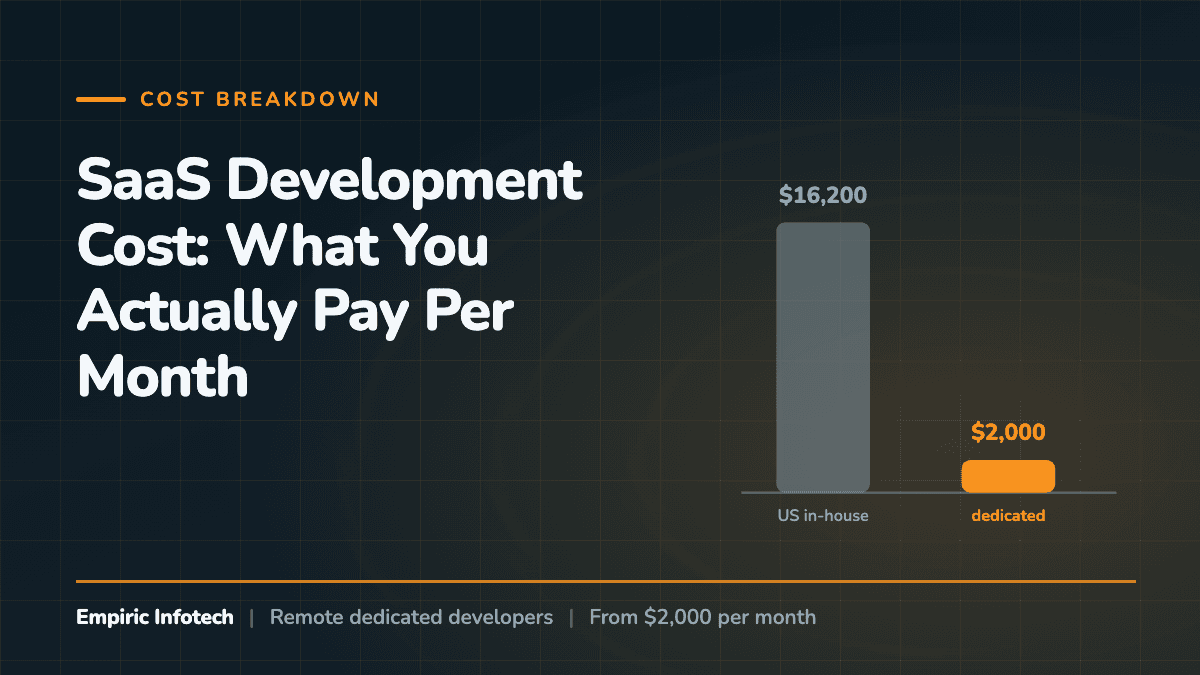
It depends on how many developers you need and for how long. With Empiric Infotech you pay a flat monthly fee per dedicated developer for 160 to 172 hours of full-time work, or an hourly rate for a defined piece of work such as one integration. Current rates are in the pricing section above. Most SaaS products run on one dedicated developer for a long time and add a second developer, or a UI/UX designer, at the same monthly rate when the roadmap needs it.
Book a 30-minute call and walk us through the product, the stack and the next items on the roadmap. Within 24 hours you get a short written scope and an introduction to one developer who fits your stack, and you meet them before anything starts. The NDA and IP assignment are signed first, your developer starts within 48 hours, and the first 7 days are a risk-free trial with a full refund if it is not a fit.
Your developer starts within 48 hours, ships a first reviewed change in week one and puts the first roadmap item into production in month one. The time to a full first version depends on its scope, so we map it into monthly milestones on the scoping call and you see the plan before you commit. On a live product, work ships release by release from the first month.
Yes. The first week goes on reading the code, getting a local environment running, mapping how deployments work and shipping one small reviewed change. By the end of that week you get a short written note on what we found: the risky areas, missing tests and anything that should be fixed before new features are added on top.
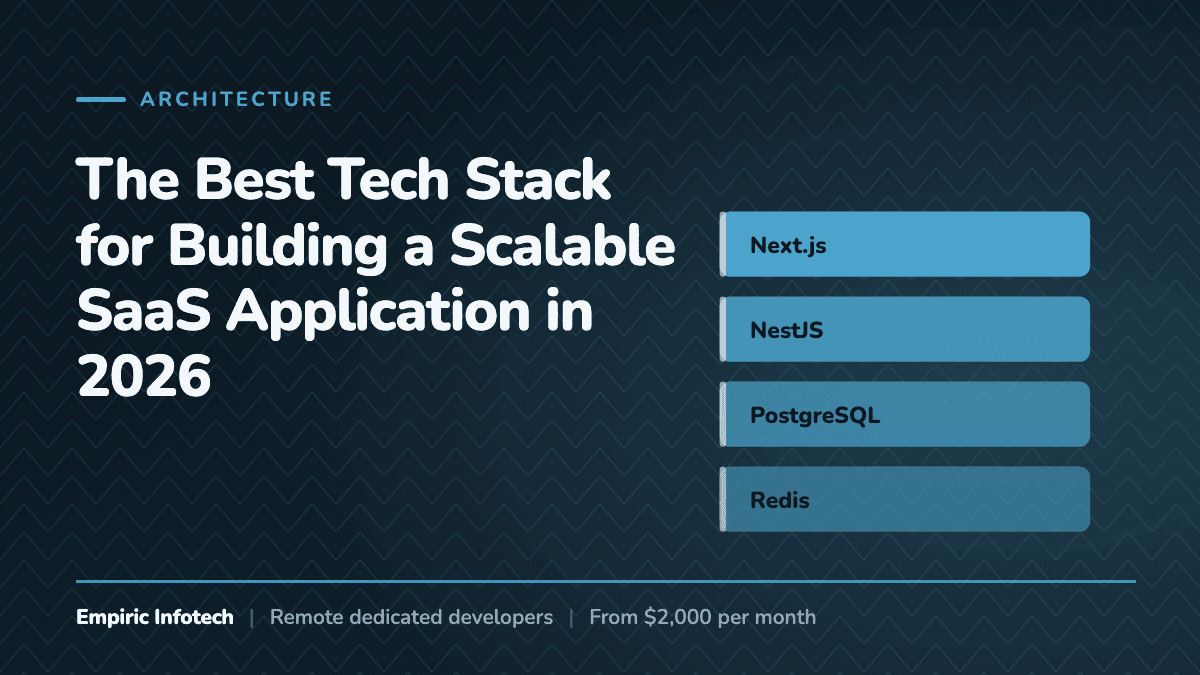
Most of the SaaS products we work on run on React, Next.js and TypeScript on the front end, Node.js or Python (Django, FastAPI) on the back end, PostgreSQL, MySQL or MongoDB for data, Stripe for billing, and AWS, Azure or Cloudflare for hosting, with Supabase or Firebase where they fit. On an existing product, we match you with a developer who already works in the stack it runs on.
Yes. Assistants, search over each customer's own data, document processing and agents that take actions inside the app. We set out which data the model may see for each tenant, track what each call costs, and decide what the product does when the model is wrong, before the feature ships.
You do, fully. The NDA and IP assignment are signed before work starts, and your developer works in your GitHub or GitLab organisation and your cloud account from the first day, so the code, the data and the accounts stay yours throughout.
Yes. You are billed monthly, upfront, and you can stop with seven days' notice. The first 7 days are a risk-free trial with a full refund if it is not a fit, and you can add a developer whenever the roadmap needs one.
GET A QUOTE NOW
Tell us about your SaaS product and your roadmap, and we will come back with a short scope and a developer who fits.

Other Services
We provide comprehensive IT solutions to help businesses stay competitive and innovative in today's digital world.
Get Insights On SaaS Development