



 Front-end
 Back-end
 Full Stack Developer
 Mobile
 Other
Other


 Company
 Contact Us
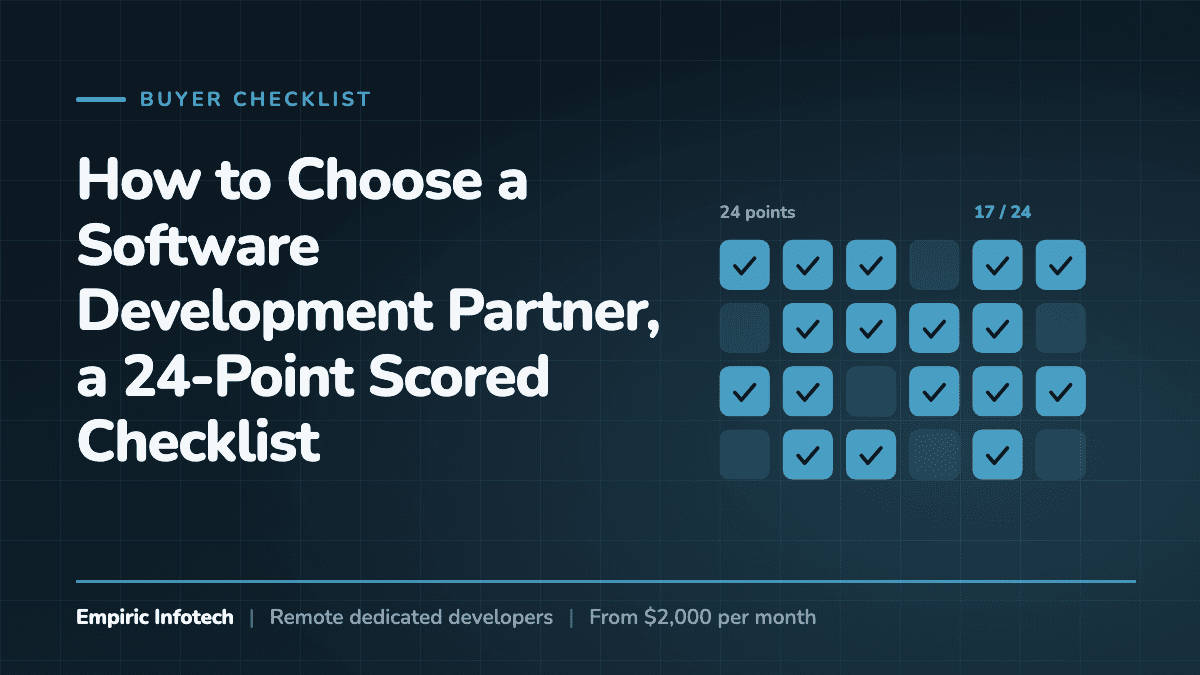
Score a software development partner on 24 checks, 0 to 3 each, for a maximum of 72. Above 55, sign. Below 40, walk away. It matters: the Standish Group's CHAOS 2020 study of more than 50,000 projects found only 31 percent succeeded, 50 percent were challenged and 19 percent failed outright.
Published 12 September 2026.
The short answer
- Score, do not shortlist. A ranked list of three vendors hides that all three failed the same check. A number does not.
- 72 points, three bands. 55 and above, sign. 40 to 54, sign only once the gaps are in the contract. Below 40, walk away.
- Four checks are pass or fail. A named engineer, a senior reviewer on every release, your accounts in your own name, and 30 days notice or less. A zero on any of them fails the whole evaluation.
- Buy a paid trial, not a proposal. Five to ten hours of real work tells you more than a 40-page deck.
- Price the month, not the project. Fixed-bid scopes convert every change into a negotiation.
- Read the exit clause first. The cost of a bad partner is the time it takes to leave, not the invoice.
What should I score a software development partner on?
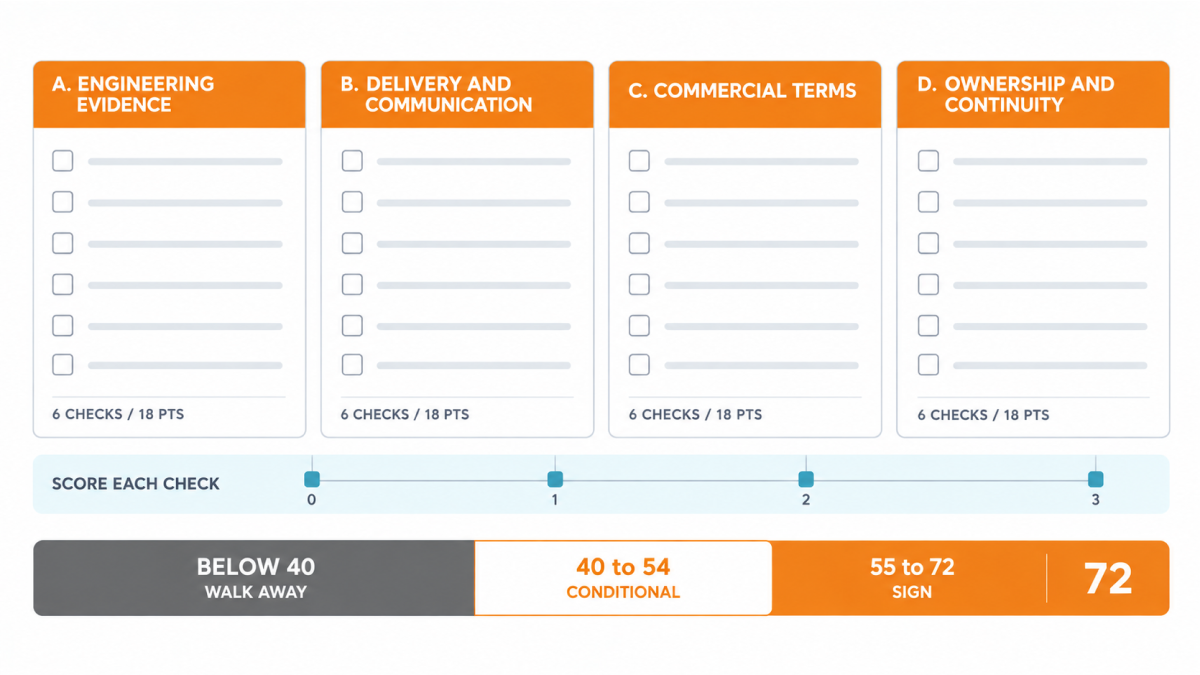
Score four areas, six checks each, 0 to 3 per check, 72 points total. Give 3 when the answer is written down and verifiable, 2 when it is true but informal, 1 when it is only a promise, and 0 when it is absent or evaded.
| Area | Checks | Max points | What it protects |
|---|---|---|---|
| A. Engineering evidence | 6 | 18 | Can they build it |
| B. Delivery and communication | 6 | 18 | Do you find out early |
| C. Commercial terms | 6 | 18 | Does a bad month cost a year |
| D. Ownership and continuity | 6 | 18 | Do you still own it at the end |
A. Engineering evidence, 18 points
- They named the exact engineer, with a CV and their availability.
- You have seen code that person wrote, in a repository, not in a slide.
- Automated tests exist on their own work and they can explain what they cover.
- A senior engineer reviews and tests every release, and you can name that reviewer.
- They can describe a production incident they caused and what changed afterward.
- They pushed back on at least one thing you asked for during the pitch.
B. Delivery and communication, 18 points
- Written status arrives on a fixed rhythm without you asking for it.
- Overlap hours with your working day are stated in the contract, not in an email.
- Your single point of contact is technical and is on the delivery team.
- They estimate in ranges and tell you what would make the range wrong.
- Their decision turnaround is defined. The Standish Group's CHAOS 2020 report names decision latency, how long an organization takes to decide, as the root cause of project failure.
- The ticket tracker and design files live in your accounts.
C. Commercial terms, 18 points
- The monthly price and the number of hours it buys are both written down.
- Notice period is 30 days or less.
- No mandatory minimum term beyond three months.
- A trial period exists that you can end without paying a full month.
- Rate changes require your written agreement, with a stated notice window.
- Invoices map to named people and calendar months, not vague milestones.
D. Ownership and continuity, 18 points
- Repository, cloud accounts and model API keys are in your name from day one.
- IP assignment is signed before the first commit.
- They commit to replacing a departing engineer within a stated window.
- Handover documentation is a named deliverable, not a favor.
- Every access grant is per person and revocable by you.
- They will name a client you can actually call.
What score means it is safe to sign?
Add the 24 scores, apply the bands below, then apply the automatic fails. Both tests must pass.
| Total out of 72 | Verdict | What to do next |
|---|---|---|
| 55 to 72 | Safe to sign | Start on the shortest term they offer |
| 40 to 54 | Conditional | Write every 0 and 1 into the contract as an obligation, then re-score |
| Below 40 | Walk away | No contract language fixes a partner who cannot evidence the basics |
Four checks are pass or fail on their own: the named engineer, the senior reviewer on every release, your ownership of repository and cloud accounts, and the 30-day notice period. A zero on any of them fails the evaluation even at 65 out of 72, because each converts a bad month into a bad year.
How do I test whether a partner can actually build?
Buy five to ten hours of real work before you buy anything else, and pay for it. Give them a small, genuine problem from your own codebase, not a puzzle. Then judge four things: the pull request description, the tests they wrote unprompted, the questions they asked first, and whether they told you something you did not want to hear.
Test the review, not the typing speed. Google's DORA 2025 State of AI-assisted Software Development report, based on responses from nearly 5,000 technology professionals, found 90 percent use AI at work and 30 percent report little or no trust in the code it generates. Its framing is that AI amplifies whatever a team already is, so a partner with a weak review process now ships weak code faster. Ask who reads the diff, what they block on, and what a review last caught.
Ask for work you can inspect rather than logos you cannot. Our case studies name the product, the stack and the scope.
Should I buy a fixed-bid project, hourly agency time, or a dedicated developer?
Buy a fixed-bid project only when the scope genuinely will not change, which for product and SaaS work is almost never. Each model fails in a predictable place.
| Engagement model | What you are buying | Where it breaks |
|---|---|---|
| Fixed-bid project | A scope and a date | Every change becomes a negotiation. McKinsey and the University of Oxford studied more than 5,400 IT projects and found large ones overran their cost plans by 45 percent and delivered 56 percent less value than predicted |
| Hourly agency time | Hours from a shared pool | People rotate, context resets, you pay for the reset |
| Dedicated developer, monthly | One named engineer, full time, month to month | Wrong fit if you need four skill sets for two weeks each |
| Direct in-house hire | A permanent employee | Slow to fill, hard to reverse. The US Bureau of Labor Statistics put the median annual wage for software developers at $135,980 in May 2025, before taxes, benefits and recruiting |
Deloitte's 2024 Global Outsourcing Survey of more than 500 executives found 83 percent were using AI as part of their outsourced services. You are choosing engineering judgment now, not an hourly rate.
What does a dedicated software development partner cost per month?
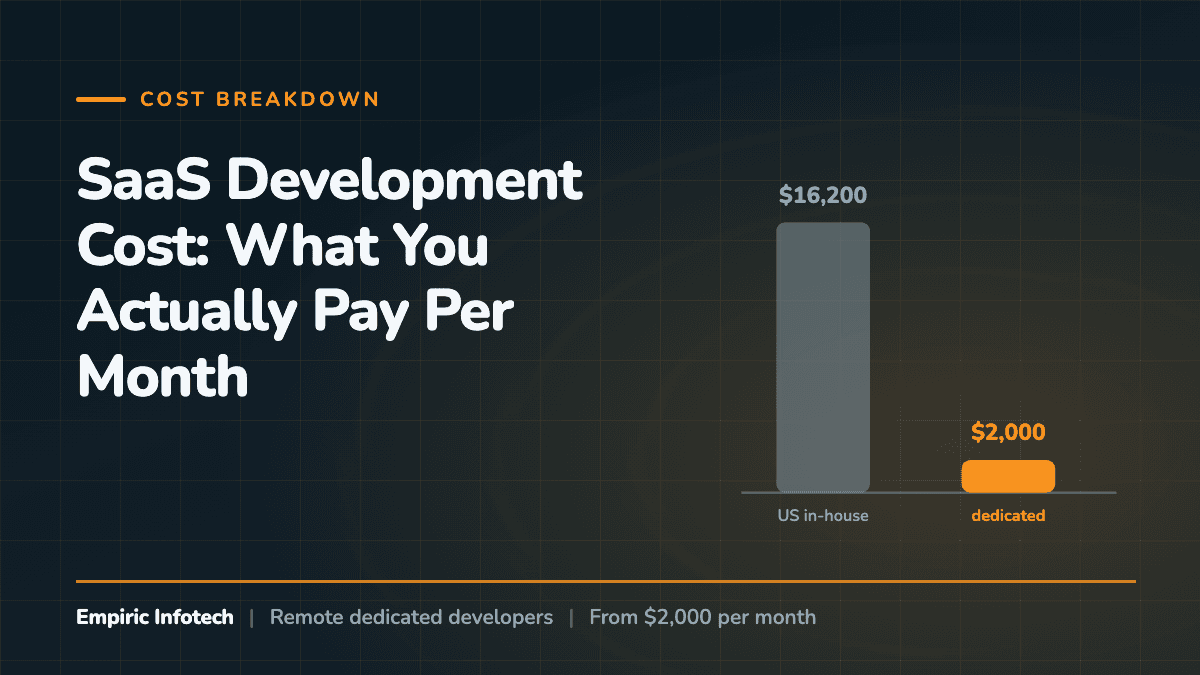
A dedicated engineer runs $2,000 a month in the US, EUR 2,000 in Europe and AUD $3,000 in Australia, for 160 to 172 hours of one named full-time engineer, billed monthly upfront. Hourly work is $15 an hour standard and $25 an hour for AI engineering, or AUD $25 and AUD $40 in Australia. AI work is charged at the same flat monthly rate.
Those are our published numbers, and a partner that will not publish theirs has told you something. A monthly figure with no stated hours is not a price, it is a range. Divide by the hours before comparing two quotes, and check whether senior review sits inside that number or is billed on top. On our dedicated developer engagements a senior team lead reviews and tests every release, and that review is not a line item.
What contract terms protect me if the partnership does not work out?
Three terms carry almost all of the protection: a notice period of 30 days or less, IP assignment signed before the first commit, and every account in your name. Everything else is comfort.
Insist on the account point. The repository, the cloud project and the model API keys should be created by you and shared with the partner, never the reverse. If the partner holds the keys, your exit cost is a migration, and that migration is what keeps clients in engagements they have outgrown. On our engagements the client keeps all three.
Then check the two things teams skip: what happens if your named engineer leaves, with the replacement window in writing, and whether handover documentation is a deliverable or a courtesy. A partner comfortable with both expects to be judged on twelve months, not the first invoice.
How do I start without committing to a year?
Start with one named mid-to-senior engineer for one month and score the same 24 checks from the inside, where answers are observable rather than promised. That is how we work: one full-time exclusive engineer, 160 to 172 hours a month, at $2,000 a month in the US, EUR 2,000 in Europe or AUD $3,000 in Australia, billed monthly upfront. AI work is charged at the same flat monthly rate, with the premium applied hourly instead.
A 7-day risk-free trial starts it, the engagement runs month to month, and you can cancel on 7 days notice. A senior team lead reviews and tests every release, and you keep the repository, the cloud accounts and the model keys from day one.
Read about the team before you decide, then run the 24 checks on us and tell us where we scored a zero.