



 Front-end
 Back-end
 Full Stack Developer
 Mobile
 Other
Other


 Company
 Contact Us
SaaS Development Cost: What You Actually Pay Per Month
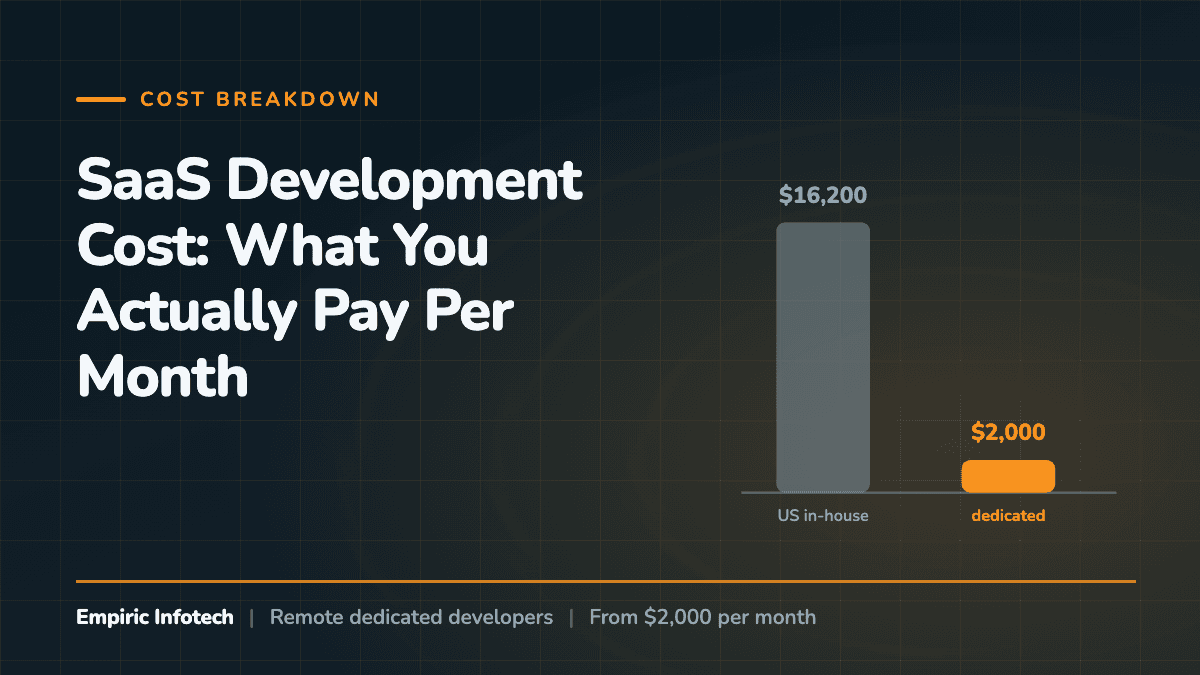
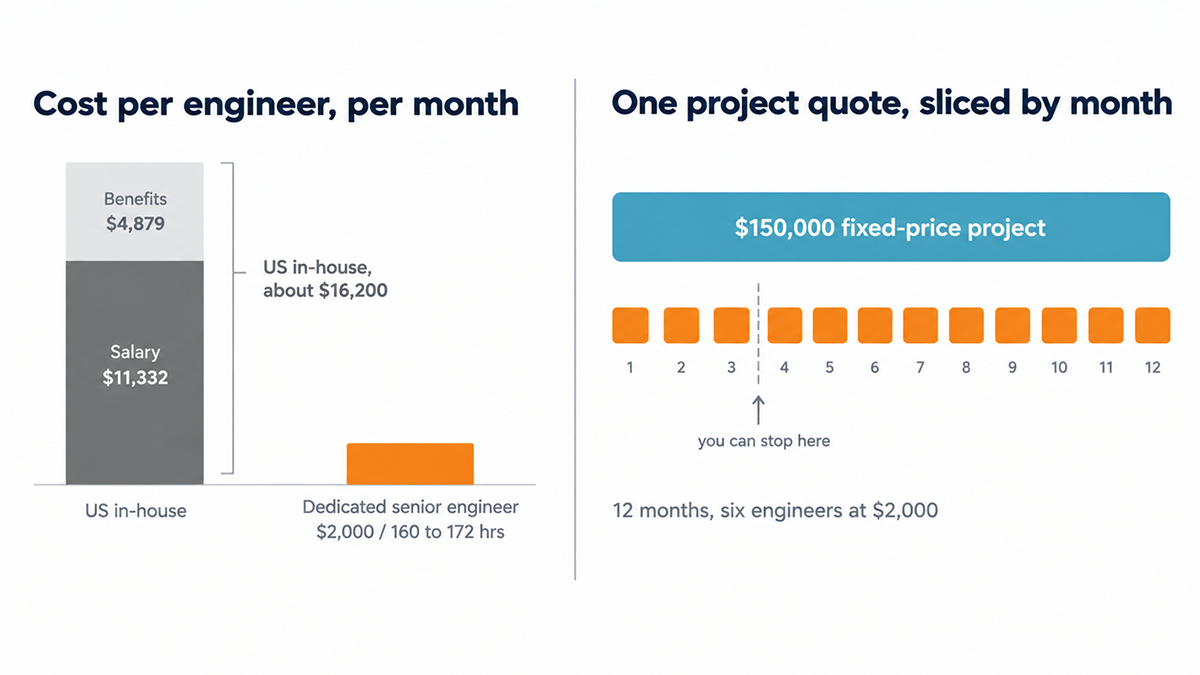
Priced as a monthly run rate rather than a project quote, one dedicated senior engineer at Empiric Infotech is $2,000 a month for 160 to 172 hours, so a three person team is $6,000. The same three engineers hired in-house in the US cost about $48,600 a month fully loaded, on the BLS build-up set out below.
The short answer
- Ask for the monthly number, not the project number. A single project price is the same money as a monthly retainer, pre-committed before anyone knows what the product needs.
- One dedicated senior engineer, month to month: $2,000 in the US and India, EUR 2,000 in Europe, AUD $3,000 in Australia, for 160 to 172 hours. AI work is charged at the same flat monthly rate. See what the engagement includes.
- The in-house comparison is about $16,200 a month per engineer. That is the $135,980 median US software developer salary (BLS 2025 wage data, via O*NET OnLine) plus benefits at 30.1 percent of total employer cost (BLS Employer Costs for Employee Compensation, March 2026).
- Cloud is a percentage, not a line item. Respondents to Flexera's 2026 State of the Cloud Report, a survey of 753 cloud decision makers, estimate that 29 percent of cloud spend is wasted.
- Compliance is the line most cost plans miss. Secureframe's 2025 guide puts SOC 2 preparation plus audit at $10,000 to $150,000, which is $833 to $12,500 a month once you spread it across a year.
- Team size in month one is one or two people, not five. Architecture, auth, billing and the deploy pipeline are serial work. Extra headcount before they exist slows delivery down.
How much does SaaS development cost per month?
A live SaaS product has five recurring cost lines, and only one of them is developers. Here is the shape of each, with the published figure behind it.
| Cost line | How it is billed | What the published data says | Monthly shape |
|---|---|---|---|
| Engineering | Per engineer, per month | Median US software developer salary is $135,980 (BLS 2025 wage data, via O*NET OnLine) | The largest line by a wide margin |
| Cloud and infrastructure | Metered usage | 29 percent of cloud spend is estimated waste (Flexera, 2026 State of the Cloud Report) | Small at launch, grows with active users |
| Compliance and audit | Annual cycle, paid in stages | SOC 2 preparation and audit runs $10,000 to $150,000 (Secureframe, 2025) | $833 to $12,500 amortized |
| Hiring and replacement | Per hire | Average cost per hire is nearly $4,700 (SHRM benchmarking data) | One-off, and it repeats on every departure |
| Tooling and licenses | Per seat | Varies entirely with stack and headcount | Smallest line, scales with team size |
Engineering sets the other four. A team that picks a stack it already knows spends less on cloud and hits compliance milestones sooner, which is why choosing a tech stack for a SaaS product is a cost decision as much as a technical one.
Why does every quote come as one big number instead of a monthly rate?
Because a fixed price is a risk premium and you are the one paying it. A vendor quoting a whole build has to cover the scope you described plus the scope nobody has found yet, so the number is padded for that gap. If the gap never appears, the vendor keeps the padding. If it does, you get a change order.
The monthly frame removes the guess. You are buying a known quantity of senior engineering time, and priority inside that time is yours to set every week. As a worked example, a $150,000 project quote and $2,000 a month for six engineers over twelve months are close to the same money. The difference is that in the second case you can stop after month three.
What does one in-house SaaS engineer actually cost per month?
About $16,200 a month in the US, before recruiting, equipment, or management time. The build-up is public data, so you can check it.
| In-house cost component | Annual | Monthly | Source |
|---|---|---|---|
| Median salary, US software developer | $135,980 | $11,332 | BLS 2025 wage data, via O*NET OnLine |
| Employer benefits at 30.1% of total compensation | about $58,550 | about $4,879 | BLS Employer Costs for Employee Compensation, March 2026 |
| Fully loaded employer cost | about $194,530 | about $16,211 | Derived from the two rows above |
| Cost per hire | $4,700, one-off | Recurs on every departure | SHRM benchmarking data |
Two things follow. The headline salary is about 70 percent of the cost, not the cost. And none of it produces code until the seat is filled, which every failed hire resets.
What are the monthly costs that are not developer salary?
Cloud, compliance, tooling and support, in that order of size for most early SaaS products.
Cloud is the one that surprises finance teams, because it is metered and nobody owns it. Flexera's 2026 State of the Cloud Report found that respondents estimate 29 percent of their cloud spend is wasted, a figure the report says rose for the first time in five years on the back of AI workloads. The control is boring: an owner, a monthly review, and alerts on the services that actually move.
Compliance is the one that surprises founders. If your customers are US enterprises you will be asked for SOC 2, and Secureframe's 2025 pricing guide puts preparation and audit at $10,000 to $150,000. Plan for it monthly from the start rather than as a shock in the quarter your first enterprise deal lands.
Support is not free either: if an engineer answers the tickets, you are paying senior rates for triage.
How many engineers do you need in month one?
One or two, not five. The first month of a SaaS build is mostly serial: data model, authentication, tenancy, billing, and a deploy pipeline that someone other than the author can run. Those decisions constrain each other, so adding a third engineer before they are settled creates coordination cost rather than output.
A useful pattern is one senior engineer for the first six to eight weeks, then a second once two workstreams stop touching the same files. At $2,000 a month per engineer, that is $2,000 in month one, $4,000 from month two, and $46,000 across the first year for a two person team. Compare that against the fully loaded in-house figure above. If you already have an internal team and only need throughput, engineering staff augmentation is the more direct route.
Is a monthly retainer better than a fixed-price project?
For a product that is still changing, yes, because the retainer prices time instead of pricing a guess. Here is how the three models behave when reality moves.
| Fixed-price project | Hourly time and materials | Monthly dedicated retainer | |
|---|---|---|---|
| What you commit to | The entire scope, up front | Nothing beyond the current invoice | One month at a time |
| A scope change costs | A change order and a renegotiation | More billable hours | Nothing, you reprioritize inside the same hours |
| Vendor incentive | Ship the minimum that passes acceptance | Bill more hours | Keep the engagement renewing |
| Cost predictability | One number, hard to audit | Lowest, varies every month | Flat and known in advance |
| Cost of stopping | Deposit forfeited, partial handover | Stop at the end of the week | Notice period |
What Empiric Infotech charges, stated separately: $2,000 a month in the US and India, EUR 2,000 in Europe, AUD $3,000 in Australia, for 160 to 172 hours of one named full-time engineer, billed monthly upfront. The hourly alternative is $15 an hour standard and $25 an hour for AI work, and AUD $25 and AUD $40 respectively in Australia. AI work is charged at the same flat monthly rate.
How do I score a SaaS development quote before I sign it?
Score the quote against these twelve items, 5 points each, 60 total. 45 or above, sign it. 30 to 44, negotiate the gaps. Below 30, walk away.
- The quote states hours per month, not only a total price. (5)
- You are told the name and seniority of every person being billed. (5)
- The repository, cloud account, and model API keys live in your organization from day one. (5)
- A named senior lead reviews and tests every release before it ships. (5)
- Notice to cancel is measured in days, not quarters. (5)
- There is a trial period before the first full invoice. (5)
- The estimate separates build cost from run cost. (5)
- Compliance scope is named explicitly, or explicitly excluded in writing. (5)
- Cloud and model token costs are billed to you at cost, not hidden inside the fee. (5)
- Timezone overlap with your team is stated in hours. (5)
- You can see work in progress weekly, not only at milestone handover. (5)
- Changing priority mid-month does not trigger a change order. (5)
Watch items 1, 5, 7 and 12 in particular. That is where a fixed-price quote and a monthly retainer diverge, and where padding tends to hide.
What $2,000 a month buys
One named mid-to-senior engineer, full time and exclusive to you, for 160 to 172 hours a month, billed monthly upfront at the rates above. A senior team lead reviews and tests every release before it goes out.
The engagement is month to month with 7 days notice, and it starts with a 7-day risk-free trial so the first invoice comes after you have seen the work, not before. Your repository, your cloud account, your model keys, from the first commit.
If you want that priced against your actual roadmap rather than a range, book a dedicated developer engagement and bring the two or three things you need shipped first.
What that engagement covers on a live SaaS product, from billing and permissions to integrations and AI features, is set out on our SaaS application development services page.