



 Front-end
 Back-end
 Full Stack Developer
 Mobile
 Other
Other


 Company
 Contact Us

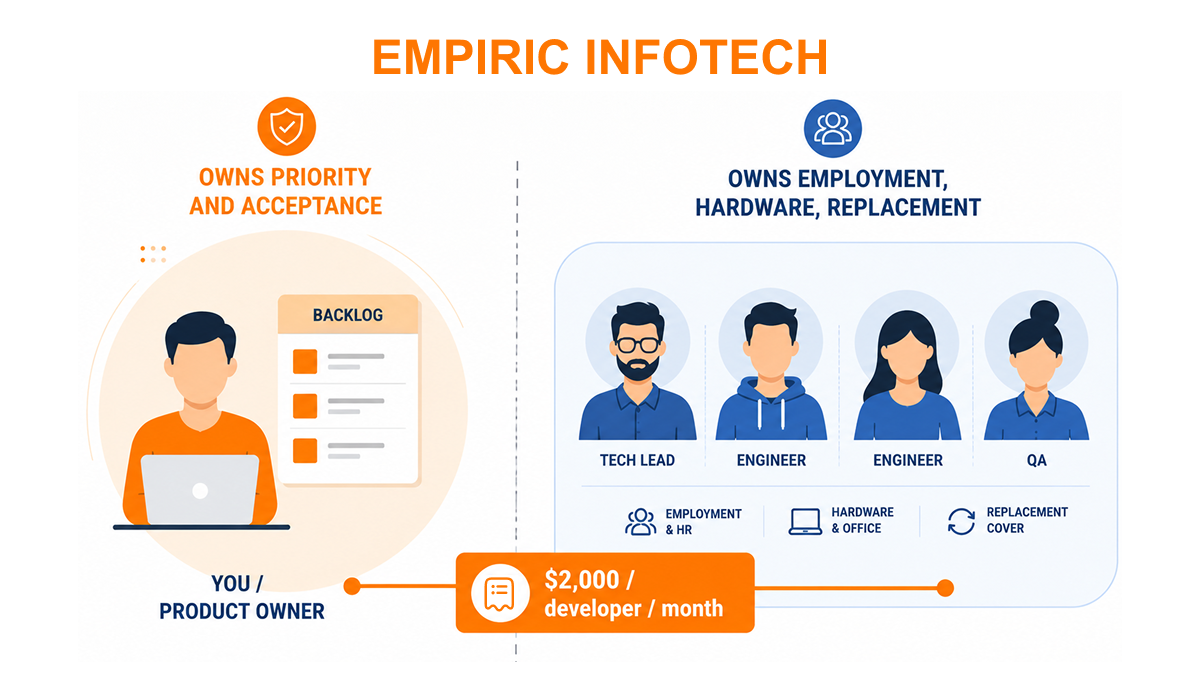
A dedicated development team is a group of engineers, testers, and specialists who work full time on one client's product and no one else's. You direct the work, the provider employs and supports the people, and you pay a flat monthly fee per person instead of per feature. At Empiric Infotech that fee is $2,000 per developer per month.
That single sentence is the whole model, and almost every question about it comes down to three follow-ups: how is it different from a fixed-price project, what does it actually cost, and when is it the wrong answer. This guide covers all three without the vagueness that usually surrounds the term. If you already know you want this model and just want the commercial detail, you can hire remote dedicated developers from $2,000/month and skip the theory.
The short version
- What it is. Named people, full time, on your product only, for as long as you keep them.
- Who decides what gets built. You do. The provider does not own your backlog.
- How it is priced. A flat fee per person per month, not per feature and not per hour.
- What it costs at Empiric. $2,000 per developer per month for 160 to 172 hours, billed monthly upfront. EUR 2,000 in Europe, AUD 3,000 in Australia.
- Typical length. Six to eighteen months, because that is how long real product work runs.
- When to avoid it. When nobody on your side has the time to own priorities.
What a dedicated development team actually is
The phrase gets used loosely, so it helps to define it by what has to be true rather than by what sounds good in a brochure. Three conditions have to hold before a team is genuinely dedicated.
The people are exclusive. A dedicated engineer is not shared across three accounts and not pulled onto someone else's escalation on Thursday. Their working month belongs to one product. This is the condition most often quietly broken, and it is the one worth writing into the contract.
The people are named and stable. You know who is on the team, you interviewed or at least met them, and they are the same people next quarter. Continuity is the entire economic argument for the model. An engineer who has been in your codebase for eight months makes decisions in an hour that a new one would need a week to make safely.
You own the direction. You set priorities, you accept or reject work, and you change your mind when the market changes. The provider owns employment, replacement, payroll, tooling, and the professional development of the people. That split is the actual product being sold.
What it is not
It is not an agency project. In an agency project the provider owns a scope document and delivers against it. Here nobody owns a scope document, because there isn't one.
It is not a pool of interchangeable contractors. If the provider's answer to "who is working on my product" is "one of our engineers", the exclusivity and continuity conditions are not met, and you are buying hours rather than a team.
It is not a way to avoid product management. The model transfers hiring, employment, and infrastructure risk to the provider. It does not transfer the responsibility for deciding what is worth building. That stays with you, and teams that miss this are the ones who conclude a year later that the model "didn't work".
Dedicated team vs fixed-price project vs staff augmentation
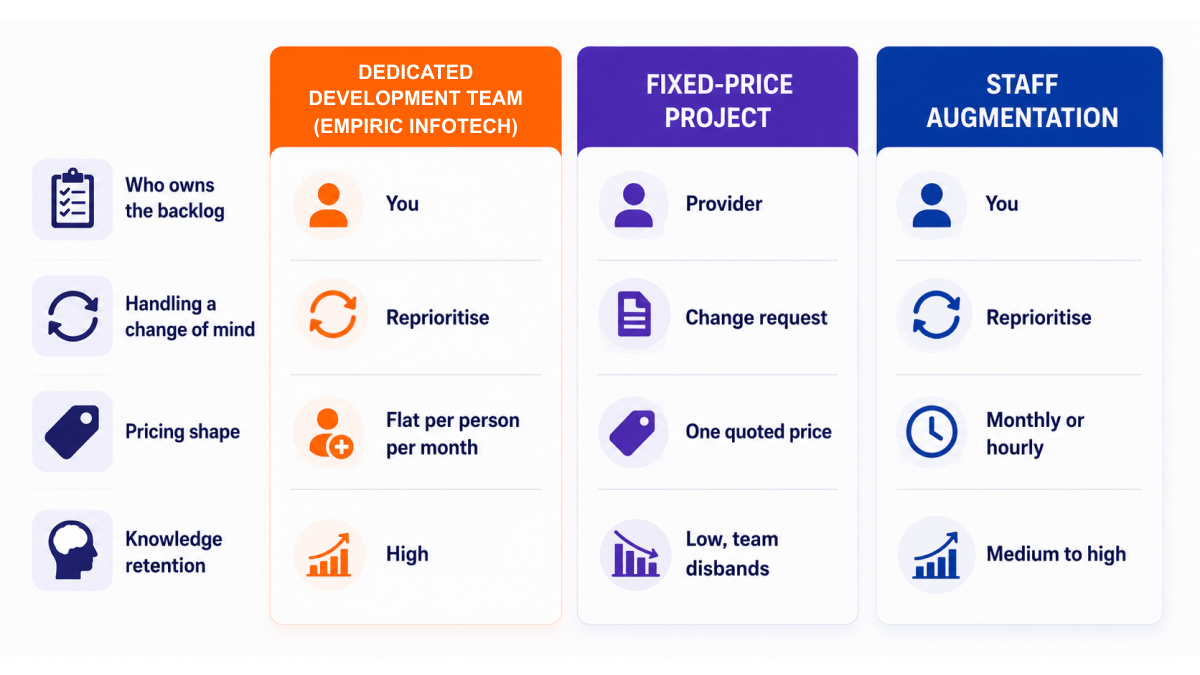
These three are the realistic options for most companies with more product work than in-house capacity, and they fail in completely different ways. The table below is the comparison most people are actually looking for when they search for this topic.
| Dedicated development team | Fixed-price project | Staff augmentation | |
|---|---|---|---|
| What you buy | Ongoing capacity: a standing team | A defined deliverable against a signed scope | One or more specialists slotted into your existing team |
| Who owns the backlog | You | The provider, within the agreed scope | You |
| Who manages day to day | You, with delivery support from the provider | The provider | You |
| Handling a change of mind | Reprioritise the next sprint, no contract change | Change request, renegotiated price and date | Reprioritise, same as your own staff |
| Pricing shape | Flat fee per person per month | One quoted price for the whole scope | Flat monthly or hourly per person |
| Cost predictability | High per month, total depends on how long you run | High total, very low tolerance for change | High per person |
| Knowledge retention | High, the same people stay on the product | Low, the team disbands at handover | Medium to high |
| Time before real work starts | Days | Weeks of scoping first | Days |
| Best when | The roadmap runs 6 to 18 months and requirements evolve | Scope is genuinely fixed and well understood | You have a working process and one specific skill gap |
| Worst when | Nobody on your side owns priorities | Requirements will change, which they usually do | The gap is leadership, not hands |
| Where Empiric fits | Core offer, $2,000 per developer per month | Not our default model | Same monthly rate, or $15 per hour, applied to individual specialists |
Where fixed price genuinely wins
Fixed price is unfairly maligned. It is the correct choice when the scope is real, closed, and understood by both sides: a migration between two known systems, a compliance-driven change with a legally defined output, an integration against a documented API. In those cases you are buying certainty of total cost, and you should buy it.
The failure mode is not the pricing model, it is applying it to work that is still being discovered. Every change request adds negotiation time, and negotiation time is where fixed-price projects lose the schedule they were supposed to protect. If you cannot write the acceptance criteria today, you cannot fix the price today.
Where staff augmentation genuinely wins
Staff augmentation is the right call when your process already works and you are short one particular skill: a mobile engineer, an infrastructure specialist, a designer for two quarters. You have a tech lead, you have ceremonies, you have code review, and you need hands with a specific shape.
Where it fails is when a company uses it to substitute for structure it does not have. Adding three augmented engineers to a team with no technical leadership produces three people asking questions nobody has time to answer. In that situation you need a dedicated team that includes a lead, not more individuals. Empiric delivers staff augmentation under the same commercial terms as the dedicated model, so the choice between them is genuinely about fit rather than price. There is more detail on our staff augmentation service if that is closer to your situation.
How to choose between the three in one paragraph
If the scope is closed, buy a fixed price. If your process is solid and you need one specific skill, augment. If the work runs for months, the requirements will move, and you want the same people to still be there in a year, run a dedicated team. Most companies that agonise over this are in the third case and are hoping the first case will save them money. It usually does not, because the change requests arrive anyway.
What a dedicated development team costs
This is where most articles on this topic become useless, because they quote a range wide enough to include everything and commit to nothing. Here are real numbers.
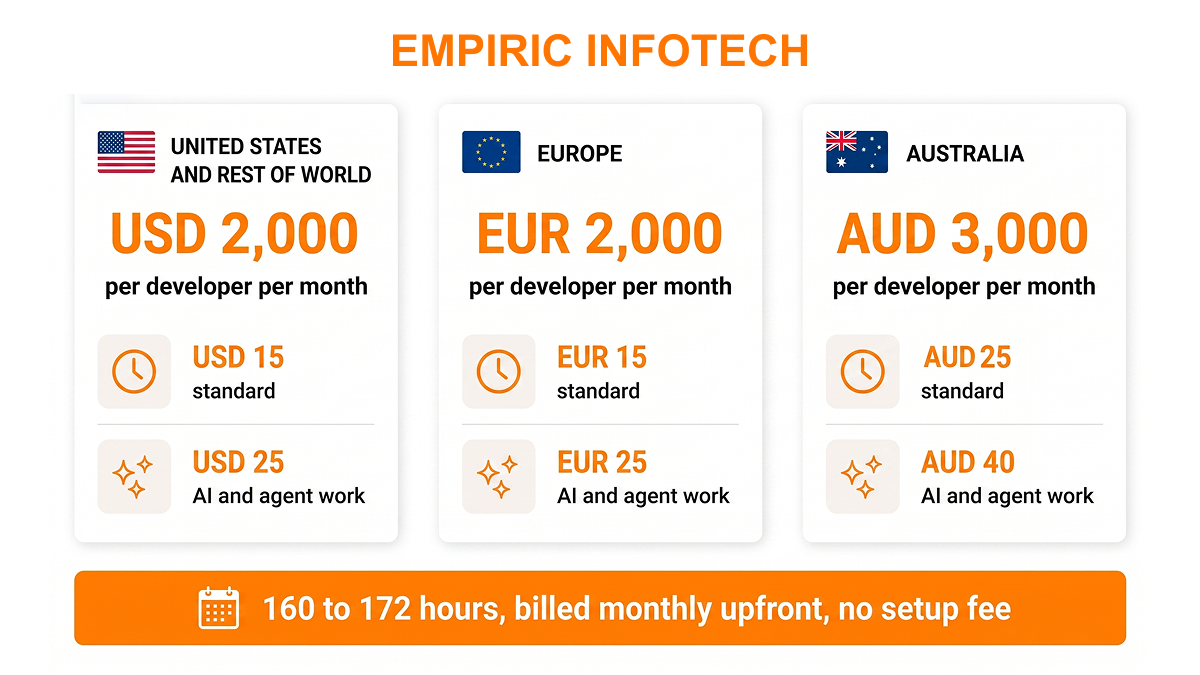
At Empiric Infotech, one dedicated developer is a flat $2,000 per month for full-time exclusive work of about 160 to 172 hours. That is one invoice, billed monthly upfront, with no hourly tracking, no setup fee, and no recruitment fee. If you prefer to pay by the hour instead, standard engineering is $15 per hour and AI engineering is $25 per hour. Rates are quoted in the currency of your region.
| Region | One full-time developer, per month | Standard engineering, hourly | AI and agent engineering, hourly |
|---|---|---|---|
| United States and rest of world | USD 2,000 | USD 15 | USD 25 |
| Europe | EUR 2,000 | EUR 15 | EUR 25 |
| Australia | AUD 3,000 | AUD 25 | AUD 40 |
Why the monthly model beats the hourly one for sustained work
The hourly model exists because some work genuinely is short and variable. But for anything running past a couple of months it introduces a quiet tax: someone has to estimate, someone has to log, someone has to review the log, and both sides start optimising for the meter rather than for the product. Engineers under an hourly meter do not refactor. They do not spend an afternoon reading your codebase before touching it. They do the ticket.
A flat monthly fee removes that incentive entirely. The developer's month is already paid for, so the only thing left to optimise is whether the product got better. It also makes budgeting trivial, which matters more than it sounds when you are the person defending the line item.
Comparing cost properly
The number to compare is not the monthly fee. It is the fully loaded cost of getting the same capacity through the alternatives you actually have. A full-time in-house engineer in the USA, the UK, or Australia carries salary, employer taxes, benefits, hardware, office cost, and recruitment cost, and none of those disappear during the two to four months it takes to find the person. A dedicated developer at $2,000 per month is roughly $24,000 a year for comparable full-time capacity, starts within 48 hours of approval, and stops with seven days notice and no severance.
That comparison is honest in one direction and not the other. What you do not get is someone in the room, in your timezone, absorbing culture by osmosis. That is a real cost and it should be priced into the decision rather than argued away.
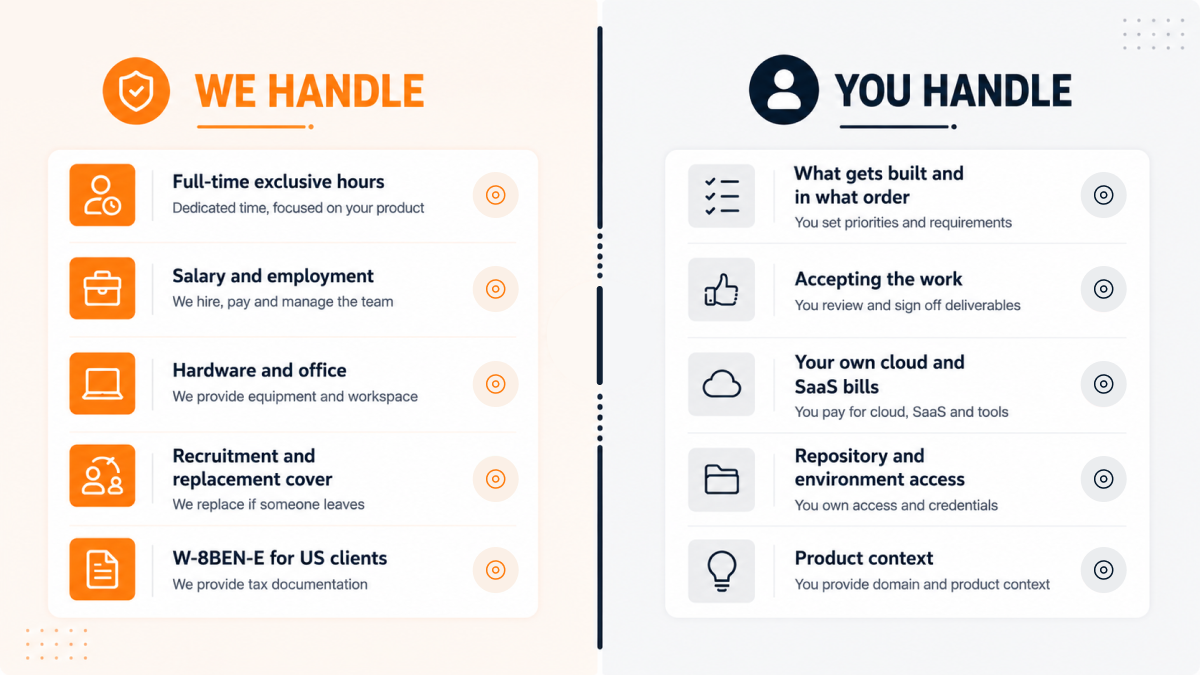
What the monthly fee covers, and what stays with you
Clarity here prevents most of the friction that shows up in month three.
| Included in the fee | Stays on your side |
|---|---|
| 160 to 172 hours of full-time, exclusive work per developer | Deciding what gets built and in what order |
| Salary, employment, taxes, and payroll administration | Accepting or rejecting the work that ships |
| Hardware, office, internet, and standard development tooling | Your own cloud, SaaS, and third-party API bills |
| Recruitment, and replacement cover if someone leaves | Access to your repository, environments, and domain experts |
| Free replacement if the fit is wrong | Onboarding context: the why behind the product |
| A completed W-8BEN-E for clients in the USA | Your own compliance and security review of the arrangement |
There are no setup fees and no long-term contract. Billing is month to month with seven days notice to stop, and the first seven calendar days of any engagement are a risk-free trial: if the fit is wrong on day seven, the first invoice is refunded in full within five business days, with no clawback for the work already done.
Who sits on a dedicated development team
Team shape should follow the product, not a template. A two-person pod is a legitimate dedicated team. So is a nine-person one. These are the roles worth understanding before you decide which you need.
Software engineers
The core of the team. Backend engineers own data models, business logic, integrations, and the parts of the system that have to still be correct at 3am. Frontend and mobile engineers own everything the user touches. On smaller pods these are the same people, and full-stack capability is worth paying attention to when the team is under four people, because handoff cost dominates at that size.
Tech lead or software architect
The role most often cut first and most often regretted. The lead sets the technical direction, reviews code, decides the stack, and is the person who says no to the shortcut that will cost six weeks in a year. If you have a strong technical person in-house, you may not need one from the provider. If you do not, a team without a lead will produce working software with a structure nobody can explain.
QA engineer
Dedicated QA changes the economics of everything else. Without it, engineers test their own work, which they do worse and slower than a specialist, and regressions surface in front of users. QA is usually the first shared role: one QA engineer can reasonably cover three to four developers depending on release cadence.
DevOps engineer
Owns pipelines, environments, deployment, monitoring, and cost. On a product that deploys weekly with a stable stack, this is a part-time need. On anything with real infrastructure complexity or compliance requirements, it is not, and treating it as an afterthought is how teams end up with an expensive cloud bill nobody understands.
UI and UX designer
Needed continuously on user-facing products and in bursts elsewhere. The common mistake is buying design as a one-off at the start of the engagement. Interfaces drift as scope evolves, and a designer who is present through the build keeps the product coherent instead of accumulating small inconsistencies until a redesign becomes necessary.
Project or delivery manager
Coordinates, unblocks, reports, and keeps the ceremony overhead low. On a team of two or three working directly with a hands-on product owner, this role can be genuine waste. Past five people it stops being optional, because coordination cost grows faster than headcount.
A note on shape
A common effective starting shape is two engineers plus shared QA, with a lead involved part time, growing as the roadmap firms up. Start smaller than you think you need. It is far easier to add a person in a week than to explain to your finance team why four engineers spent a quarter waiting for decisions.
When a dedicated development team is the right choice
Not a list of aspirations, a list of situations where the model measurably beats the alternatives.
Your roadmap runs longer than six months and the details are still moving. This is the central case. You know the direction, you do not know the next twelve tickets, and you need the freedom to change the order without a contract negotiation.
You have a product owner but not engineers. Someone on your side can answer questions, accept work, and set priority, and what is missing is people to build. This is exactly the gap the model fills.
Hiring locally is blocking the roadmap. If your open engineering role has been open for three months, the cost of the vacancy already exceeds the cost of the alternative. A dedicated developer starts within 48 hours of approval, which turns a hiring problem into a scheduling one.
Your workload is real but not permanent. You need three engineers for the next nine months and possibly one after that. Employment does not flex like that. A month-to-month arrangement does.
You want continuity, not a handover. If you expect to still be improving this product in two years, you want the people who built it to still be there. That is the argument against project-based delivery, and it is the strongest argument for this model.
You need a capability you cannot justify hiring for permanently. AI and agent engineering is the current example: genuinely useful, genuinely specialised, and hard to justify as a permanent local hire until the work proves itself. Renting the capability first and hiring later is a rational sequence.
When it is the wrong choice
Being honest about this is more useful than another benefit list, and it will save you more money.
Nobody on your side can own priorities. If the answer to "who decides what the team builds next week" is unclear, do not start. A dedicated team with no product owner produces activity, not progress, and it produces it at full price.
The scope is genuinely fixed. If you can write complete acceptance criteria today and you are confident they will not change, buy a fixed-price project and take the cost certainty.
The engagement is shorter than about two months. Ramp-up is real. A developer needs one to three weeks to be genuinely productive in an unfamiliar codebase. On a six-week engagement you are paying mostly for ramp. Use the hourly model instead.
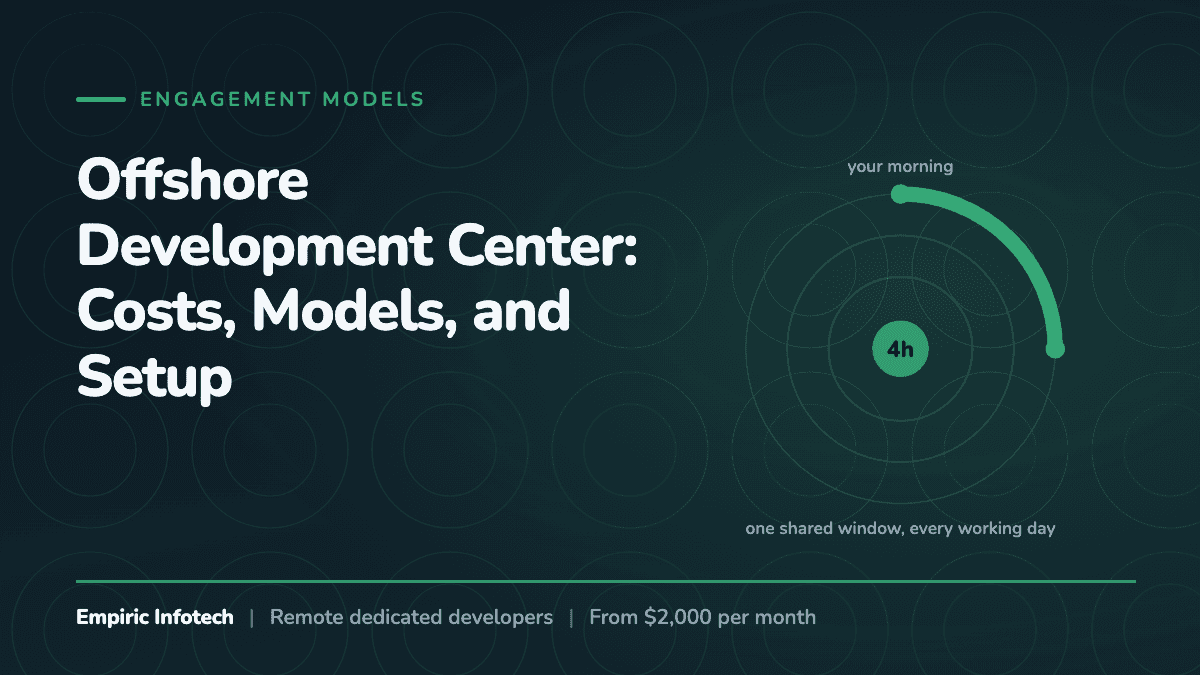
You need physical presence or same-hour availability all day. Distributed teams work well with four or more overlapping hours and clear async habits. They work badly when someone expects a tap on the shoulder. Be honest about which one your organisation is.
You are buying it primarily to reduce cost. The model does reduce cost, but the teams that get the most out of it are buying capability and speed. The ones optimising purely for the lowest number tend to underinvest in the leadership and QA roles that make the rest work, and then blame the model.
How the engagement runs, week by week
The mechanics matter more than the pitch, because this is where models succeed or fail in practice.
Before day one. You describe the product, the stack, and the seniority you need. Within about one business day a matching developer is introduced, and you meet them in a working session rather than reading a CV. You approve the person, not a profile.
Days one to seven, the trial. The developer joins your standups, gets repository access, and ships real work. This is not a shadowing period. On day seven you continue or you cancel for a full refund of the first invoice, paid within five business days, with no clawback on the work delivered. The purpose of the trial is to make a wrong fit cost a week rather than a quarter.
Weeks two to four. Ramp continues. Expect throughput to be visibly below steady state and do not read that as a problem. The right things to measure here are whether questions are getting answered quickly on your side and whether the developer is asking good ones.
Month two onward, steady state. The team should be operating inside your process: your board, your definition of done, your release cadence. If the provider is running a parallel process and reporting into yours, something has gone wrong. The whole point is that they are inside the team, not adjacent to it.
Scaling and stopping. Adding a person follows the same path as the first one. Stopping takes seven days notice. There is no minimum term, no auto-renewal, and no severance, which is precisely what makes it reasonable to start smaller than you think you need.
How to evaluate a provider
Most evaluation advice is generic. These are the questions that actually separate providers.
"Is this person working on anything else?" Ask it plainly and ask for it in writing. Exclusivity is the condition most often assumed and least often contracted.
"Can I meet the specific engineer before I commit?" A provider who will only introduce a role rather than a person is selling hours. Meeting the individual, ideally in a working session on a real problem, is the single highest-signal step in the process.
"What happens if they leave?" Attrition is normal. What matters is whether replacement is free, how fast it happens, and who pays for the ramp-up of the replacement. Get the answer before you need it.
"What does the fee include?" Hardware, tooling, employment overheads, and replacement should be inside the number. If a quote is unusually low, the missing pieces are usually the ones that reappear as invoices later.
"How do you handle timezone overlap?" You want a specific commitment in hours, not a reassurance. Four hours of genuine overlap is generally enough for a team with good written habits.
"Show me code." Not a portfolio of screenshots. A repository, a pull request, a code review thread. Delivery quality is visible in review culture long before it is visible in a case study.
Red flags
A quote with no stated hours behind it. Reluctance to name the individual. A minimum term of six or twelve months on a model that is supposed to be flexible. Pricing that changes materially after the discovery call. Case studies with impressive percentages and no client willing to be named. And any provider who agrees with every technical decision you describe, because a team that never pushes back is not paying attention.
How to get real value out of the team once it starts
The model does not fail on capability nearly as often as it fails on operations.
Give them the why, not just the ticket. Engineers who understand the business reason for a feature make better small decisions all day, and those small decisions are most of the product.
Answer questions fast. In a distributed setup, a question that waits eight hours costs a day. The single highest-leverage thing a client can do is keep the response time short.
Use one board. Two systems of record means two versions of the truth, and reconciling them becomes someone's job.
Review the work weekly, not quarterly. A weekly demo of running software catches drift while correcting it still costs an afternoon. A quarterly review catches it after three months of work have been built on top of it.
Measure outcomes, not hours. You bought a month, not a timesheet. Cycle time, escaped defects, and whether the roadmap moved are the numbers that matter. If you find yourself asking how many hours something took, something upstream in the relationship needs fixing.
Treat them as staff. Include them in planning, retrospectives, and the internal channel where decisions actually get made. Teams that keep a dedicated pod at arm's length get arm's-length work, and then conclude the model does not work.
Starting an engagement with Empiric Infotech
Empiric Infotech runs this model as its core offer: full-time, exclusive developers at $2,000 per month for 160 to 172 hours, EUR 2,000 in Europe and AUD 3,000 in Australia, billed monthly upfront with no setup fee and no minimum term. A developer starts within 48 hours of you approving the fit, the first seven days are a risk-free trial with a full refund if the fit is wrong, and you can stop at any point with seven days notice.
The commercial detail, the regional pricing, the trial terms, and the engagement options all live on one page. If this model matches your situation, the next step is to hire remote dedicated developers from $2,000/month. If you are still deciding between models, the frequently asked questions cover billing, replacement, contracts, and security in more detail, and the guide to offshore software development covers the operational side of running a distributed team.
Conclusion
A dedicated development team is a straightforward trade. You give up the illusion of a fixed price and you get people who stay, who learn your product, and who can be redirected the week your priorities change. It works when someone on your side owns the direction and the work runs long enough for continuity to compound. It does not work when the scope is truly closed, the engagement is truly short, or nobody has time to decide what matters.
Judge it on that fit rather than on the monthly number, and the monthly number will look after itself.
Frequently asked questions
What is a dedicated development team in simple terms?
It is a group of engineers and specialists who work full time on one client's product only, employed and supported by a provider but directed by the client. You set the priorities, the provider handles employment, hardware, and replacement, and you pay a flat monthly fee per person.
How much does a dedicated development team cost?
At Empiric Infotech, one dedicated developer is $2,000 per month for 160 to 172 hours of full-time exclusive work, billed monthly upfront. In Europe the rate is EUR 2,000 and in Australia it is AUD 3,000. A team is simply that figure multiplied by the number of people. Hourly engagement is also available at $15 per hour for standard engineering and $25 per hour for AI engineering.
How is a dedicated team different from staff augmentation?
Staff augmentation adds individual specialists to a team you already run, with your own technical leadership and process in place. A dedicated team is formed for you and can include the leadership, QA, and delivery roles as well. In practice the commercial terms are the same, so the choice is about what is missing on your side, not about price.
How is it different from a fixed-price project?
A fixed-price project buys a defined deliverable for an agreed sum, and every change goes through a change request. A dedicated team buys ongoing capacity, and changes are handled by reprioritising the next sprint. Fixed price protects the total; a dedicated team protects your ability to change your mind.
How long does a dedicated team engagement usually last?
Most run six to eighteen months, because that is the natural length of sustained product work. There is no minimum term at Empiric Infotech and billing is month to month, so length is a consequence of the work rather than a contractual obligation.
How quickly can a dedicated developer start?
Within 48 hours of you approving the fit. The requirement is assessed in about one business day, one matching developer is introduced, you meet them in a working session, and onboarding onto your tools and repository happens on day one of the engagement. Rare or highly specialised skill sets can take slightly longer, and that is flagged upfront.
What happens if a developer is not a good fit?
The first seven calendar days of every engagement are a risk-free trial. If the fit is wrong on day seven, the first invoice is refunded in full within five business days, with no clawback for the work already delivered. Beyond the trial, replacement is free if the fit turns out wrong later.
Who owns the intellectual property?
The client does, throughout. Ownership is not something that transfers at the end of a phase, because there is no handover event in this model; the work is yours as it is produced.
How many people should a dedicated team start with?
Usually fewer than you expect. Two engineers with shared QA and part-time technical leadership is a common and effective starting shape. Adding a person takes about a week, so starting small and growing into the roadmap costs far less than staffing up ahead of decisions.
Does this model work across timezones?
Yes, with about four hours of genuine overlap and disciplined written communication. It works badly in organisations that rely on immediate, in-person availability, and that is worth being honest about before starting rather than after.