



 Front-end
 Back-end
 Full Stack Developer
 Mobile
 Other
Other


 Company
 Contact Us
An offshore development center is a dedicated engineering team abroad that works only on your product and takes direction from you, not from a vendor project manager. Plan for $2,000 to $6,560 per engineer per month: Accelerance's 2026 rates guide puts senior Asian developers at $31 to $41 an hour, and Empiric Infotech charges $2,000 a month for 160 to 172 hours.
Published 10 September 2026.
The short answer
- What it is: a long-lived, named, exclusive engineering team in another country, working inside your tools, your backlog, and your security rules.
- What it costs: roughly $4,960 to $6,560 per engineer per month at Asian agency rates, against $9,600 to $12,160 in Latin America or Europe for the same 160 hours, on Accelerance's 2026 bands. Empiric Infotech's flat rate is $2,000.
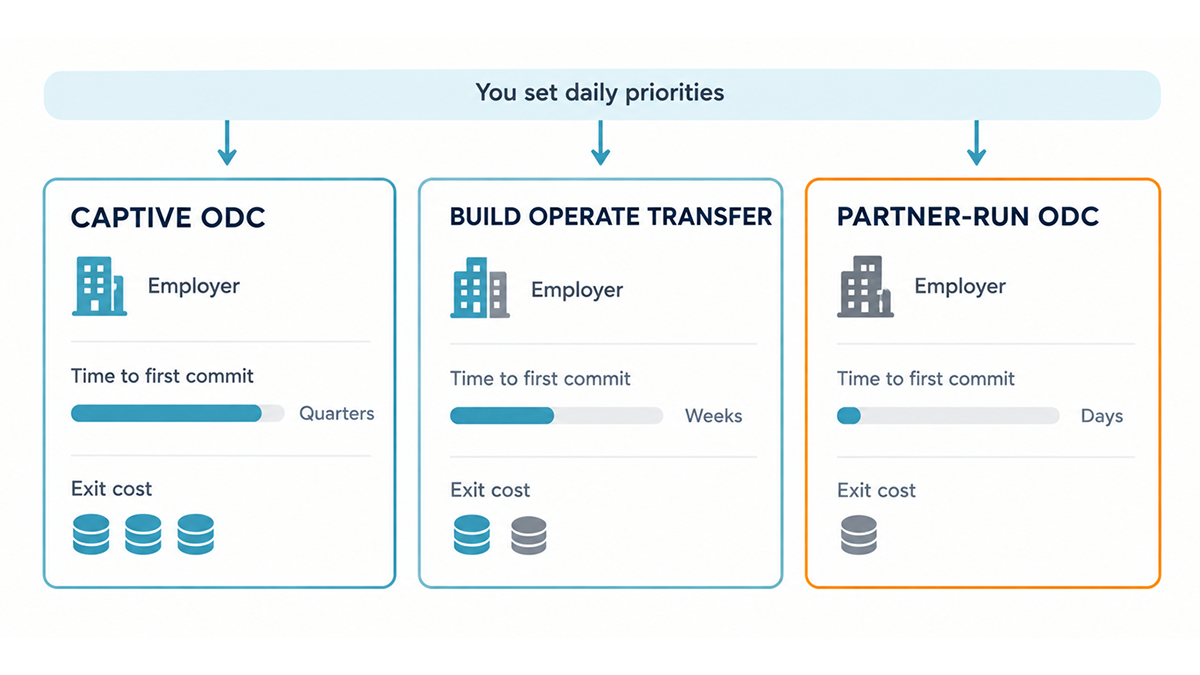
- Three models: captive (you own the entity), build operate transfer (a partner builds it, you buy it later), and partner-run (a partner employs the team, you direct it). Under about fifty engineers offshore, choose partner-run, the same commercial shape as remote staff augmentation services.
- Setup time: a partner-run center starts in days. A captive entity is a multi-quarter program: incorporation, payroll, permanent establishment tax advice, an office, and a local leadership hire.
- Why companies do it: in Deloitte's 2024 Global Outsourcing Survey of more than 500 leaders, 42% named access to specialized talent as the top driver and only 34% named cost reduction, down from 70% in 2020.
- When it fails: when nobody on your side owns the backlog, when the engineers are shared across accounts, or when you find out at month nine that the vendor holds the repository.
- The test: score the arrangement out of 60 on the checklist below. Below 45, do not sign.
What is an offshore development center?
An offshore development center, usually shortened to ODC, is a permanent team of engineers in a lower-cost country who work exclusively on one client's products. The distinguishing feature is not location, it is direction. You write the tickets, you set the sprint goals, you run the standup. The offshore side supplies people, employment, and a place to sit. The engineers are named, they stay for years, and they learn your codebase the way an in-house hire does.
India remains the default location. The Zinnov-NASSCOM India GCC Landscape Report 2026 counts 2,117 global capability centers in India across 3,728 units, employing about 2.36 million people and generating $98.4 billion in revenue, up 32% in center count since FY2021.
How much does an offshore development center cost per month?
Cost per engineer per month is the only number that lets you compare an ODC against an in-house hire, so convert everything to it. Accelerance's 2026 Global Software Development Rates and Trends guide, drawn from data across more than 100 firms in North America, Latin America, Europe, and Asia, publishes these senior developer bands.
| Region | Senior developer rate (Accelerance 2026) | At 160 hours a month |
|---|---|---|
| Asia | $31 to $41 an hour | $4,960 to $6,560 |
| Latin America | $60 to $75 an hour | $9,600 to $12,000 |
| Europe | $64 to $76 an hour | $10,240 to $12,160 |
Those are agency list rates, and smaller firms price below them. Empiric Infotech charges USD 2,000 a month in the US and India, EUR 2,000 in Europe, and AUD $3,000 in Australia for one named mid-to-senior engineer at 160 to 172 hours, billed monthly upfront. AI work is charged at the same flat monthly rate, with the premium applied hourly instead.
Three costs people forget. A captive center adds entity, payroll, compliance, office, and a local manager on top of salary. Every model adds your own management time, which is usually the real constraint. And turnover: NASSCOM's Quarterly Industry Review for March 2026 put Indian IT attrition at 14.6%, so plan for handovers.
Which offshore development center model should you choose?
Choose by how permanent the function is and how many engineers you will run, not by headline rate. There are three real options plus the project-outsourcing alternative people confuse them with.
| Captive ODC | Build operate transfer | Partner-run ODC | Project outsourcing | |
|---|---|---|---|---|
| Who employs the engineers | You, via a local entity | Partner first, you later | The partner | The vendor |
| Who sets daily priorities | You | You | You | The vendor |
| Time to first commit | Multiple quarters | Weeks | Days | Weeks |
| Ongoing admin burden | High | Medium, then high | Low | Low |
| Exit cost | Severance, lease, entity wind-down | Negotiated transfer fee | Notice period | Contract end |
| Best fit | A permanent function you intend to own for a decade | A team you will absorb once it is proven | One to a dozen engineers alongside your existing team | Bounded scope with a fixed end |
If you cannot name the person on your payroll who will run the offshore team full time, a captive center is premature. Partner-run keeps direction and the codebase with you while somebody else carries employment, payroll, and the office. Build operate transfer is worth the premium only when you have already decided to own the entity and are buying time.
How is an ODC different from outsourcing a project?
They differ on who is accountable for the plan. Outsourcing transfers the plan to the vendor and pays for an outcome. An ODC keeps the plan with you and pays for capacity. That matters on the day something slips: with an outsourced project a slipped date is a contract conversation, with an ODC it is a sprint retro, because it is your sprint.
The ODC model also survives a change of technology. If the roadmap moves from a React front end to an agent pipeline, a statement of work has to be rewritten, while a dedicated team is retasked in a planning meeting. That is why dedicated remote developers suit product roadmaps better than fixed-bid projects.
How long does it take to set up an offshore development center?
A partner-run center starts within days, because the legal entity, payroll, and office already exist and you are only selecting people. The work on your side is meeting the engineers, granting access, and picking the first two weeks of tickets.
A captive center is a program, not a purchase. You incorporate a subsidiary, take tax advice on permanent establishment exposure, register for payroll and statutory contributions, lease space, and hire a local engineering leader before a line of code is written. Build operate transfer sits in between: a working team in weeks, then a negotiated transfer, which is when the entity and compliance work begins.
Whichever model you pick, the honest measure of setup is not when the contract is signed. It is when the first ticket written by your team is merged by their team without you explaining the codebase twice.
How do you tell a good offshore development center from a bad one?
Score it. Most ODC failures are visible in the contract before anyone writes code. Grade the arrangement against these ten items, full points or zero, no partial credit.
| # | Item | Points |
|---|---|---|
| 1 | You interview and can reject every engineer before they join | 8 |
| 2 | The engineers are named, full time, and work on no other account | 8 |
| 3 | Your company owns the repository, cloud accounts, and any model API keys from day one | 8 |
| 4 | Notice period is 30 days or less, in writing | 6 |
| 5 | Guaranteed overlap with your working day, stated in hours, in the contract | 6 |
| 6 | A senior lead reviews and tests every release before it reaches you | 6 |
| 7 | Signed IP assignment from each individual engineer, not just the company | 5 |
| 8 | A trial period before the first full invoice | 5 |
| 9 | Written replacement terms, including who pays for a replacement's ramp-up | 4 |
| 10 | You have spoken to a reference client in your own time zone | 4 |
Threshold: 45 out of 60. At 45 or above, the arrangement is safe to sign. Between 30 and 44, fix the failing items before money is committed. Items 1, 2, and 3 cause the expensive failures. Below 30 you are buying a project outsourcing contract labeled an ODC.
When does an offshore development center stop making sense?
It stops making sense when the work is genuinely bounded, when nobody in-house has capacity to direct a team, or when the roadmap ends within six months. An ODC pays back through accumulated context, and context takes quarters to accumulate. A three-month need is a project, not a center.
It also stops making sense when your reason is purely cost. Deloitte's 2024 survey showed cost reduction falling from 70% of respondents in 2020 to 34% as the primary driver. Teams funded purely as a cost line get staffed accordingly, and you notice within two quarters. Teams built to reach engineers you cannot hire locally, particularly for AI integration, evaluation, and guardrail work, tend to survive.
Finally, it stops making sense if you will not hold the ownership items in the checklist. If a partner will not hand you the repository, the cloud account, and the model keys, you are not running an offshore development center. You are renting one.
Start with one engineer, not with an entity
The lowest-risk version of this is one named mid-to-senior engineer working in your repository, on your backlog, inside your working hours, expanding once you have proof.
That is how Empiric Infotech works. One full-time, exclusive mid-to-senior engineer, 160 to 172 hours a month, at USD 2,000 in the United States, EUR 2,000 in Europe, or AUD $3,000 in Australia, billed monthly upfront. Month to month, stop with seven days' notice, and the first seven days are a risk-free trial. A senior team lead reviews and tests every release. You keep the repository, the cloud accounts, and the model keys throughout.
If you want the full team version, that is remote staff augmentation. To start with one person and test the model on your codebase, start by hiring a dedicated remote developer.