



 Front-end
 Back-end
 Full Stack Developer
 Mobile
 Other
Other


 Company
 Contact Us

Offshore software development scales engineering without a six-month hire: part of your team runs from another country under your roadmap and your definition of done, at $2,000 a month per developer for 160 to 172 hours, shipping in one to two weeks instead of the three to six months a local hire takes. For a scaling US, UK, or Australian company the practical version is a dedicated team in India: engineers assigned to one product, paid a flat monthly rate, working your sprint cadence rather than a fixed-bid statement of work.
That is the whole idea, and it is also where most attempts go wrong. Companies compare an offshore hourly rate against a local salary, sign whoever posts the lowest hourly rate, and discover six months later that they bought capacity without buying accountability. The version that holds up is narrower: you outsource software development to a dedicated remote team that reports into your sprint, ships into your repository, and is reviewed against your quality bar. This guide covers what each delivery model actually costs, what the money buys, how the working day overlaps, and the operating model that separates the engagements that last eighteen months from the ones that die in week nine.
What offshore software development actually means
Offshore means the engineers sit in a different country and, usually, a materially different time zone. Our model is offshore India: the delivery team works from Surat, on Indian Standard Time, with working hours shifted to meet the client's day. We say India explicitly because the geography drives everything downstream: the cost base, the overlap window, the public holiday calendar, and the contracting structure.
There are three shapes this takes commercially, and they are not interchangeable.
Project outsourcing. You write a specification, a vendor quotes a fixed price, and you accept a delivery. Good for a bounded, well-understood build. Bad for a product that is still learning what it is, because every change of mind becomes a change order.
Staff augmentation. You add named engineers to your existing team. They use your tools, attend your ceremonies, and take tickets from your backlog. Your engineering manager still manages.
Dedicated team. You take a self-contained team, typically some mix of engineers, a QA lead, and a designer, with a delivery lead who runs the day to day. You set priorities, the team runs the sprint.
Most scaling companies who succeed offshore start with staff augmentation, prove the working relationship over one or two quarters, then grow the group into a dedicated team. Starting with a full dedicated team is possible, but it front-loads all the trust you have not yet earned.
The three delivery models a scaling company chooses between
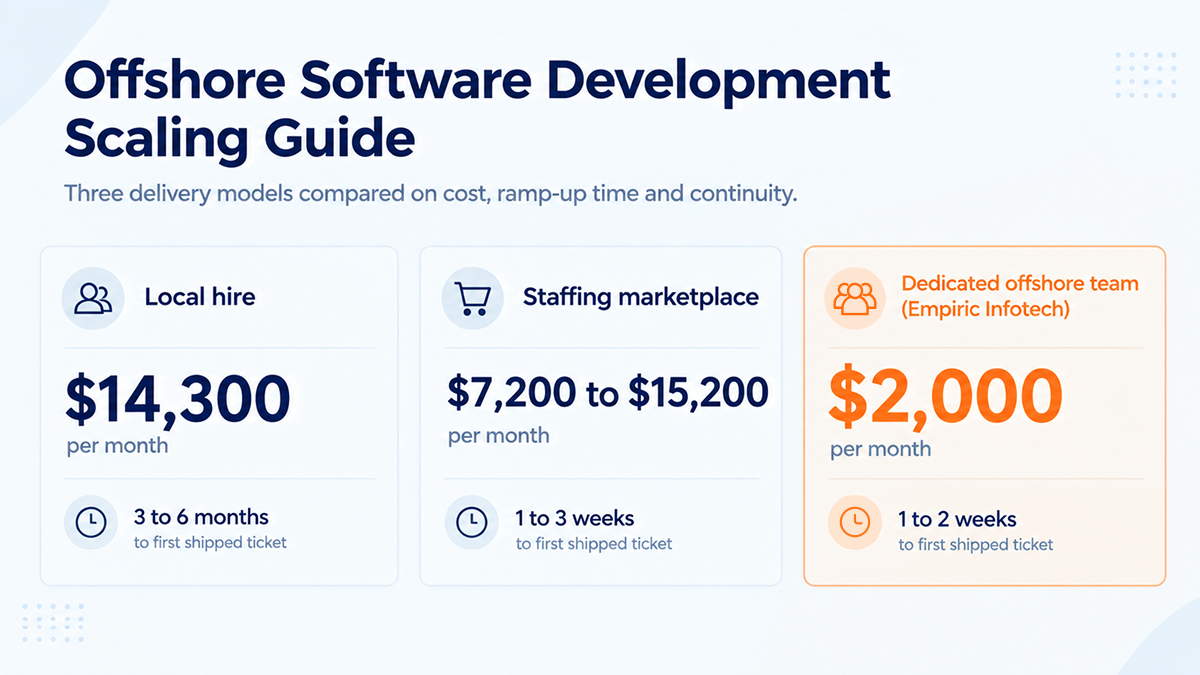
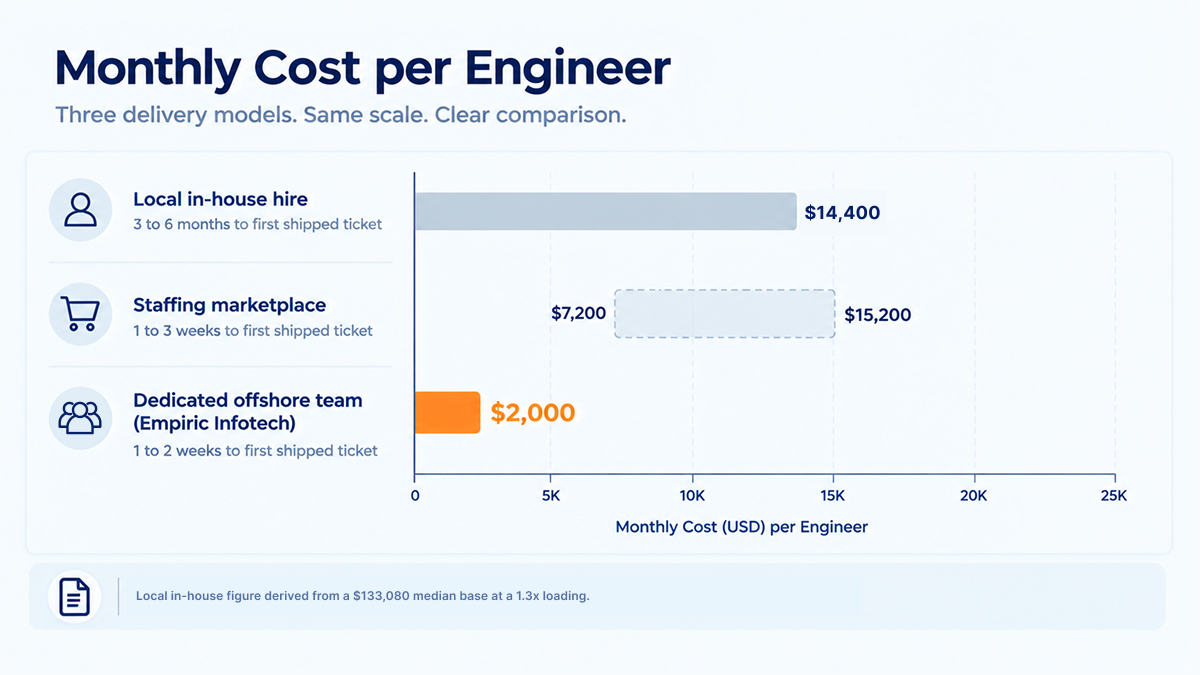
Almost every engineering leader adding capacity is really choosing between three options: hire locally, buy hours through a staffing marketplace, or stand up a dedicated offshore team. Here is what each costs and what it gives you.
| Local in-house hire | Staffing marketplace | Dedicated offshore team (India) | |
|---|---|---|---|
| Cost per engineer, per month | About $14,300 fully loaded | $7,200 to $15,200 at 160 billable hours | $2,000 flat |
| What that rate is derived from | $132,270 median base, at a 1.3x loading | $45 to $95 per hour, typical vetted senior range | $2,000 per month for 160 to 172 hours |
| Effective hourly cost | About $89 | $45 to $95 | $11.63 to $12.50 |
| One-off cost to start | Roughly $4,700 cost per hire, more with an agency fee | None to low | None |
| Time to first shipped ticket | 3 to 6 months, including notice period and ramp | 1 to 3 weeks | 1 to 2 weeks |
| Three engineers, first 12 months | About $530,000 including hiring cost | $259,000 to $547,000 | $72,000 |
| Who owns code review and QA | You | You | Shared: the team's QA plus your review gate |
| Continuity if someone leaves | You restart the search | Engineer disappears with the context | Vendor backfills, handover is contractual |
| Commitment | Employment, notice period, severance exposure | Per hour, stop any time | Monthly, billed upfront, 7-day risk-free trial |
| Best fit | Roles that must sit in the room with the business | Short bursts and specialist gaps | Sustained roadmap capacity over 6 to 18 months |
Where those numbers come from
Nothing in that table is a guess dressed up as a benchmark, so here is the arithmetic.
The local figure starts from the US Bureau of Labor Statistics, which reported a median annual wage of $132,270 for software developers in its 2023 occupational wage data. We then apply a 1.3x loading for payroll taxes, health cover, equipment, software seats, and desk space. That is our own planning multiplier, not a published statistic, and if your benefits package is richer the real number is higher, not lower. The result is roughly $171,900 a year, or about $14,300 a month. The one-off cost to start uses the average cost per hire of roughly $4,700 that SHRM published in its 2022 benchmarking work, which is a floor: a contingency agency fee at 20 percent of base would add about $26,000 on top.
The marketplace band is a range of typical listed rates for vetted senior contractors rather than a survey figure, and it is wide on purpose. Converted at 160 billable hours a month it lands between $7,200 and $15,200. The important detail is not the rate, it is that you are buying hours, so the meter stops when the engineer stops, and so does the context.
The dedicated offshore figure is our published price: $2,000 USD per developer per month for 160 to 172 hours of full-time, exclusive work, billed monthly upfront, with a 7-day risk-free trial at the start of the engagement. In the EU the same engagement is EUR 2,000 a month; in Australia it is AUD $3,000. If you would rather pay by the hour, the rates are $15 an hour for standard engineering and $25 an hour for AI work, and in Australia $25 and $40.
The cost ladder as the team grows
The gap between models compounds, which is why the model you pick at three engineers determines what you can sustain at eight.
| Team size | Local in-house, per year | Staffing marketplace, per year at a $70 blended rate | Dedicated offshore team, per year |
|---|---|---|---|
| 1 engineer | About $172,000 | About $134,000 | $24,000 |
| 3 engineers | About $516,000 | About $403,000 | $72,000 |
| 5 engineers | About $860,000 | About $672,000 | $120,000 |
| 8 engineers | About $1,376,000 | About $1,075,000 | $192,000 |
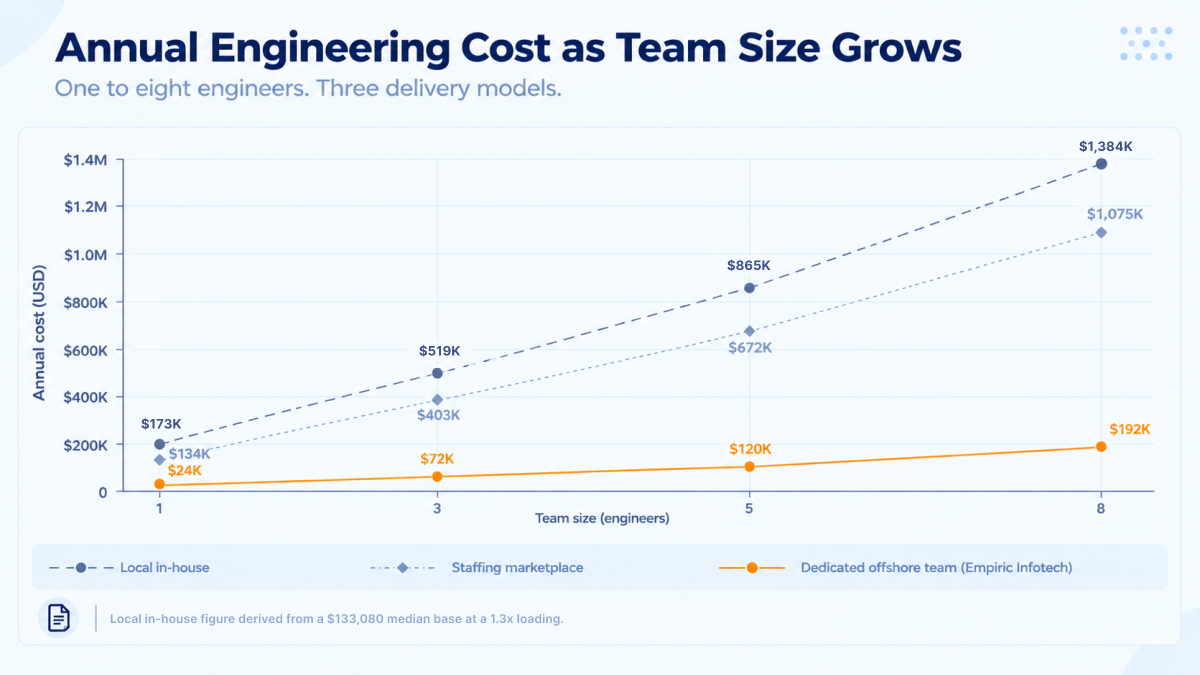
Read that ladder as runway rather than savings. An eight-person offshore team at $192,000 a year is roughly what one senior US hire plus a contractor costs. The question is not which one costs less, it is which one lets you staff the roadmap you already have.
What the monthly rate has to include before it is comparable
A monthly rate is only meaningful if you know what sits inside it. Before you compare any offshore quote against a salary, get written answers to these.
- Hours. Ours is 160 to 172 hours a month depending on the calendar. Anything quoted without an hours figure is not a price.
- Exclusivity. Is the engineer assigned to your product only, or shared across accounts? Shared capacity is a different product at a different price.
- Who is in the seat. Named engineers, with CVs, that you interview. Not a role title to be filled later.
- Holiday calendar. Indian public holidays differ from yours. Ask for the list at signature, not in October.
- Ramp. Is week one billed while the engineer reads your codebase? Ours is covered by the 7-day risk-free trial, which is the point of having one.
- Notice and exit. Monthly billing is only flexible if the exit terms match it.
- IP and confidentiality. Assignment of work product, NDA coverage for every individual on the team, and a named data processing arrangement if the team touches production data.
If a vendor cannot answer all seven in a single email, that is the answer.
Time zones: what overlap with India actually looks like
The most common objection to offshore India is the clock. It is a real constraint and it is manageable, but only if you plan the shift deliberately instead of hoping for goodwill. Indian Standard Time is UTC+5:30. Figures below assume standard time; daylight saving moves each by an hour for part of the year.
| Your location | India works | Live overlap with a 9 to 5 local day | What that supports |
|---|---|---|---|
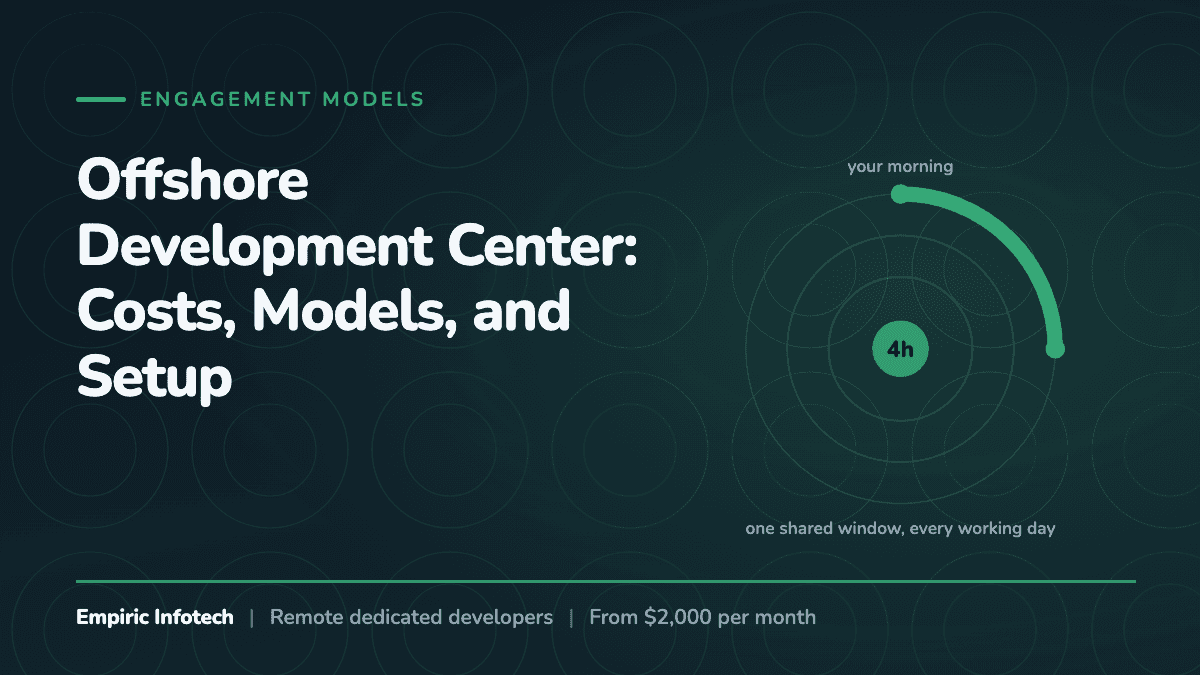
| US Eastern | 12:30 to 21:30 IST | 3 to 4 hours, your morning | Standup, live review, same-day unblocking |
| US Pacific | 14:30 to 23:30 IST | 2 to 3 hours, your morning | Standup plus one working session |
| UK | 10:00 to 19:00 IST, no shift needed | 4 to 5 hours, your morning | Near-continuous collaboration |
| Central Europe | 10:00 to 19:00 IST, no shift needed | 5 to 6 hours | Effectively a co-located day |
| Australia East | 07:00 to 16:00 IST | 5 to 6 hours, your afternoon | Full afternoon overlap |
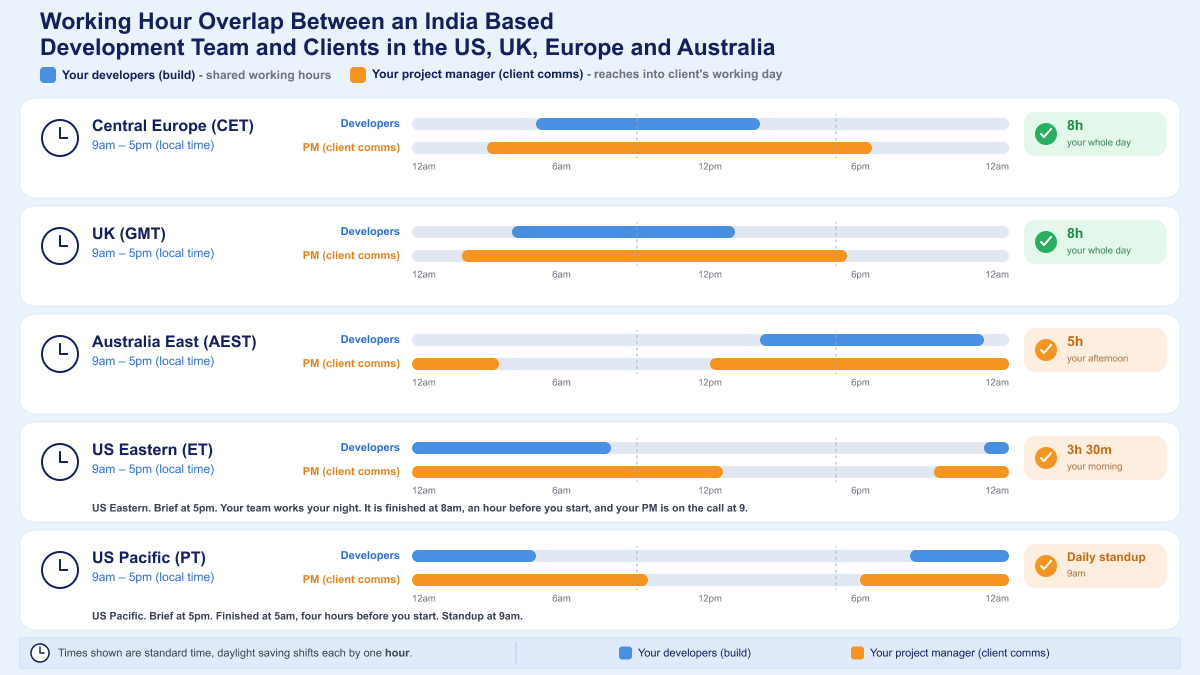
Two to four hours of overlap is enough to run a product team, provided you spend it correctly. Use the overlap for the things that need two brains at once: standup, design review, pairing on a hard defect, and the demo. Push everything else, status, written specs, questions with a known answer, into asynchronous form. Teams that fail on time zones usually fail because they tried to hold a two-hour planning meeting inside a two-hour window and left no room for the work.
The upside of the gap is real too. A US Eastern team that hands off at 18:00 gets review comments and a rebuilt branch waiting at 09:00. That only happens if the handoff note is written, which is a discipline, not a benefit that arrives on its own.
The operating model that makes it work
Cost is the reason people look at offshore. Process is the reason it works or does not. These are the practices that carry the engagement.
One backlog, yours. The offshore team pulls from the same board as everyone else. A separate offshore backlog is how two divergent products get built.
A written definition of done. Tests written, CI green, documentation updated, reviewed by a named person. Put it in the repository, not in someone's head. This is the single highest-leverage document in a distributed team.
Code review across the boundary. At least one review per pull request from your side for the first two months. It is slower and it is how the codebase stays yours. After the team has absorbed your conventions, cross-review inside the team is enough for routine work.
QA in the sprint, not after it. Regression coverage grows with the feature, not in a hardening week that never gets scheduled.
Weekly demo of running software. Not a slide, not a status document. Working software, in an environment you can click on. If a week passes without something to demo, the feedback loop is already broken and you have one week of drift to correct rather than six.
Written handoff at the end of the India day. What moved, what is blocked, what needs a decision before tomorrow. Three bullets is enough.
Direct access to the engineers. Not to an account manager who relays. If you cannot message the developer working on your feature, you have bought a layer, not a team.
Five failure modes, and how to design them out
- Buying hours instead of ownership. The lowest per-hour arrangement is usually the most expensive per shipped feature, because nobody on the other side is accountable for the outcome. Fix: name an engineer per workstream and hold that name to the outcome.
- No local technical counterpart. An offshore team with no senior engineer on your side to answer architecture questions will pick an answer and move. Fix: assign one person, even part time, as the technical point of contact.
- Specification by Slack message. Requirements delivered as scattered messages produce exactly what was asked and nothing that was meant. Fix: a ticket with acceptance criteria before work starts.
- Skipping the trial period. The first week tells you almost everything about communication quality. Fix: use the 7-day risk-free trial as an actual evaluation, with a real ticket and a real review.
- Scaling before the first pair works. Adding six engineers to a process that is not working produces six times the mess. Fix: get one or two engineers to steady state, then grow.
A 30-day rollout that does not gamble
Week 1. Two or three CV reviews and a technical interview per role. Sign, then run the risk-free trial on a small but genuine ticket, not a toy exercise. Grant repository access, issue tracker access, and a staging environment on day one.
Week 2. First sprint, deliberately undersized. The goal is a merged pull request and a working demo, not velocity. Write the definition of done together and commit it to the repository. Agree the overlap window and the handoff format.
Week 3. Normal sprint size. Turn on the weekly demo. Start measuring the things that matter: cycle time from ticket start to merge, and escaped defects.
Week 4. Review honestly. Is the pull request review load falling as the team absorbs your conventions? Are questions arriving as written tickets rather than 22:00 messages? If yes, plan the next two seats. If no, fix the process before adding people.
What to measure in the first 90 days
Offshore engagements are rarely cancelled because of one bad sprint. They are cancelled because nobody agreed in advance what good looks like, so the decision to continue becomes a matter of mood. Agree four numbers at signature and review them monthly.
Cycle time. Ticket start to merged pull request, measured the same way you measure it for your in-house team. Expect it to be worse for the first three weeks and comparable by week six. If it is still double at week eight, the problem is specification quality, not the engineers.
Review rework rate. The share of pull requests that need a second round of changes. This should fall steadily as the team internalises your conventions. A flat line means your conventions are not written down anywhere.
Escaped defects. Bugs found in staging or production that the sprint should have caught. This is the honest measure of whether QA is really inside the sprint.
Questions answered asynchronously. The proportion of blocking questions resolved through the tracker rather than a live call. A rising number is the clearest sign the working relationship is maturing, because it means context now lives in writing.
None of these require a dashboard. A shared document updated once a month is enough, and it converts the renewal decision from a feeling into a comparison.
When offshore is the wrong call
It is worth being direct about the cases where this model does not fit.
- Work that requires being physically present with customers, hardware, or a regulated site.
- Compliance regimes that require data and personnel to remain inside a specific jurisdiction. Check before you scope, not after.
- A roadmap that does not exist yet. If nobody can say what the next six weeks contain, no delivery model saves you.
- An organisation that cannot commit to a weekly live session. Two hours a week is the minimum viable investment.
- Deep specialist work with a hiring pool of a few hundred people worldwide. Hire that person wherever they are.
Everything else, and that is most product roadmaps, is a fit.
Frequently asked questions
How much does offshore software development cost per developer?
Our rate is $2,000 USD per month per dedicated developer for 160 to 172 hours of full-time work, billed monthly upfront. That is EUR 2,000 in the EU and AUD $3,000 in Australia. Hourly engagements are $15 an hour for standard engineering and $25 an hour for AI work, and AUD $25 and AUD $40 in Australia. The effective hourly cost of the monthly plan is between $11.63 and $12.50.
How fast can an offshore team start?
One to two weeks from the first conversation to a merged pull request, assuming access is granted promptly. The gating factor is almost always repository and environment access on your side, not engineer availability on ours.
How do I keep code quality from slipping?
Require review from your side on every pull request for the first two months, keep a written definition of done in the repository, and make QA part of the sprint. Quality does not fall because of distance. It falls when the review gate is removed to move faster.
Who owns the intellectual property?
You do, from the first commit, under a work-for-hire assignment signed before work begins, with individual NDAs covering every person on the team. Ask for this in writing at contract stage.
What happens if an engineer is not the right fit?
Replace them. That is the structural advantage of a dedicated team over an employment relationship: the trial period exists for exactly this, and after it, a replacement with a documented handover is a vendor obligation rather than a three-month search.
Is a dedicated team better than staff augmentation?
They solve different problems. Staff augmentation adds named engineers to a team you already manage. A dedicated team gives you a self-contained unit with its own delivery lead. Most companies start with augmentation, then grow into a dedicated team once the working relationship is proven.
Where to start
Pick the smallest piece of your roadmap that is real, has acceptance criteria, and is currently waiting on capacity. Staff it with one engineer for a month. Measure cycle time and escaped defects against your own team's numbers. That single experiment tells you more than any vendor comparison document, and it costs one month at $2,000.
If the numbers in the tables above match the gap you are trying to close, the next step is a scoping conversation about which roles to fill first: you can hire remote dedicated developers from $2,000/month on a monthly commitment with a 7-day risk-free trial, or start with the broader picture of how we outsource software development to a dedicated remote team across engineering, QA, and design. Either way, bring a ticket. The first week should produce working code, not a proposal.