



 Front-end
 Back-end
 Full Stack Developer
 Mobile
 Other
Other


 Company
 Contact Us
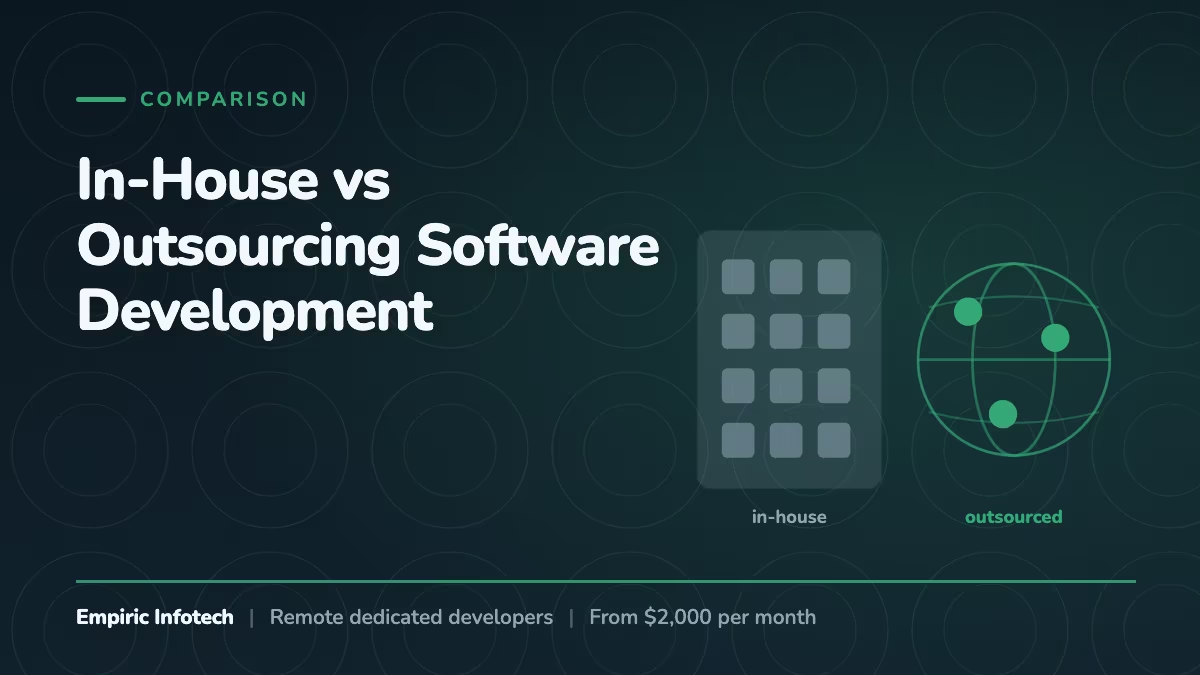
Outsourcing costs less to start. In-house costs less to control. One in-house US developer costs roughly $190,000 a year fully loaded, derived from the BLS median wage of $132,684 in May 2025 and benefits at 30.1% of employer compensation cost. Outsourced senior engineers bill $31 to $76 an hour in Accelerance's 2026 rate survey. Choose by who owns the roadmap, not by rate.
Published 8 September 2026.
The short answer
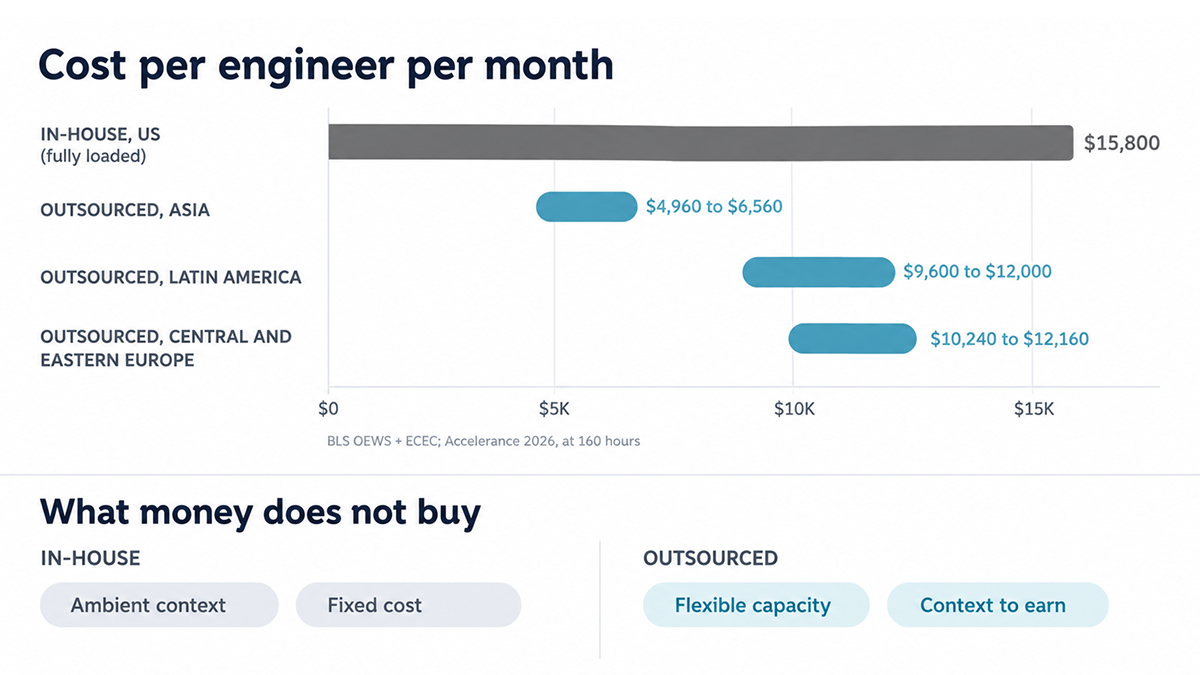
- The cost gap is real but smaller than the sales decks claim. A fully loaded in-house US engineer is about $15,800 a month on BLS wage and benefit data. Outsourced senior engineers run $4,960 to $12,160 a month at 160 hours in Accelerance's 2026 bands.
- Cost is no longer the main reason companies outsource. In Deloitte's 2024 Global Outsourcing Survey of more than 500 business and technology leaders, 42% named access to specialized talent as the top driver and 34% named cost reduction, down from 70% in 2020.
- The real difference is direction, not location. In-house means you set daily priorities. Project outsourcing means a vendor does. A dedicated or augmented team keeps direction with you and moves only the employment.
- In-house wins for the parts of the product that are your competitive position, for work that needs constant hallway context, and for anything a regulator will ask you to explain.
- Outsourcing wins for capacity you need this quarter, for a skill you will need for six months and not forever, and for work with a clean interface to the rest of the system.
- Most teams end up hybrid. A small in-house core owns architecture, security, and the roadmap. Outside engineers carry execution volume.
- The test: score the specific piece of work out of 60 on the checklist below. Below 45, close the gaps before you send the work outside.
Does in-house or outsourced software development cost less?
Outsourcing costs less per engineer per month in every published rate band, usually by a factor of 1.3 to 3.2. The honest comparison is not salary against invoice, it is fully loaded cost against invoice, so here is the arithmetic.
The US Bureau of Labor Statistics put the median annual wage for software developers at $132,684 in its May 2025 Occupational Employment and Wage Statistics release. Wages are not the whole cost. The BLS Employer Costs for Employee Compensation release for March 2026 found that benefits accounted for 30.1% of total compensation for private industry workers, leaving wages at 69.9%. Grossing the median wage up on that ratio gives about $189,800 a year, or roughly $15,800 a month, which is close to $99 an effective hour at 160 hours, and more once you subtract paid time off.
Now put that next to agency list rates. Accelerance built its 2026 Global Software Development Rates and Trends guide from a survey of 60 development partners and published these senior developer bands.
| Model | Cost per engineer per month | Basis |
|---|---|---|
| In-house US developer, fully loaded | About $15,800 | BLS OEWS May 2025 median wage, grossed up using BLS ECEC March 2026 |
| Outsourced, Asia | $4,960 to $6,560 | Accelerance 2026, senior $31 to $41 an hour, at 160 hours |
| Outsourced, Latin America | $9,600 to $12,000 | Accelerance 2026, senior $60 to $75 an hour, at 160 hours |
| Outsourced, Central and Eastern Europe | $10,240 to $12,160 | Accelerance 2026, senior $64 to $76 an hour, at 160 hours |
Two costs sit outside that table. Hiring in-house carries a one-off acquisition cost: SHRM's 2025 Benchmarking Report puts the average nonexecutive cost per hire at $5,475. And every model costs you management attention, which is usually the scarcer resource.
For reference, and separately from the model comparison above, Empiric Infotech charges USD 2,000 a month in the US and India, EUR 2,000 in Europe, and AUD $3,000 in Australia for one named mid-to-senior engineer at 160 to 172 hours, and the monthly rate is the same for AI engineering. Hourly is USD 15 for standard work and USD 25 for AI work, or AUD $25 and AUD $40 in Australia.
What do you actually give up when you outsource?
You give up ambient context, and you can give up control if you buy the wrong shape of contract. Those are two separate problems and only one of them is unavoidable.
Ambient context is the corridor conversation, the half-remembered reason a table has a strange column, the sense of which complaint matters. An outside engineer starts without it and earns it over weeks. You shorten that by writing decisions down and by keeping one named engineer on the product for a year rather than a sprint.
Control is a contract question, not a geography question. Fixed-scope project outsourcing genuinely transfers the plan to the vendor, and on the day a date slips you are in a change-order conversation rather than a sprint retro. Staff augmentation and dedicated teams do not: the tickets are yours, the standup is yours, and the vendor supplies employment and a desk. That distinction is the whole subject of staff augmentation versus outsourcing, and it is why remote staff augmentation services sit closer to in-house than to project work.
The last thing worth protecting is ownership of the assets. Repository, cloud accounts, CI, and model keys should be in your organization's name from day one. If you find out at month nine that the vendor holds them, you did not outsource, you were captured.
What do you actually give up by hiring in-house?
You give up flexibility, and you buy capacity you cannot switch off. An in-house engineer is a fixed cost with a notice period, a salary review, and a career expectation. That is exactly right for work that will exist for five years and exactly wrong for a six-month push.
You also carry hiring risk twice: once when you recruit, because a senior offer can be declined after weeks of process, and again when the person leaves with the knowledge unless you wrote it down. The mitigations are the ones a good outsourced arrangement needs anyway: documented decisions, tested code, and no single person owning a system alone.
And you carry specialization risk. A permanent generalist team is a poor fit for a skill you need intensely and briefly. If the roadmap needs an evaluation harness for an LLM feature this quarter and nothing like it next year, hiring for it permanently is the expensive option.
Which model fits which situation?
Match the model to how permanent the work is and who is accountable for the plan. Most in-house versus outsourcing arguments are really arguments about which row you are in.
| Situation | Better model | Why |
|---|---|---|
| The system is your competitive position | In-house | The knowledge is the asset, and you want it to compound on your payroll |
| You need three more engineers this quarter | Outsourced, dedicated or augmented | Capacity now, without a permanent cost base |
| A specialist skill needed for six months | Outsourced | Hiring permanently for a temporary need is the expensive path |
| A regulator will ask who wrote this | In-house, or outsourced with named engineers and full audit trail | Anonymity is the problem, not location |
| A bounded piece of work with a fixed end | Project outsourcing | The vendor can own a plan that will not change |
| A roadmap that changes every few weeks | In-house or dedicated team | Fixed-scope contracts turn every change into a change order |
| You cannot name an internal owner for the backlog | Neither yet | No model survives an unowned backlog |
If the answer is a long-lived offshore team rather than a handful of engineers, the structural choices are in the guide to the offshore development center. The difference between buying people and buying an outcome is in staff augmentation versus managed services.
Should you run both at once?
Yes, and most companies already do. The pattern that works is a small in-house core owning architecture, security review, and the roadmap, with outside engineers carrying execution volume against tickets that core wrote. Deloitte's 2024 survey found 80% of executives planning to maintain or increase investment in third-party outsourcing, which is not the behavior of an industry choosing one side.
The hybrid fails in one predictable way: the in-house team treats the outside engineers as a separate tier. Same repository, same pull request standard, same standup, same definition of done, or the split becomes a queue and the queue becomes a bottleneck.
How do you score the decision before you sign?
Score the specific piece of work, not the company. Give yourself 5 points for each statement that is true today. Maximum 60.
- Someone on your payroll owns the backlog for this work and will review it weekly.
- The work has a written definition of done that your side wrote.
- Repository, cloud accounts, and model keys are in your organization's name.
- A new engineer can get the project running locally by following a README.
- Continuous integration runs the test suite on every pull request.
- The engineer will be named and exclusive to you, not shared across accounts.
- You have at least two hours of overlapping working time each day.
- A senior reviewer tests every release before it ships.
- The contract lets you stop inside 30 days with no termination fee.
- Production data is masked or unreachable from the development environment.
- You can write the first four weeks of tickets today.
- Losing this engineer next quarter would not take irreplaceable knowledge with them.
45 or above: the work is safe to send outside. 30 to 44: fix the failing items first, because every one of them costs less to fix now than at month six. Below 30: keep it in-house until the basics exist; an outside team will only expose the gaps faster.
What does the outsourced option cost, and how do you test it at low risk?
One named mid-to-senior engineer, exclusive to your product, is USD 2,000 a month in the US, EUR 2,000 in Europe, and AUD $3,000 in Australia, for 160 to 172 hours, billed monthly upfront. AI work is charged at the same flat monthly rate, with the premium applied hourly instead. The engagement is month to month with 7 days notice, there is a 7-day risk-free trial, a senior team lead reviews and tests every release, and the repository, cloud accounts, and model keys stay in your name.
Run the trial against a real ticket from your backlog, score the arrangement on the twelve items above, and compare the result to a month of in-house capacity. If you want the engagement shaped as long-term capacity rather than a trial, that is dedicated remote developers.