



 Front-end
 Back-end
 Full Stack Developer
 Mobile
 Other
Other


 Company
 Contact Us
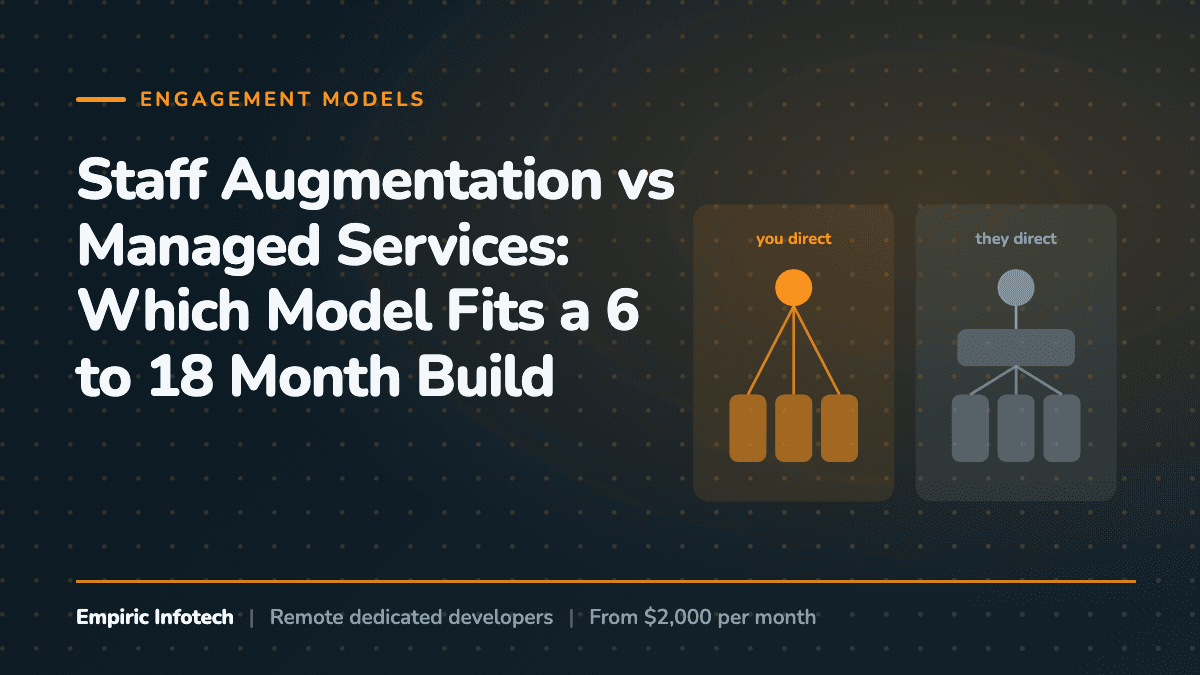
Short answer: choose staff augmentation when you own the roadmap and need more engineering capacity working inside your own process. Choose managed services when you want to hand a defined outcome to a vendor and stop managing it. Across a 6 to 18 month build, augmentation usually wins on control and cost, and managed services wins mainly when nobody in-house can direct engineers.
That is the whole decision in four sentences. The rest of this page is the evidence: what each model does to your roadmap, your repository, your notice period, and your monthly invoice, with the numbers written down instead of hidden behind a discovery call.
If you already know you want engineers inside your own team rather than a vendor running delivery, our IT staff augmentation services page covers how that engagement is set up, scoped, and priced. This article is the step before that: deciding which of the three models you are actually buying.
The three models, defined without vendor spin
Most confusion here is vocabulary, not strategy. Vendors relabel the same work depending on who is asking, so start with plain definitions.
Staff augmentation
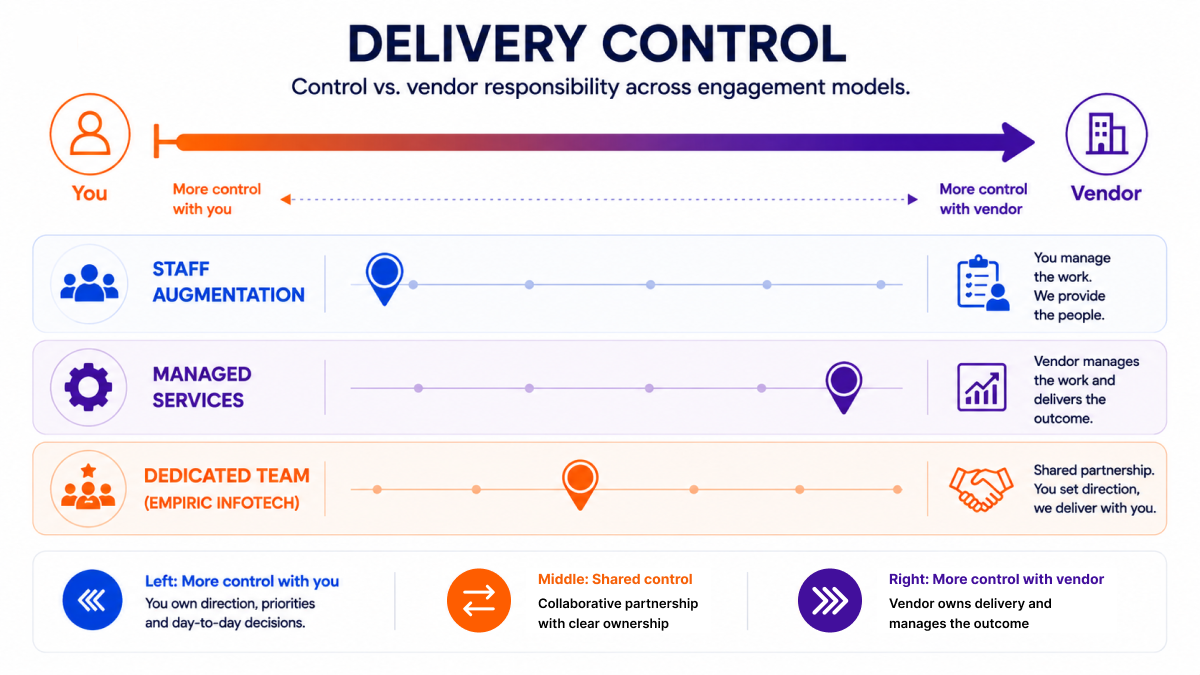
You add engineers to your existing team. They attend your standups, take tickets from your tracker, push to your repository, and answer to your engineering manager. The vendor supplies people and handles employment, payroll, and replacement. The vendor does not decide what gets built, and the vendor does not carry delivery risk. If the sprint slips, that is your sprint.
The classic use case is a known roadmap with not enough hands. You have a lead, a backlog, and a definition of done. You are short two backend engineers and a mobile developer for the next year.
Managed services
You hand the vendor an outcome and a service level. The vendor assembles the team, assigns a delivery manager, runs the process, and reports against agreed targets. You approve scope and review demos. You do not manage individual engineers, and often you do not choose them.
The classic use case is work you want off your plate entirely: platform maintenance, a support tier, a compliance workstream, or a self-contained module you can specify tightly. Managed services is a genuine fit when there is no internal technical owner with the time to direct a team every day.
A dedicated team, the model in the middle
A dedicated team is staff augmentation with the vendor's quality layer left switched on. The engineers are full-time and exclusive to you, embedded in your process, taking direction from your roadmap. What the vendor keeps is engineering supervision: a senior lead who reviews and tests what the team ships before it lands in your main branch.
This is how Empiric Infotech runs every engagement, and it is why the comparison below has three columns rather than two. You get augmentation's control without inheriting the code review burden that pure augmentation drops on your lead.
Staff augmentation vs managed services vs dedicated team, side by side
The seven rows below are the ones that change how a 6 to 18 month build actually feels. Note which column publishes numbers and which two do not.
| Decision point | Staff augmentation | Managed services | Dedicated team (Empiric Infotech) |
|---|---|---|---|
| Who manages the work | Your engineering manager or tech lead, daily | The vendor's delivery manager, against an SLA | Your manager sets the work, an Empiric Infotech senior lead reviews and tests what ships |
| Who owns the roadmap | You, entirely | The vendor delivers to an agreed scope or service level; changes go through a change request | You, entirely. No change requests, no scope negotiation |
| Who owns the IP and repo | You. Code lands in your repository from day one | Commonly the vendor's environment until handover, with IP assigned at project end | You. NDA and IP assignment signed before work starts, engineers commit to your GitHub or GitLab org, we retain nothing |
| Minimum commitment | Commonly 3 to 6 months per contractor | Commonly 12 months or a fixed statement of work | None. Month to month, no minimum term |
| Monthly cost | A bill rate per engineer, negotiated per deal and rarely published | A retainer or fixed project fee, almost never published | $2,000 USD per developer per month for 160 to 172 hours. EUR 2,000 in Europe, AUD $3,000 in Australia. Hourly also available at $15, or $25 for AI work |
| Ramp time | 2 to 6 weeks including sourcing and interviews | 4 to 12 weeks of discovery and scoping before the first commit | Onboarded in 48 hours, first pull request inside week one |
| Exit notice | The contract term, or commonly 30 days | Commonly 30 to 90 days, often with an early termination fee | 7 days written notice, no penalty. The first 7 days are a risk-free trial with a full refund |
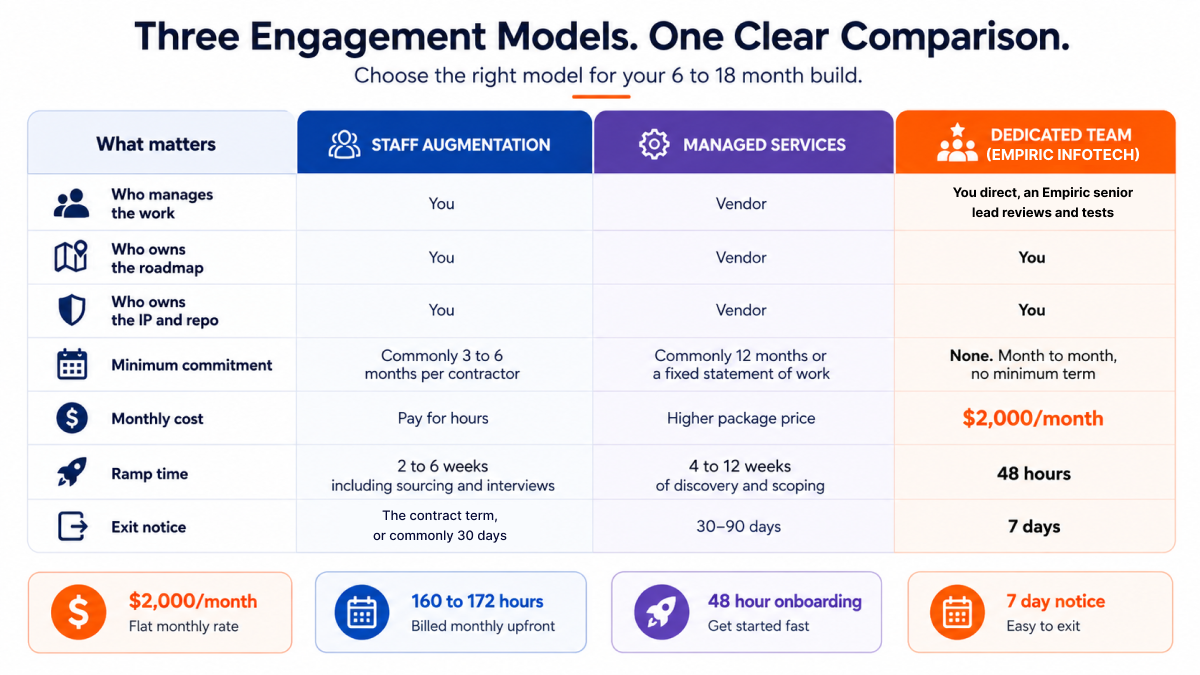
Two of those columns describe what the market commonly quotes. They are ranges because staffing and managed service vendors negotiate every deal individually and publish almost nothing. The third column is our standing contract, and it is the same on every page of this site, in every region, for every client.
That is deliberate. If you cannot compare two models on price, you are not comparing models, you are comparing sales processes. A published number lets you build a twelve month cost line before you have spoken to anyone.
Why 6 to 18 months is the deciding variable
Engagement length changes the answer more than team size or stack does.
Under about three months, managed services often looks attractive, because a tightly scoped statement of work is a fast way to get one thing finished without hiring anyone. The overhead of a discovery phase is annoying but survivable when the whole engagement is short.
Between 6 and 18 months, that overhead compounds. This is the length of real product work: a platform rebuild, a mobile app plus its backend, a migration, an AI feature that has to survive contact with real users. Over a year, four things start to matter far more than they did in month one.
Context accumulation. An engineer who has been in your codebase for nine months is a different asset from one who arrived last week. Managed services rotates people against its own utilisation targets, and every rotation resets that context. Augmentation and dedicated teams keep the same names on the same code.
Roadmap volatility. No twelve month roadmap survives intact. Under a statement of work, every change is a commercial conversation. Under augmentation or a dedicated team, a change is a conversation in your standup.
Compounding cost. A bill rate that looks reasonable per hour becomes the single largest cost line over eighteen months. Multiply whatever you are quoted by twelve before you compare it to anything.
Exit risk. A 90 day notice period on a struggling engagement is three months of paying for work you have already decided to stop. This is the row teams skip in month one and regret in month eleven.
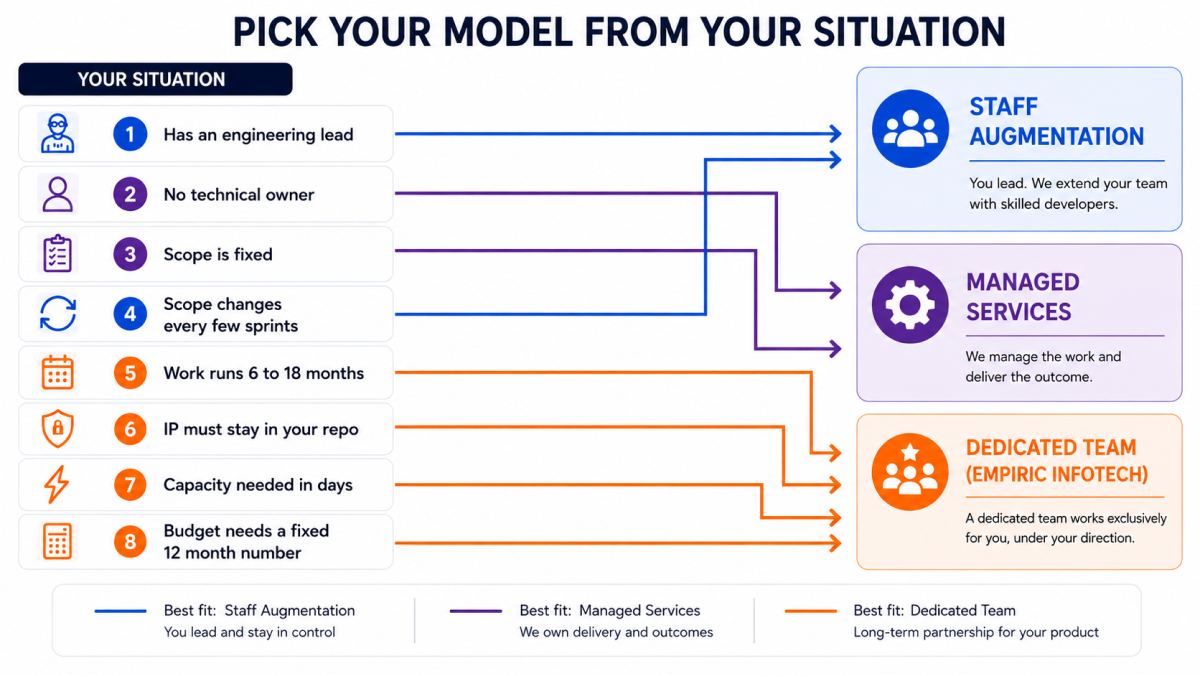
Pick your model from your own situation, not the vendor's pitch
Read down the left column. Whichever row describes your team today is the row that decides it.
| If this is true of your team | The right model | Why |
|---|---|---|
| You have an engineering lead with capacity to direct people daily | Staff augmentation or a dedicated team | You already have the function managed services would charge you for |
| You have no technical owner and nobody to review code | Managed services, or a dedicated team with senior lead review | Someone has to own quality. Pure augmentation assumes you do |
| Scope is genuinely fixed and you can specify it in writing | Managed services | A statement of work rewards precise scope |
| Scope will change every few sprints | Staff augmentation or a dedicated team | Change requests turn a moving roadmap into contract admin |
| The work runs 6 to 18 months | Dedicated team | Retains context, keeps monthly flexibility, avoids long notice |
| You need to protect IP and keep everything in your own repo | Staff augmentation or a dedicated team | Code never leaves your environment |
| You need capacity live in days, not after a discovery phase | Dedicated team | 48 hour onboarding, first pull request in week one |
| Finance approval requires a fixed number twelve months out | Dedicated team | A flat per developer monthly rate multiplies cleanly |
What each model genuinely does better
Neither model is a trap. They solve different problems, and pretending otherwise is how teams end up in the wrong one.
Where managed services earns its fee
It absorbs management. If your CTO is also your only architect and your only reviewer, handing an entire workstream to a vendor with a delivery manager buys back real hours. It also transfers delivery risk in a way augmentation cannot: when a service level is contractual, missing it is the vendor's problem. For maintenance, monitoring, a support tier, or a compliance workstream with stable requirements, that is worth paying for.
Where staff augmentation earns its fee
It keeps the decisions with the people who understand the product. Your engineers and the vendor's engineers sit in the same standup, look at the same board, and argue about the same pull request. There is no account manager translating between them, no change request for a change of mind, and no handover event at the end, because the code was already in your repository the whole time.
The cost difference over a long build is not marginal. You are paying for engineering rather than for engineering plus a delivery management layer plus a risk premium plus a margin on all three.
The three failure modes we see most
Buying managed services because you have no lead, then managing it anyway. If you end up in every sprint review rewriting acceptance criteria, you are paying a managed services premium for a model you are not using. Either commit to the vendor owning it, or move to a model where your direction is the input.
Buying augmentation with no review layer. Pure augmentation assumes your senior engineers will review everything the new people write. If your lead is already at capacity, quality quietly degrades for two months before anyone names it. This is exactly the gap a dedicated team with senior lead review is meant to close.
Signing a long minimum term to unlock a discount. A twelve month minimum with a 90 day exit is not a discount, it is a fifteen month liability. On a build whose shape you cannot fully predict, monthly terms are worth more than any percentage off.
What this costs, in plain numbers
Empiric Infotech charges $2,000 USD per developer per month for 160 to 172 hours of full-time, exclusive work. In Europe that is EUR 2,000, and in Australia AUD $3,000. Billing is monthly and upfront. Where an hourly arrangement suits the work better, standard engineering is $15 per hour and AI engineering is $25 per hour, and in Australia $25 and $40 respectively.
The terms attached to that number matter as much as the number:
- 7 day risk-free trial. If the engineer is not the right fit in the first week, you get a full refund.
- No minimum term. Month to month, with 7 days written notice to stop. No auto-renewal, no early termination fee.
- NDA and IP assignment signed before work starts. All rights, title, and interest in the code, designs, and documentation are yours. We are happy to sign your own legal template.
- Onboarded in 48 hours. Your repository, your tracker, your CI pipeline, your Slack, your standup cadence.
- Senior lead review included. It is not a separate line on the invoice.
Multiply for your own case before you compare. Three engineers for twelve months is $72,000 USD at a flat rate you can state to a finance team today, without a discovery call and without a proposal cycle.
How to run the first 30 days, whichever model you choose
Model choice does not save a badly started engagement. Four things do.
- Name one owner on your side. One person who answers questions and unblocks. Not a committee.
- Ship something real in week one. Even a small fix. It proves access, environment, review, and deploy all work before anything important depends on them.
- Agree what "done" means in writing. Tests, review, documentation, deploy. Ambiguity here is the root of most disputes in month six.
- Set a 30 day checkpoint with a real exit. Write down what good looks like at day 30 and be willing to act on it. Short notice terms are what make that checkpoint honest rather than decorative.
Frequently asked questions
Is a dedicated team the same as staff augmentation?
Nearly. Both put engineers inside your process, under your roadmap, committing to your repository. The difference is supervision: a dedicated team keeps a senior vendor-side lead reviewing and testing the work, where pure augmentation leaves all review to your team.
Which model has the lower total cost over twelve months?
Augmentation and dedicated teams almost always land lower, because you are not funding a delivery management layer and a risk premium on top of the engineering. The honest caveat is that managed services transfers delivery risk, and if you have no internal capacity to manage engineers, that transfer has real value.
Can you switch models mid-engagement?
With monthly terms, yes. Teams commonly start with one engineer to test the fit, then add a second and a third as the roadmap firms up. Adding or removing capacity takes 7 days notice and costs nothing in penalties.
Who owns the code in each model?
Under staff augmentation and a dedicated team, you do, from the first commit, because the work happens in your repository. Under managed services, the vendor commonly builds in its own environment and assigns IP at handover, so read the assignment clause before you sign rather than at the end.
How long do these engagements usually run?
Most of ours run six to eighteen months, because that is the natural length of real product work. That is a pattern, not a contract. There is no minimum term.
Choosing, and starting
If you have a technical owner and a roadmap you intend to keep steering, you want engineers inside your team, not a vendor between you and your codebase. If you have neither, managed services is a legitimate answer and you should ask any vendor pitching it to publish a number before you commit to a discovery phase.
If the first description fits, you can hire remote dedicated developers from $2,000/month with a 7 day risk-free trial, 7 day notice, and onboarding inside 48 hours. Tell us the role and the stack, and we will introduce one engineer who fits it. You interview them before anything starts.