



 Front-end
 Back-end
 Full Stack Developer
 Mobile
 Other
Other


 Company
 Contact Us
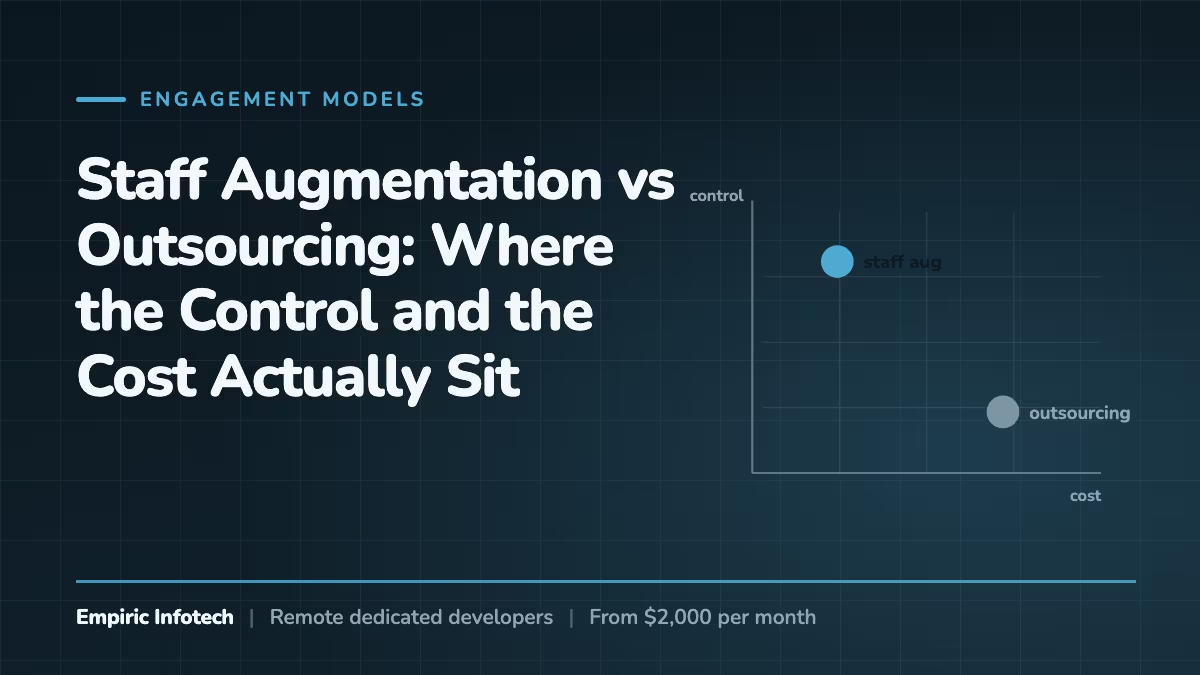
Staff augmentation gives you control and hands you the management load. Outsourcing gives up control and hands the management load to a vendor. That single trade decides everything else: who writes the tickets, who owns the IP, who absorbs attrition, and what you actually pay. Staff augmentation costs less per hour when it is billed monthly rather than hourly.
Everything below is the detail behind those four sentences. If you read one section, make it the arithmetic.
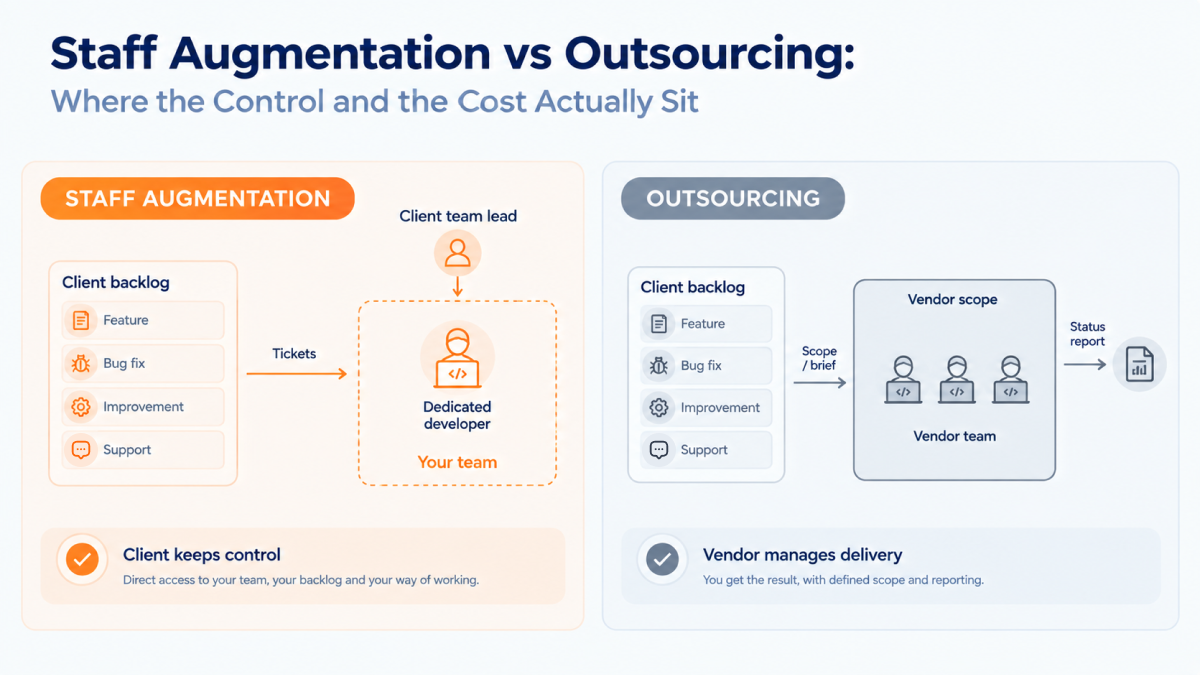
The distinction is control, not headcount
Both models put people who are not on your payroll onto your product. That is where the similarity stops.
With staff augmentation, a developer joins your team. They pull from your backlog, sit in your Slack, push to your repo, and take direction from your team lead. You are still the engineering manager. What you bought is capacity. Our own IT staff augmentation services are structured exactly this way: a full-time, exclusive remote developer in your stack, onboarded within 48 hours of sign-off, with a senior lead reviewing what they ship.
With outsourcing, a scope of work leaves your building. You describe an outcome, a vendor agrees to deliver it, and how they get there is largely their business. You are now a client, not a manager. What you bought is a result.
Neither is better in the abstract. They fail in different places. Staff augmentation fails when you have no one to write the tickets. Outsourcing fails when what you are building is still changing shape.
A note on scope: this post is about control and cost. Who runs the work day to day and who carries delivery accountability is the managed services comparison, a separate question.
The control and cost matrix
This is the table to keep. Each row is a decision that will land on someone, and the two models put it in different hands.
| Control point | Staff augmentation | Project outsourcing |
|---|---|---|
| Who writes the tickets | Your product owner or team lead, in your tracker | The vendor's business analyst, derived from a signed scope document |
| Who runs stand up | You do, in your existing ritual, with the developer attending | The vendor runs an internal stand up; you get a weekly or fortnightly status call |
| Who sets priority mid-sprint | You, same day, no paperwork | Change request, re-estimate, then a revised statement of work |
| Who owns the IP | You, from the first commit, under an assignment clause in the engagement agreement | Usually transfers on milestone acceptance or final payment, so it is contract-dependent |
| Where the code lives | Your GitHub or GitLab org from day one | Vendor infrastructure, migrated to you at handover |
| Who absorbs attrition | The vendor. At Empiric Infotech a replacement inside the 7-day trial window is free | The vendor absorbs the cost, but you absorb the schedule slip |
| Who holds the domain knowledge at the end | Your team, because the work happened in your rituals | The vendor, unless a handover phase is contracted and paid for |
| Notice period | 7 days written notice, month to month | Typically the remaining milestone, or a 30 to 90 day termination clause |
| Commitment shape | One month at a time, scale a developer at a time | Fixed term tied to the scope, with change orders priced separately |
| The real monthly rate | $2,000 USD per developer per month for 160 to 172 hours, billed monthly upfront | Fixed bid or time and materials, plus change orders, plus a handover phase |
| What a surprise costs you | A conversation | A change order |
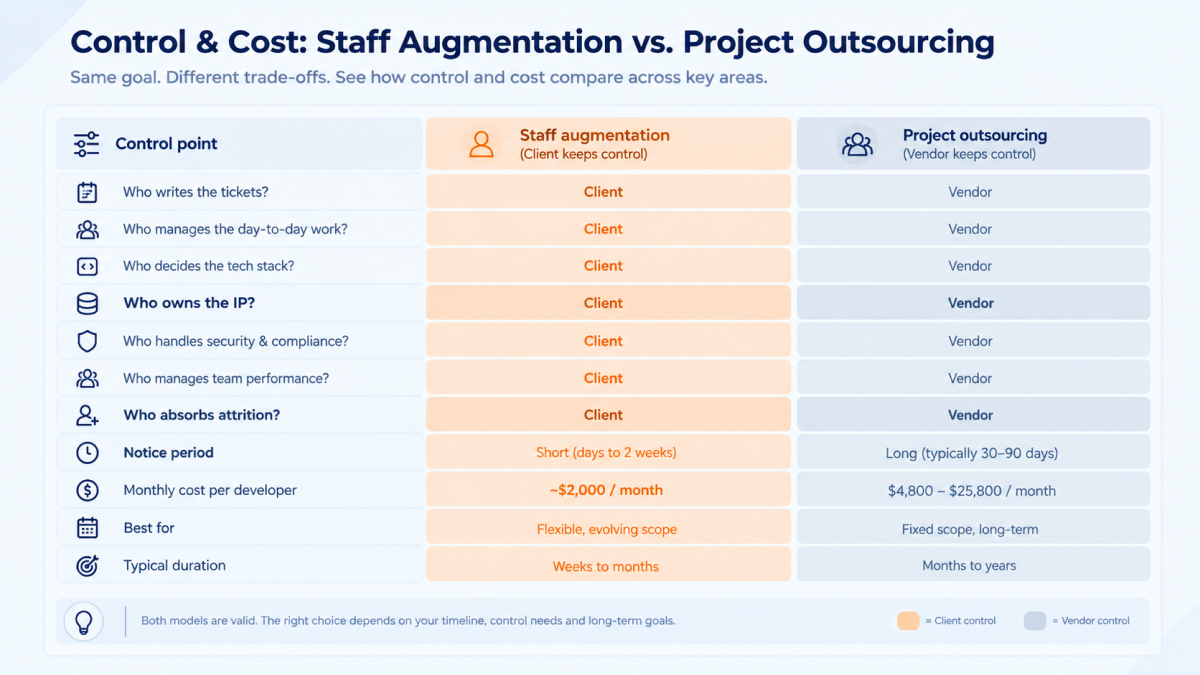
Who writes the tickets is the row that predicts the others
If you cannot staff someone to write clear tickets and answer questions within a few hours, staff augmentation will underperform no matter how good the developer is. An augmented developer with an ambiguous backlog produces exactly what an in-house developer with an ambiguous backlog produces.
Outsourcing exists to solve that. You pay a premium so somebody else does the specification work. That premium is real, and it is fine to pay it as long as you know it is what you are buying.
Who runs stand up decides how fast you can change your mind
A mid-sprint priority change costs close to nothing under staff augmentation and something real under outsourcing. That is not vendors being difficult: a fixed-scope contract is priced against a fixed scope, so changing the scope reprices it.
The practical test: how many times in the last quarter did your roadmap change inside a two-week window? If the answer is more than twice, a fixed-scope contract will spend its life in change orders.
Who owns the IP is a contract question, not a model question
Under staff augmentation the answer is simple, because the developer commits into your repository under your organisation from day one. There is no transfer event, because the code never left. Confirm the assignment clause anyway.
Under outsourcing, ownership usually transfers on acceptance or final payment. Workable, but it means a disputed invoice and a contested IP claim become the same event. Read the clause before the dispute, not during it.
Who absorbs attrition is where the two models look similar and are not
In both models the vendor absorbs the direct cost of replacing a person. The difference is what happens to your timeline.
Under staff augmentation the replacement joins your rituals and reads your repo, and your team still holds the context. Under outsourcing, if the vendor rotates their lead engineer, the context that walks out is context you never had, and you find out when the milestone slips.
The arithmetic: $15 an hour against $2,000 a month
Here is the piece most comparisons skip. The headline rate is not the effective rate, and hourly billing is not automatically the lower-cost structure.
Our standard rate is $15 USD per hour for non-AI engineering work, and $25 USD per hour for AI work. The monthly engagement is $2,000 USD per developer per month for 160 to 172 hours of full-time, exclusive work, billed monthly upfront.
Work it out.
Hourly, at the lower end of the month: 160-hour month x $15.00 = $2,400
Hourly, at the upper end of the month: 172-hour month x $15.00 = $2,580
Monthly flat, either way: $2,000
Effective hourly rate under the monthly model: $2,000 / 160-hour month = $12.50 per hour $2,000 / 172-hour month = $11.63 per hour
The gap: $2,400 - $2,000 = $400 saved in a 160-hour month, which is 16.7% off the hourly rate $2,580 - $2,000 = $580 saved in a 172-hour month, which is 22.5% off the hourly rate
Over twelve months, one developer: $4,800 to $6,960 lower than the same hours billed hourly at the standard $15.
| Line item | Hourly at $15 | Monthly flat |
|---|---|---|
| Contracted hours in a month | 160 to 172 | 160 to 172 |
| Quoted rate | $15.00 per hour | $2,000 per month |
| Cost in a 160-hour month | $2,400 | $2,000 |
| Cost in a 172-hour month | $2,580 | $2,000 |
| Effective hourly, 160-hour month | $15.00 | $12.50 |
| Effective hourly, 172-hour month | $15.00 | $11.63 |
| Variance if the month runs long | You pay more | You pay $2,000 |
| Difference per developer per month | baseline | $400 to $580 lower |
| Difference per developer per year | baseline | $4,800 to $6,960 lower |
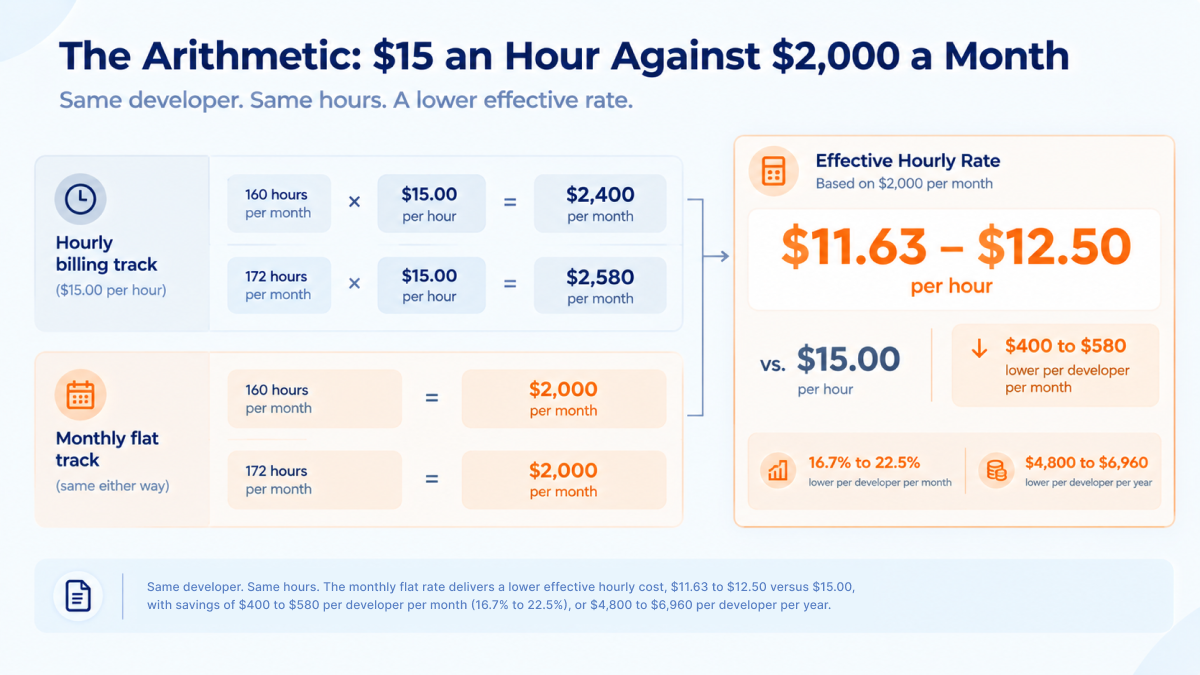
The monthly number wins because the flat rate absorbs variance, not because it is a discount. Some months hold 160 working hours and some hold 172. Under hourly billing you carry that swing; under monthly billing the vendor does. That is also why the monthly model only works when the developer is exclusive to you: nobody absorbs hour variance across clients they are splitting.
The same shape holds in the other regions we serve. In the EU the engagement is EUR 2,000 per developer per month for the same 160 to 172 hours. In Australia it is AUD $3,000 per month against a standard hourly rate of AUD $25, so a 160-hour month billed hourly is AUD $4,000 and the effective monthly rate lands at AUD $17.44 to AUD $18.75 per hour.
For AI work the divergence is wider, because the hourly rate is $25 rather than $15 while the monthly engagement stays at $2,000. Do that multiplication before you agree to an hourly AI retainer.
What this arithmetic does not tell you
It compares one vendor's two billing structures for identical work. It is not a comparison against a fixed-bid outsourcing quote, because a fixed bid is priced against a scope, and scopes are not comparable across proposals unless someone normalised them.
If you are holding a fixed bid, divide it by the number of full-time developer months it implies and compare that to $2,000. If the vendor will not tell you how many developer months are in the bid, you have learned something useful about how the engagement will be run.
Which model fits which situation
| Your situation | Better fit | Why |
|---|---|---|
| You have a product owner and a backlog, and you are short on hands | Staff augmentation | The specification work already exists in-house |
| Requirements are still moving weekly | Staff augmentation | Change costs a conversation, not a change order |
| The work is continuous for 6 to 18 months | Staff augmentation | Monthly billing beats per-project mobilisation |
| You need the knowledge to stay in your team afterwards | Staff augmentation | The work happens inside your rituals and your repo |
| A defined, bounded system with a fixed deadline and stable requirements | Outsourcing | A fixed scope can be fixed-priced |
| You have no engineering management capacity at all | Outsourcing | Somebody has to run the work |
| A one-off migration or integration outside your team's stack | Outsourcing | Specialist depth you will not need again |
| Compliance requires a single accountable delivery party | Outsourcing | Accountability is contractual, not distributed |
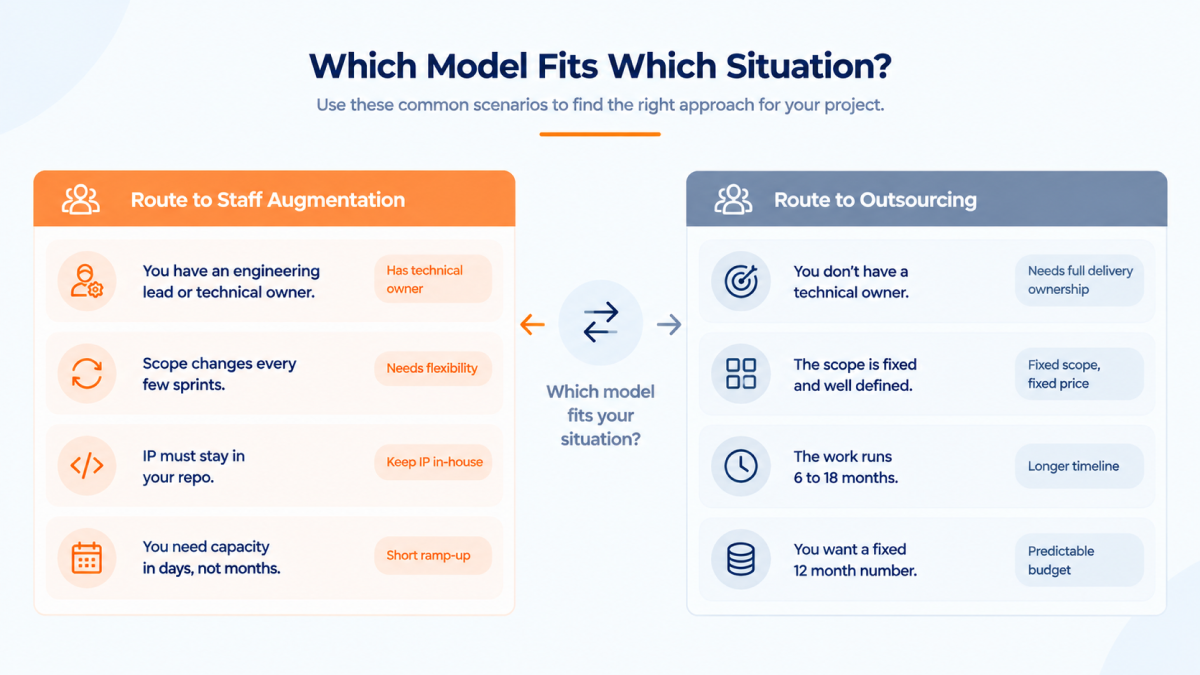
Four questions that settle it in an afternoon
- Name the person who will write the tickets. If you cannot name them, you are outsourcing whether you meant to or not.
- Count your roadmap changes last quarter. More than two inside a two-week window, and a fixed scope will not hold.
- Decide where the knowledge has to live in twelve months. In your team, or with a vendor you will keep paying.
- Ask what leaving costs. Under our engagement it is 7 days written notice. Under a fixed-scope contract it is usually the remaining milestone. Get that number in writing before you sign, not after.
Running both, which is what most teams actually do
The models are not exclusive. A sensible shape is to keep the core product on augmented developers inside your team and hand a bounded, separable piece to a fixed-scope engagement: a payments integration, a data migration, a compliance module.
The failure mode is the reverse: outsourcing the core product while augmenting the edges. That puts your most volatile work behind the highest change cost, and your most stable work under the loosest structure.
What we do, and where each fits
Empiric Infotech runs both. The augmentation engagement is a full-time, exclusive remote developer added to your team at $2,000 USD per developer per month for 160 to 172 hours, billed monthly upfront, onboarded within 48 hours of sign-off, with a senior team lead reviewing and testing what they ship. There is a 7-day risk-free trial, no placement fee, no long-term lock-in, and you cancel with 7 days written notice. You scale a developer at a time without re-contracting.
When the work is genuinely bounded and you want a single accountable delivery party instead of capacity in your own stand up, the right route is to outsource software development as a scoped engagement, where the specification, the sequencing, and the delivery management sit with us.
The honest summary: if you can direct the work, staff augmentation gives you more control and a lower effective hourly rate at $11.63 to $12.50 against $15. If you cannot direct the work, buying control you will not use is the expensive mistake, and a scoped engagement is the better buy.
Tell us the stack, the seniority, and how your team works. Within 24 hours we come back with the developer we would put on it and a flat monthly price, and you talk to them before anyone starts.