



 Front-end
 Back-end
 Full Stack Developer
 Mobile
 Other
Other


 Company
 Contact Us
Vibe Coding Cleanup, From AI Prototype to Production
A vibe coding cleanup is a staged repair of an AI-generated codebase, run in this order: secrets and authorization, then observability, then tests, then the data model, then structure. Security goes first because Veracode's 2025 GenAI Code Security Report, testing 80 coding tasks, found models chose an insecure implementation 45% of the time. Plan for one senior engineer, not a team.
Published 22 September 2026. For CTOs, VPs of Engineering and founders whose AI-generated prototype now has real users and cannot safely take another feature.
The short answer
- It is a repair sequence, not a rewrite. The clean-up-or-rebuild call is made per module, not per codebase, and the score below decides it.
- Security is phase one, always. Veracode's 2025 GenAI Code Security Report ran 80 coding tasks through more than 100 large language models: the insecure option won 45% of the time, and Java failed 72% of tasks.
- Duplication is the debt you actually pay. GitClear's 2026 Maintainability Gap study of 623 million code changes found duplication up 81% and refactoring line moves down 70% against its pre-AI baseline.
- Silence is worse than errors. That study also found 47% more error masking than in its base year: catch blocks and safe-navigation operators that swallow the signal you need.
- The AI that wrote it will not reliably fix it. In Stack Overflow's 2025 Developer Survey, 66% of developers named "AI solutions that are almost right, but not quite" as their biggest frustration.
- Speed was never the constraint. Google's 2025 DORA report surveyed nearly 5,000 professionals, found 90% AI adoption, and found AI adoption still correlated with lower delivery stability.
- Staff it as one named senior engineer. At Empiric Infotech a mid-to-senior engineer is USD 2,000 a month for 160 to 172 hours, with a senior team lead reviewing every release. You can hire a dedicated remote developer month to month.
What is a vibe coding cleanup?
A vibe coding cleanup is the engineering work that turns a prompt-generated prototype into a system a team can safely operate. Andrej Karpathy coined "vibe coding" in February 2025 for building software by describing what you want and accepting the result without reading it closely. Collins Dictionary made it Word of the Year in November 2025. The phrase describes how code was produced, and says nothing about whether that code is fit to run.
That is the whole gap. A vibe-coded prototype is correct on the path its author demonstrated and undefined everywhere else: no threat model, no data constraints, no rollback, no test that would notice a regression. The failure is treating one as a foundation because it looks finished. A cleanup is therefore not refactoring for taste. It closes a specific list of gaps in an order where each phase makes the next one measurable.
What breaks first in an AI-generated codebase?
Authorization breaks first, and silently. Generated code tends to enforce permissions in the interface, where the person prompting can see them, rather than on the server, where they matter. Every row below follows that pattern: the demonstrated path works, the failure path was never defined.
| Layer | What the prototype has | How it fails in production |
|---|---|---|
| Authorization | Role checks in the UI only | A user calls the endpoint directly, reads another tenant's data |
| Secrets | Keys committed, or shipped in the client bundle | Key extracted from the bundle, billed to you |
| Data model | No foreign keys, no indexes | Queries degrade sharply as rows grow, no obvious culprit |
| Business rules | One rule copy-pasted into several files | A pricing change lands in some copies and is missed in others |
| Error handling | Empty catch blocks everywhere | Failures return success, data is dropped, nothing alerts |
| Model and API calls | No timeout, retry ceiling or spend cap | A retry loop burns a month of model spend overnight |
Two rows are measurable. GitClear counted duplication as five or more consecutive repeated meaningful lines, found it up 81% (the copy-paste row) and found error masking up 47% (the silent-failure row). Those two are where a cleanup earns its money.
Should I clean up the prototype or rebuild it?
Score it before you scope it. Rate each gate from 0 to 5 against the module you care about most, not the whole repository. Sixty points available.
| # | Gate | Points |
|---|---|---|
| 1 | No secret in the repo or the client bundle | 5 |
| 2 | Authorization enforced server side, tenant isolation tested | 5 |
| 3 | Structured logs and error tracking, one trace ID per request | 5 |
| 4 | A test suite that fails when a real user path breaks | 5 |
| 5 | Foreign keys, indexes and a committed migration history | 5 |
| 6 | A backup restored successfully at least once, not just scheduled | 5 |
| 7 | Each business rule has exactly one home | 5 |
| 8 | Errors surface to a human, no empty catch on write paths | 5 |
| 9 | Every outbound API and model call has a timeout and a spend cap | 5 |
| 10 | Dependencies pinned, lockfile committed | 5 |
| 11 | Deploys scripted and reversible in one command | 5 |
| 12 | Personal data has a written retention and deletion path | 5 |
How to read the score. 45 or above and you clean up in place, module by module, without pausing the roadmap. 30 to 44 and you clean the core while rebuilding the one or two modules that score worst, the usual outcome. Below 30 and you replace the backend behind the existing interface, keeping the screens the prototype got right. Gates 1, 2 and 4 are load bearing: if all three read zero, fix those before trusting the total.
Note what the instrument never asks: language, framework, or whether a human or a model typed the lines. Provenance is not the risk. Undefined behavior is.
What order does a vibe coding cleanup run in?
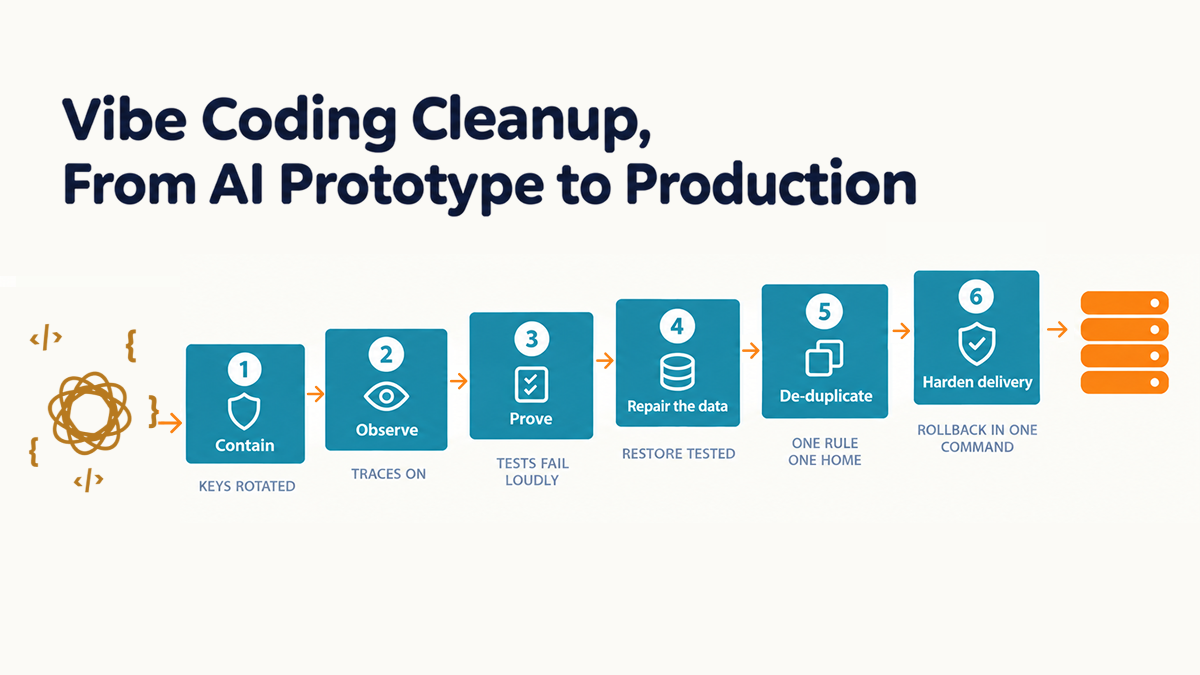
Contain first, observe second, prove third. Each phase makes the next measurable, so running them out of order means restructuring code you cannot verify.
| Phase | Work | Done when |
|---|---|---|
| 1. Contain | Rotate keys, move authorization server side, add spend caps | Every route authorizes server side |
| 2. Observe | Structured logging, error tracking, one trace ID per request | You can answer "what happened to this user" in minutes |
| 3. Prove | Characterization tests around paths that currently work | The suite fails when you break something users rely on |
| 4. Repair the data | Constraints, indexes, migrations, a tested restore | A test restore completed against a recent backup |
| 5. De-duplicate | Collapse copied rules into one owner each, delete dead branches | Every business rule has one home |
| 6. Harden delivery | Scripted deploys, staging, one-command rollback | You can roll back without a human decision tree |
Phase 3 is the one teams want to skip and cannot. Characterization tests do not assert the code is correct. They assert it behaves the way it behaves today, which is what lets you restructure safely in phases 5 and 6.
Can the AI that wrote it also clean it up?
Not on its own, and the evidence is direct. METR's July 2025 randomized controlled trial put 16 experienced open-source developers through 246 real tasks on repositories they had worked in for an average of five years. With AI tools allowed they were 19% slower, and afterwards still estimated AI had made them about 20% faster. Stack Overflow's 2025 survey says the same thing: 66% named "almost right, but not quite" as their top frustration, 45% said debugging AI-generated code is more time-consuming, and trust in AI accuracy fell to 33% from 43% in 2024.
The tools stay useful inside a cleanup. They write characterization tests well, find every copy of a duplicated rule, and draft migrations. They are poor at deciding which duplicate is correct, which failure paths matter to your business, and when a module has crossed from repairable to disposable. Those three judgments are the engagement.
Who should run the cleanup?
One senior engineer with continuous context, not a rotating team. A cleanup is a long run of small judgment calls about code nobody wrote deliberately, so continuity beats headcount.
| Staffing route | Commitment | Who reviews the code | Fits when |
|---|---|---|---|
| Permanent senior hire | A full recruiting cycle before anyone starts | Your existing team | You have an org to absorb them |
| Fixed-price rebuild | One quote, one locked scope | The vendor, until handover | The prototype is disposable, the spec is stable |
| Dedicated engineer, monthly | Month to month, one named person | A senior lead on the supplier side | Scope is directionally clear, fuzzy in detail |
Whichever route you take, ask for the phase order they intend to run and the name of the person reviewing each release. A supplier who cannot answer the second question is offering throughput, and throughput created the problem.
Start the cleanup
Run the twelve gates against your worst module this week and write down the number. That figure decides whether you are scoping a repair, a partial rebuild, or a backend replacement behind screens you keep.
Then put one named senior engineer on it. Empiric Infotech is a remote software development company in Surat, India, founded in 2020. A cleanup runs as one exclusive mid-to-senior engineer on your codebase, with a senior team lead reviewing every release, for 160 to 172 hours a month, billed monthly upfront: USD 2,000 in the US and India, EUR 2,000 in Europe, AUD $3,000 in Australia, and the same monthly rate applies when the work is AI engineering such as agents, retrieval, evaluations and guardrails. Hourly is USD 15, or USD 25 for AI work, AUD $25 and AUD $40 in Australia. There is a 7-day risk-free trial, the engagement runs month to month, and you cancel on 7 days notice. You keep the repository, the cloud accounts and the model keys throughout, so there is nothing to extract if you stop. A senior team lead reviews and tests every release, which is exactly the control the prototype never had.
If the prototype is a web or mobile application that grew past its foundations, hire a dedicated remote developer and spend the trial week on phases 1 to 3. If it is an agent, a tool-calling workflow or a retrieval pipeline needing evaluations and guardrails, start with AI agent development.