



 Front-end
 Back-end
 Full Stack Developer
 Mobile
 Other
Other


 Company
 Contact Us
Why AI Proofs of Concept Never Reach Production
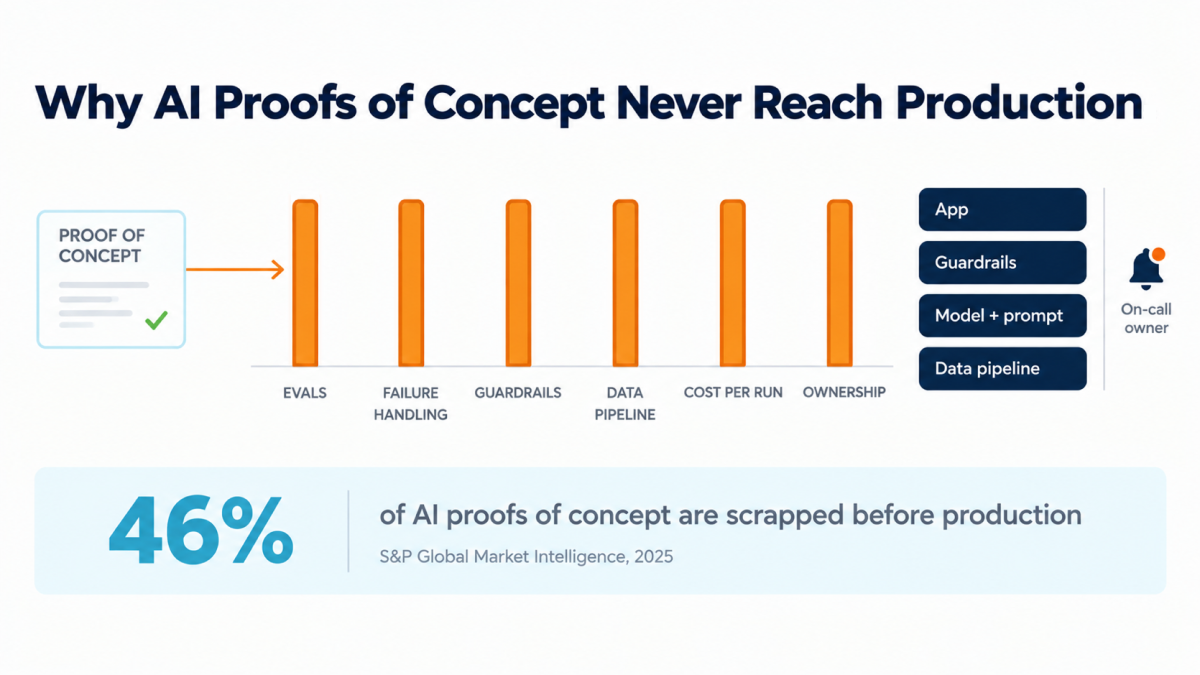
Most AI proofs of concept die at the handover, not at the demo. S&P Global Market Intelligence found in March 2025 that the average organization scrapped 46% of its AI proofs of concept before they reached production. The cause is almost never model quality. It is missing evaluation, missing guardrails, unowned data pipelines and unbudgeted cost per run.
Published 22 September 2026. Written for CTOs, VPs of Engineering and founders who have a pilot that works and still cannot get a launch date.
The short answer
- The demo was never the hard part. A proof of concept proves one narrow claim about model output. It deliberately skips everything that makes a system supportable.
- Evaluation is the artifact that is missing. Without a golden set and a repeatable score, no one can say whether a change made the system better or worse, so no one signs off.
- Guardrails are a product decision, not a model setting. Somebody has to write down what the system is not allowed to say or do, and what happens when it tries.
- Cost per run only becomes real at real traffic. Pilot spend on a few hundred calls tells you nothing about spend on a few hundred thousand.
- Manual data steps do not survive contact with production. If a person exported a CSV to make the pilot work, that person is now a single point of failure.
- Nobody owns it on call. An AI feature with no on-call owner and no rollback path will not pass a release review, and it should not.
- This is six to twelve weeks of ordinary engineering. Not a rewrite, and not a research project.
What is an AI proof of concept actually meant to prove?
An AI proof of concept exists to prove one falsifiable claim: that a given model, prompt and data source can produce an acceptable output on your real inputs, at a quality bar you wrote down before you started. That is the whole job. It is not meant to prove the system is safe, economical, observable, or supportable by anyone other than the person who built it.
The trouble starts when the pilot proves something weaker. Twenty hand-picked examples in a screen share is a different claim from a measured pass rate on a representative sample of production inputs. If your pilot never had a written quality bar, the reason it cannot get a launch date is that nobody can agree it passed. Fixing that comes first, and it is usually the least expensive item on this page. If your pilot is retrieval, extraction or content generation, that scoping work sits inside generative AI development.
Why do so many AI proofs of concept never reach production?
Because the work that makes a system production ready was excluded from the pilot on purpose, and nobody rebudgeted it afterwards. The published failure data is remarkably consistent about which four things go wrong.
Gartner predicted in July 2024 that at least 30% of generative AI projects would be abandoned after proof of concept by the end of 2025, naming poor data quality, inadequate risk controls, escalating costs and unclear business value. In June 2025, after a poll of more than 3,400 webinar attendees, Gartner predicted over 40% of agentic AI projects would be canceled by the end of 2027, citing the same four causes. MIT's Project NANDA report "The GenAI Divide: State of AI in Business 2025" analyzed 300 public AI deployments alongside 52 executive interviews and found that 95% of enterprise generative AI pilots delivered no measurable P&L impact.
Read that list again. Not one of the four causes is "the model was not good enough". Every one is an engineering and ownership problem.
What is the difference between a working demo and a production AI system?
Six things, and none of them are the model. The demo answers a question. The production system answers the same question ten thousand times, within its cost limits, with a record of what it said and a way to stop it.
| Dimension | Proof of concept | Production system |
|---|---|---|
| Quality signal | Someone looked at the output and liked it | A golden set of real cases with a pass rate that runs in CI |
| Failure handling | The demo is re-run until it works | Retries, fallbacks, a defined degraded mode, an alert |
| Guardrails | The prompt says "be helpful and accurate" | Input and output filters tested against adversarial cases, with logged refusals |
| Data | A CSV someone exported last month | A pipeline that runs on schedule, at volume, with no human step |
| Cost | A rounding error on a personal API key | Cost per run, tracked per feature, with a ceiling and an alarm |
| Ownership | The engineer who built it | A named on-call owner, a runbook and a rollback procedure |
How do I score whether my AI proof of concept is production ready?
Score twelve gates, five points each, sixty points available. Every gate is either done and demonstrable or it scores zero. Partial credit is how teams talk themselves into a launch date they cannot hold.
| # | Gate | Points |
|---|---|---|
| 1 | A golden set of at least 100 real inputs with expected outputs, agreed with the business owner | 5 |
| 2 | An automated eval that scores that set and runs on every change | 5 |
| 3 | A written pass threshold, decided before the eval was run | 5 |
| 4 | Input guardrails tested against prompt injection and out-of-scope requests | 5 |
| 5 | Output guardrails for the things the system must never say or do, with refusals logged | 5 |
| 6 | Every run logged with inputs, outputs, latency, tokens and cost | 5 |
| 7 | Measured cost per run at projected production volume, with a monthly ceiling and an alarm | 5 |
| 8 | A data pipeline with zero manual steps, tested at full volume | 5 |
| 9 | A rollback path that reverts model, prompt and config together in one action | 5 |
| 10 | A named on-call owner and an alert that fires on an abnormal failure or refusal rate | 5 |
| 11 | Security review of what the model can read and which systems it can call | 5 |
| 12 | A human review path for low-confidence cases, with the confidence rule written down | 5 |
How to read the score. 45 or above and you can commit to a launch date. 30 to 44 and you have roughly six to twelve weeks of engineering ahead, so set the date after that work, not before. Below 30 and you have a prototype rather than a proof of concept. Gates 1, 2 and 3 are load bearing. If those are zero, the other nine cannot be assessed honestly.
How long does it take to move an AI proof of concept to production?
For a single well-scoped feature, six to twelve weeks of one senior engineer's full attention, assuming the pilot works and the score is above 30. The eval harness and golden set usually take two to three weeks, most of it spent getting the business owner to commit to what "correct" means. Guardrails, logging and cost controls take another two to four. The data pipeline is the wildcard: if a human is exporting anything by hand, plan for more.
Two things stretch this. The first is quality that does not survive a representative sample, which sends you back to model and prompt work. The second is a security review arriving late. Start that conversation in week one, not week ten.
Should the pilot team do this work, or someone else?
Usually someone else, because the skills barely overlap and the pilot team is measured on the next experiment. The person who proved a model could do the thing rarely wants to spend eight weeks on eval harnesses, cost ceilings and runbooks. The three common routes behave differently.
| Staffing route | Best when | Common failure |
|---|---|---|
| The original pilot team | The pilot is small and the team owns the production service already | Production hardening loses every priority contest to the next pilot |
| A fixed-scope project agency | The scope genuinely will not move | AI scope always moves, and change requests eat the saving |
| A dedicated senior engineer, month to month | Scope is clear in direction and fuzzy in detail, which is the normal case | Weak handover if the engineer never gets access to the real data |
Gartner's June 2025 research also warned about "agent washing", estimating that only around 130 of the thousands of vendors marketing agentic AI were doing anything genuinely agentic. Ask any vendor for their eval harness and their cost-per-run figure. People who have shipped answer both quickly.
What does it cost to staff the production work?
Empiric Infotech is a remote software development company in Surat, India, founded in 2020. For AI work we put one named mid-to-senior engineer on your codebase full time, and monthly is a flat USD 2,000 in the US and India, EUR 2,000 in Europe and AUD $3,000 in Australia for any service, AI included. That buys 160 to 172 hours a month from one exclusive engineer, billed monthly upfront. Standard non-AI engineering on the same terms is USD 2,000 a month in the US and India, EUR 2,000 in Europe and AUD $3,000 in Australia. If you prefer hourly, AI work is USD 25 an hour, AUD $40 in Australia, against USD 15 an hour for standard development.
The terms are deliberately short. A 7-day risk-free trial before you commit. Month to month after that, cancel on 7 days notice. You keep the repository, the cloud accounts and the model keys throughout, so there is nothing to extract if you leave. A senior team lead reviews and tests every release before it ships.
If your score came back under 45, that gap is the work, and it is a fixed number of weeks rather than an open-ended rewrite. Start with AI agent development if your pilot is an agent or a tool-calling workflow, or generative AI development if it is retrieval, extraction or content generation. To scope the engineer first, hire a dedicated developer for one month and run the twelve gates against your own pilot during the trial.