



 Front-end
 Back-end
 Full Stack Developer
 Mobile
 Other
Other


 Company
 Contact Us
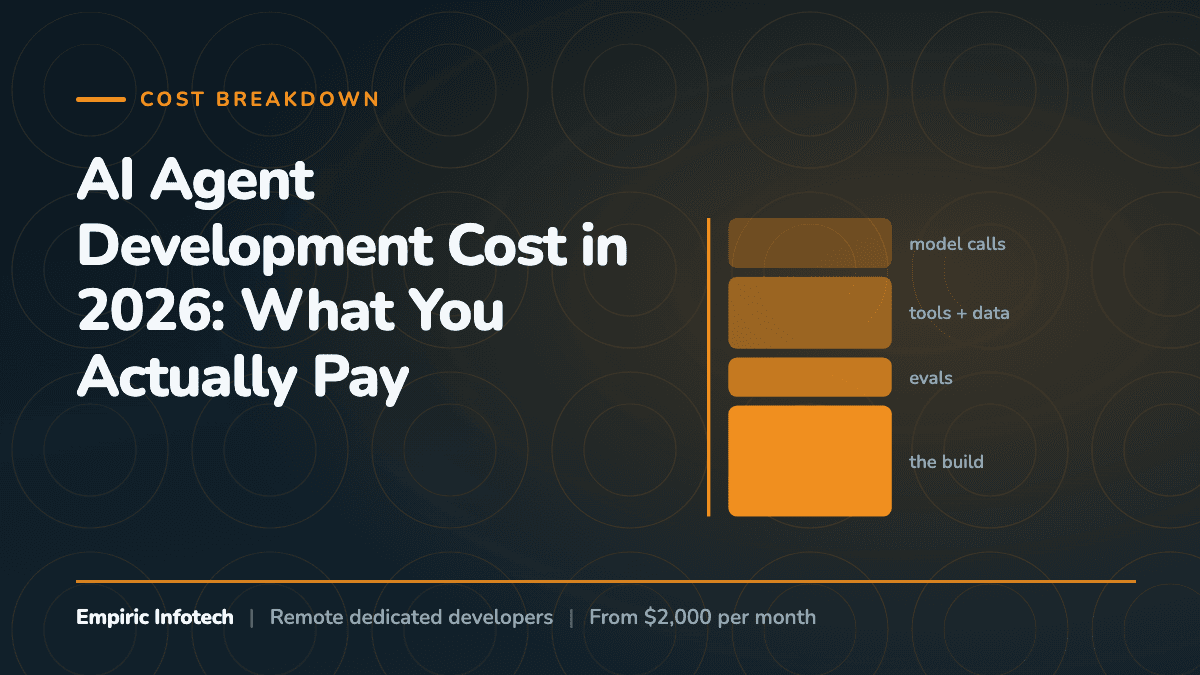
AI Agent Development Cost in 2026: What You Actually Pay
AI agent development cost in 2026 runs about $20,000 to $200,000 as a fixed-price project, depending on how many of your systems the agent is allowed to touch. Running it adds roughly $1,500 to $10,500 a month on tokens and vector storage alone. Hiring the engineer directly is USD 2,000 a month at Empiric Infotech for 160 to 172 hours of AI work.
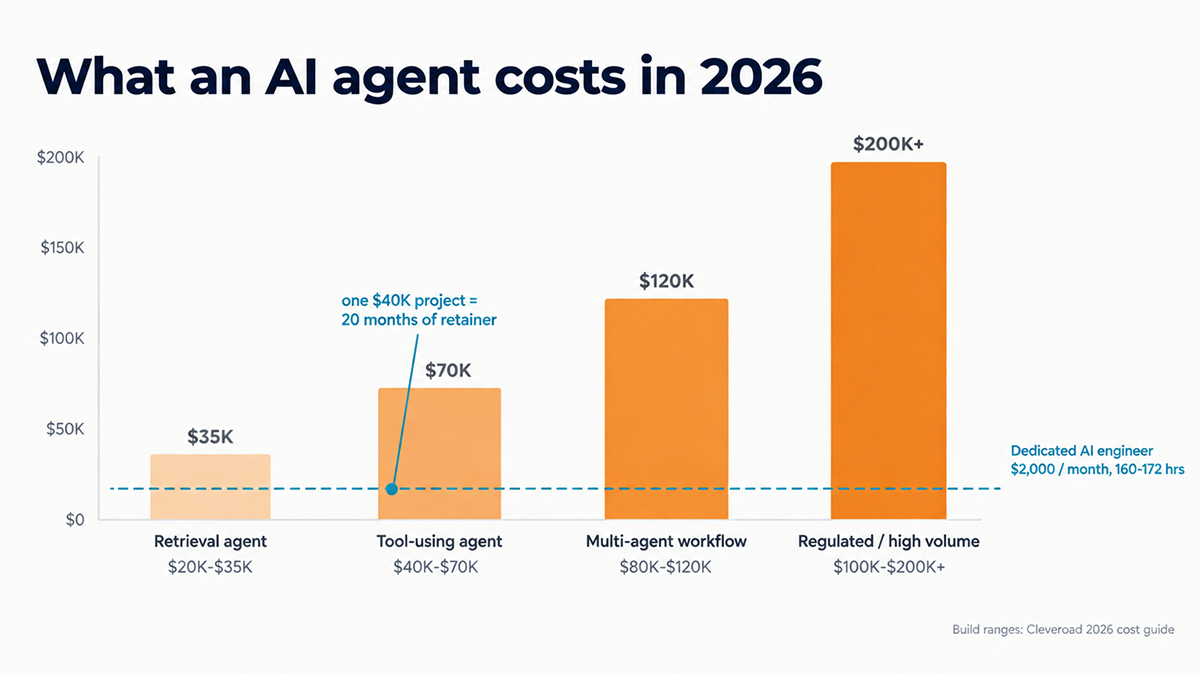
Published 19 September 2026. Build and run ranges are Cleveroad's 2026 cost guide, checked on the date of writing.
The short answer
- Build cost: $20,000 to $35,000 for a retrieval agent, $40,000 to $70,000 once it writes to your systems, $100,000 to $200,000 and up when compliance enters the picture.
- Run cost: $1,500 to $10,500 a month for tokens and vector storage, before observability and hosting, starting on launch day, not payback day.
- The 10x spread is scope, not skill: price follows how many systems the agent writes to and what happens when it is wrong.
- Retainers beat projects for agent work: agent scope moves every few weeks, and a fixed-price contract turns each move into a change order.
- Empiric Infotech charges a flat monthly fee: a flat USD 2,000 a month in the US and India, EUR 2,000 in Europe and AUD $3,000 in Australia, for one named mid-to-senior engineer at 160 to 172 hours. AI work is charged at the same monthly rate as any other service. See AI agent development.
- Plan for a failure rate: Gartner predicts over 40% of agentic AI projects will be canceled by the end of 2027.
How much does it cost to build an AI agent in 2026?
A production AI agent costs roughly $20,000 to $200,000 to build in 2026, and where it lands is decided almost entirely by how many of your systems it is permitted to write to, not by how clever the model is.
| Agent type | What it actually does | Published build range | Where the money goes |
|---|---|---|---|
| Retrieval agent (RAG) | Answers from your own documents with citations | $20,000 to $35,000 | Data cleanup, chunking, evals |
| Tool-using agent | Reads and writes across two or three systems | $40,000 to $70,000 | Integrations, permissions, retries |
| Multi-agent workflow | Plans, delegates, escalates to a human | $80,000 to $120,000 | Orchestration, tracing, evals |
| Regulated or high volume | Audit trail, PII handling, an SLA | $100,000 to $200,000 and up | Compliance, security review, load work |
Every range in that table is Cleveroad's published 2026 cost guide. Note what it implies: inside one vendor's own price list, the top band is ten times the bottom. When a single term stretches that far, it is not a unit of work. "AI agent" describes a shape, not a scope, and no two quotes are comparable until you have pinned the shape down.
What does it cost to run an AI agent every month?
Tokens and vector storage alone run about $1,500 to $10,500 a month once the agent is live, and that bill starts the day you launch, not the day the agent pays for itself.
| Monthly line item | Typical range | Does it shrink over time? |
|---|---|---|
| Model API tokens | $1,000 to $8,000 (Cleveroad, 2026 guide) | Yes, quickly |
| Vector store and memory | $500 to $2,500 (Cleveroad, 2026 guide) | Slowly |
| Observability, tracing, eval runs | Vendor priced, per trace or per seat | No |
| Hosting, queues, retry infrastructure | Your normal cloud rates | No |
| Human review of escalated cases | Staff time | Only as accuracy improves |
The last three lines are priced by your own vendors, so ask for them in writing before you sign. The pattern that matters is which lines fall. Stanford HAI's 2025 AI Index Report found inference for GPT-3.5 level performance fell from $20 per million tokens in November 2022 to $0.07 in October 2024, a more than 280-fold drop in two years. Model spend is the line most likely to shrink next year. Integration maintenance, eval upkeep and human review are not, and they are the lines most quotes leave out.
Why do two quotes for the same agent differ by 10x?
Two quotes differ by 10x because one priced a demo and the other priced a system that is allowed to be wrong in front of a customer. Six variables produce almost the whole gap.
- Write access. Reading from Salesforce is a week. Writing to Salesforce with rollback and an audit trail is a quarter.
- Evals. A quote with no eval set prices a prototype. The graded case set is real engineering time, usually the second largest line.
- Data readiness. If the documents live in three formats across two systems, that cleanup is billed to the agent project.
- Failure design. Retries, timeouts, escalation paths and a kill switch are not optional in production, and are missing from the low quote.
- Compliance. PII handling, data residency and a security review can add more than the agent itself.
- Ownership. A quote where the vendor holds the model keys and cloud account costs less on paper and far more to leave.
Does a fixed-price project or a monthly engineer cost less?
A fixed-price project wins when scope genuinely cannot move. A monthly engineer wins for everything else, which in agent work is nearly everything: the second week of real usage always changes the specification.
| Engagement model | What you commit to | How it is priced | Where it breaks |
|---|---|---|---|
| Fixed-price project | A signed scope document | One number up front | Every discovery becomes a change order, and agent work is mostly discovery |
| Time and materials | A rate and a soft cap | Hourly, varies widely by region | Nobody can forecast next month's invoice |
| Monthly dedicated engineer | A named person, cancellable | Flat monthly fee | Poor fit if the work really is a one-off |
| In-house senior AI hire | Salary, equity, notice period | Highest total cost in the US and EU | Hiring takes months and the cost stays when the roadmap stalls |
What Empiric Infotech charges. One named mid-to-senior engineer is USD 2,000 a month in the US and India, EUR 2,000 in Europe and AUD $3,000 in Australia. The monthly rate is the same whether the work is AI or not. Hourly is available instead at $15 an hour standard and $25 an hour for AI work, and in Australia at AUD $25 and AUD $40. Every monthly engagement is 160 to 172 hours of one named full-time exclusive engineer, billed monthly upfront. You keep the repository, the cloud account and the model keys, and a senior team lead reviews and tests every release. Both AI agent development and AI-powered full stack developers run on these terms.
How do I check a cost estimate is real before I sign?
Score the proposal on the twelve items below, five points each, sixty available. Below 45 out of 60, the number in front of you is a guess and it will move.
- The agent has one named job you can state in a single sentence. (5)
- You can list the systems it reads from and the ones it writes to. (5)
- There is a written definition of a wrong answer, and one person owns it. (5)
- An eval set of at least 100 real cases exists before build starts. (5)
- The data the agent needs is reachable without building a new pipeline. (5)
- A human review step is designed in for escalated cases. (5)
- The quote separates one-off build cost from monthly run cost. (5)
- Model spend is estimated from a real token count, not a guess. (5)
- Rollback is defined, including how the agent is switched off in a minute. (5)
- You hold the cloud account, the repository and the model keys. (5)
- There is a named baseline metric the agent is meant to move. (5)
- Someone has agreed what happens in month four when the model changes. (5)
The items are weighted equally on purpose. The quiet omissions, no eval set, no rollback, no owner for wrong answers, cost most later.
Where does this money usually get wasted?
The money is usually wasted before any code is written, on a program scoped as a platform instead of as one agent doing one job. The published evidence is consistent.
Gartner predicted in June 2025 that more than 40% of agentic AI projects will be canceled by the end of 2027, citing escalating costs, unclear business value and inadequate risk controls. In the same release Gartner estimated only around 130 of the thousands of vendors claiming agentic capability are genuine, calling the rest "agent washing", chatbots and RPA relabeled. Separately, MIT NANDA's "The GenAI Divide: State of AI in Business 2025" found roughly 95% of organizations seeing no measurable P&L impact from generative AI spending, and blamed a workflow and learning gap rather than model quality.
None of that argues against building. Gartner also expects 33% of enterprise software applications to include agentic AI by 2028, up from less than 1% in 2024. It argues against buying a six-figure program before one agent works in one workflow with one measured number attached.
What should you do next?
Pick the workflow that consumes the most human hours this quarter, define what a wrong answer costs you there, and build one agent for it. Scoped honestly, a first agent is a two to three month piece of work, not a platform.
Run as a monthly engagement, the terms are the ones above: USD 2,000 a month in the US and India, EUR 2,000 in Europe, AUD $3,000 in Australia, one named mid-to-senior engineer, 160 to 172 hours, billed monthly upfront, cancel on 7 days notice, with the first 7 days a risk-free trial.
Start with AI agent development if you know the workflow you want automated, or AI-powered full stack developers if you need the engineer first and the scope second.
Sources: Gartner press release, 25 June 2025, on agentic AI project cancellations. MIT NANDA, "The GenAI Divide: State of AI in Business 2025". Stanford HAI, "2025 AI Index Report". Cleveroad, "The Complete AI Agent Development Cost Guide for 2026".