



 Front-end
 Back-end
 Full Stack Developer
 Mobile
 Other
Other


 Company
 Contact Us
AI integration is no longer optional. It is the surface where the next decade of enterprise software will be built. The question is no longer whether to add AI to your stack. It is whether your stack will survive the integration.
The forward numbers tell the story. Global enterprise AI spending is projected to reach $632 billion by 2028, more than doubling current spending (IDC). The AI software market alone is on track to hit $467 billion by 2030 at a 25% CAGR (NextMSC AI Market Forecast). And by year-end 2026, Gartner forecasts that 40% of all enterprise applications will feature task-specific AI agents, up from a single-digit baseline today (Gartner). The companies winning this curve will not be the ones who picked the right foundation model. They will be the ones who integrated it into existing systems without taking those systems down. This guide breaks down that pattern into six steps you can apply to your own stack, whether you are integrating an LLM into a 12-year-old ERP or layering predictive analytics on a Node.js monolith.
If you want to skip ahead to working with a team that has integrated AI into mobile apps, fintech platforms, and clinical tools, our AI agent development services page covers our build process.
Key Takeaways
- 40% of enterprise applications will feature task-specific AI agents by end of 2026, up from a single-digit baseline today (Gartner). Integration is the gating constraint, not model choice.
- Global enterprise AI spending will reach $632 billion by 2028 at a 27% CAGR (IDC), with AI agents alone projected to exceed $1.3 trillion and 26% of worldwide IT spending by 2029 (IDC).
- Through 2026, Gartner predicts 60% of AI projects will be abandoned due to lack of AI-ready data (Gartner). Data readiness is the integration gate.
- Over 40% of agentic AI projects will be canceled by end of 2027 due to escalating costs, unclear business value, or inadequate risk controls (Gartner).
- By 2027, fragmented AI regulation will cover 50% of the world's economies, driving $5 billion in compliance investments (Gartner Strategic Predictions). Plan compliance into the integration, not after it.
- By 2028, 33% of enterprise software applications will include agentic AI and 15% of day-to-day work decisions will be made autonomously (Gartner). The integration window closes faster than most roadmaps assume.
Why Will Most AI Integrations Break the Systems Around Them Through 2027?
Gartner forecasts that over 40% of agentic AI projects will be canceled by the end of 2027, with escalating costs, unclear business value, and inadequate risk controls as the primary causes (Gartner). The failure mode is not the model. It is the integration layer that sits between the model and your existing systems.
The pattern repeats across industries. A team picks an impressive model. They wire it into a customer-facing surface without an API contract, without a fallback, and without monitoring. The first time the model returns a malformed response or a billing endpoint times out, the integration cascades through three downstream services. The rollback takes a weekend. The CFO asks why.
This is not a model problem. It is a systems problem. AI is a stateful, probabilistic dependency added to a stack that was designed for deterministic, request-response behavior. The integration layer is where every assumption that worked yesterday gets stress-tested today.
Citation Capsule: 79% of enterprises will report having adopted AI agents through 2026, but only 11% will run them in true production, according to recent IDC tracking (AWS/IDC). That gap is the integration gap. The seam where the model meets existing software is where most enterprise AI value will be won or lost through 2028.
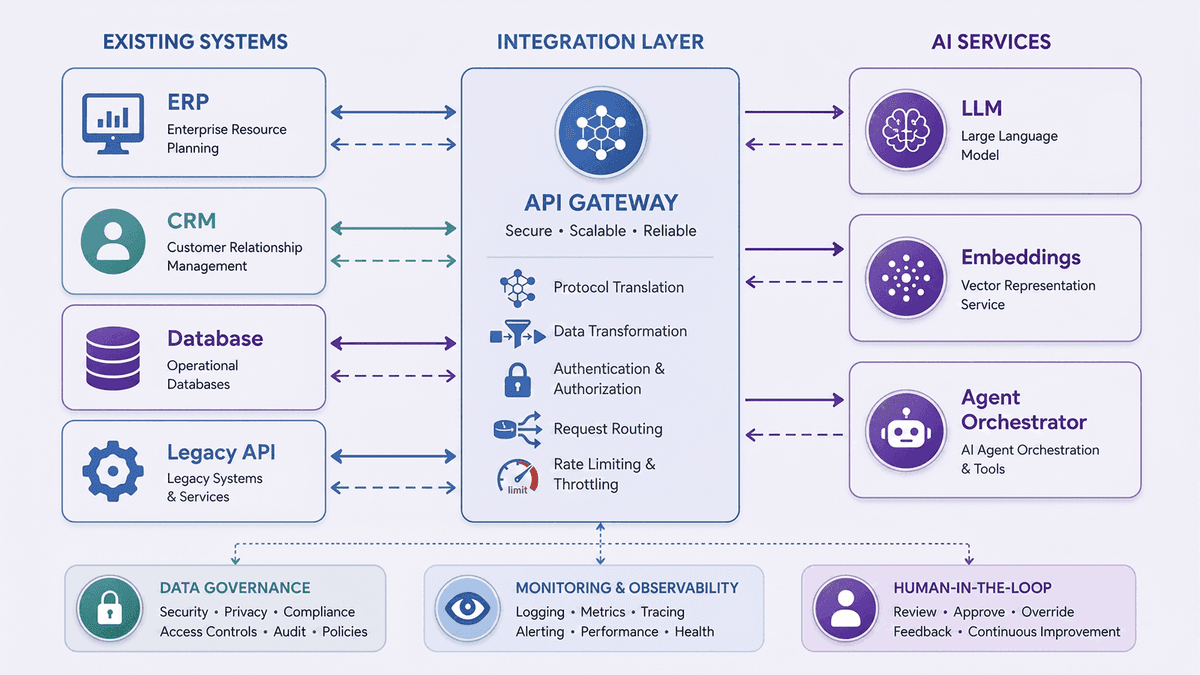
The teams who get this right treat AI as an additional service in a service-oriented architecture, not as a replacement for one. They keep the existing system stable, expose a thin API contract, and let the AI service evolve behind that contract. The legacy app does not need to know that an LLM is now answering the routing question. It just calls the same endpoint it always called.
Step 1: Audit Your Stack Before You Architect Anything
The first 80% of integration risk is removed before any code is written. Gartner forecasts that through 2026, 60% of AI projects unsupported by AI-ready data will be abandoned, and the abandonment rate is projected to climb as agentic deployments scale through 2027 (Gartner). An honest audit catches this before you spend the budget.
Run a three-part inventory across the systems you plan to touch:
- Data inventory. Map every database, file store, message queue, and external API that will feed or consume AI. Record schema, freshness, ownership, and quality. Flag PII, PHI, and any data covered by GDPR, HIPAA, or the EU AI Act.
- API inventory. Document every endpoint the AI service will call or be called by. Note authentication, rate limits, latency budgets, and error contracts. If an endpoint has no documented SLA, give it one before integration.
- Workflow inventory. Walk the actual human and machine workflow end to end. Where does a human currently decide? Where does the system auto-execute? Where will the AI sit on that spectrum?
A surprising number of integrations fail at this step because the team finds out, three sprints in, that the source-of-truth database has 11% duplicate records or that the API the AI needs returns inconsistent date formats. Fix that first. With AI infrastructure spending projected to surpass $223 billion by 2028 (IDC), most of that money will flow to enterprises that fixed the data layer before they bought the GPUs.
For teams running on Flutter, React, or Node.js stacks, our writeup on AI agent development for production builds covers the audit checklist we use on day one of every engagement.
Step 2: Choose an Integration Pattern That Does Not Touch the Core
The architectural decision that determines whether your AI integration is safe or risky is whether the AI lives inside your existing code or beside it. With one-third of agentic AI implementations expected to combine agents with different skills to manage complex tasks by 2027 (Gartner), the integration pattern you pick today decides whether you can plug in those multi-agent systems tomorrow without a rewrite.
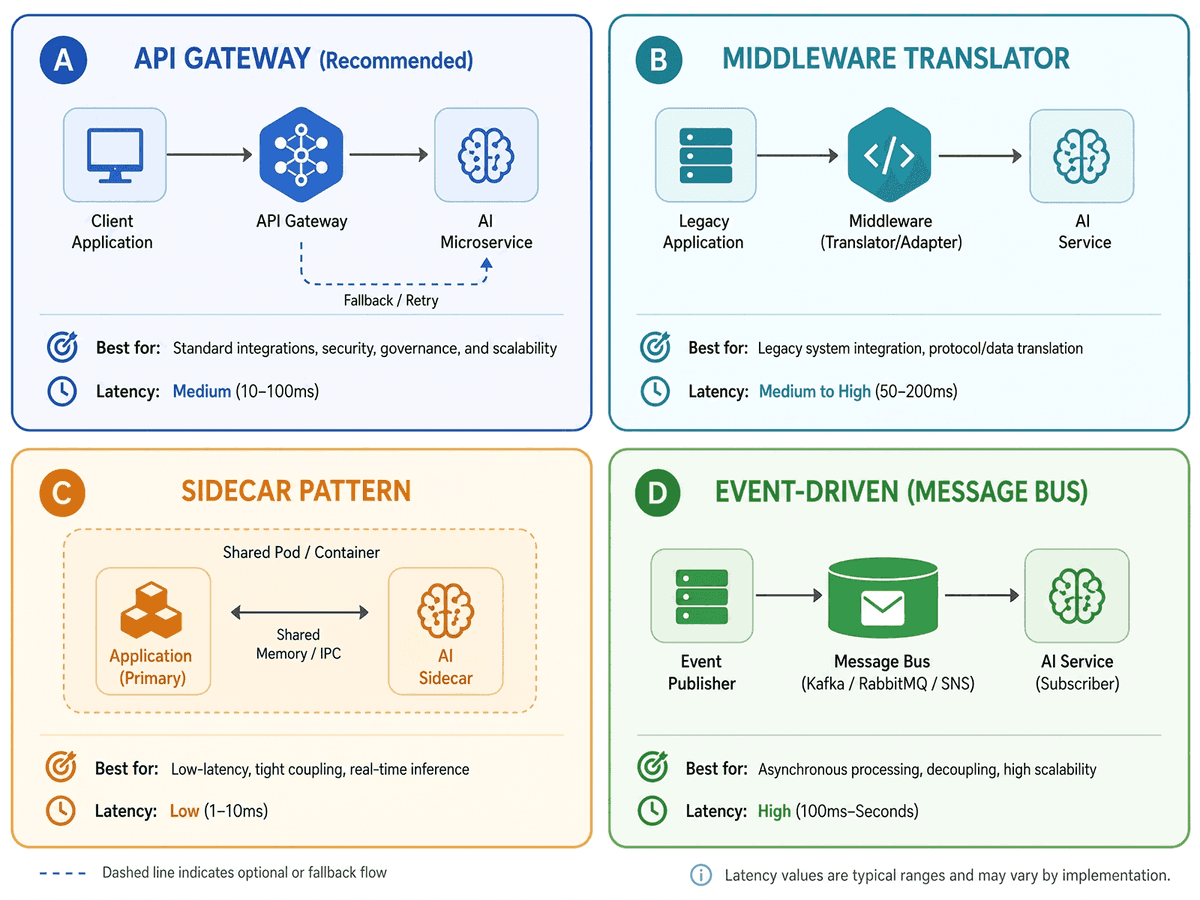
There are four integration patterns that work. Pick one before you pick a model.
Pattern A: API Gateway in Front of an AI Service
The AI runs as an independent microservice. Your existing systems call it through an API gateway that handles authentication, rate limits, retries, and circuit breakers. If the AI service goes down, the gateway returns a fallback or routes to a deterministic path. This is the safest pattern for customer-facing AI.
Pattern B: Middleware Between Legacy and AI
An integration layer (often built on n8n, Apache Camel, or a custom Node.js service) translates between the legacy system's data formats and the AI service's expected input. Useful when the legacy system cannot easily be modified.
Pattern C: Sidecar AI on the Same Host
An AI process runs alongside the application on the same server, sharing local data over a unix socket or shared memory. Lowest latency, highest coupling. Use only when the application is already containerized.
Pattern D: Event-Driven AI on a Message Bus
The AI subscribes to a Kafka, RabbitMQ, or AWS SNS topic, processes events asynchronously, and publishes results back. Suited for batch scoring, document processing, and any workflow where sub-second response is not required.
Citation Capsule: With enterprise server revenue projected to roughly double to $110 billion by 2030 on AI workloads (Goldman Sachs Research), the integration architecture decided in 2026 will determine which enterprises can scale their AI footprint and which will be replatforming for the next half-decade.
On a recent fintech build, we replaced a planned in-code LLM call with an API gateway pattern after the team realized a single model timeout would block the entire loan-application flow. The rebuild took four extra days. The team has not had a single AI-related outage in the seven months since. The pattern paid for itself in the first week.
Step 3: Fix Your Data Layer Before You Fine-Tune a Model
Models do not fix data. Data fixes models. Gartner's forward outlook shows the primary driver of AI project abandonment through 2026 will be the lack of AI-ready data, and as agentic deployments scale through 2028, the data-readiness gate will determine which 33% of enterprise applications successfully integrate agentic AI (Gartner, April 2026).
Before any AI service goes to production, the data layer needs four things:
- Single source of truth. Every entity (customer, transaction, document) must have one authoritative record. Duplicates poison embeddings and confuse retrieval.
- Schema discipline. Field names, data types, and units must be consistent. An LLM cannot reliably infer that
usr_dob,birthDate, anddob_tsmean the same thing across three systems. - Freshness contracts. Each data feed needs a documented update frequency. Stale data is the silent killer of recommendation, fraud, and underwriting models.
- Ownership. Every dataset needs a named owner who decides on schema changes, retention, and access. Without ownership, governance dies.
This is also where you build the retrieval layer if you are using a RAG (retrieval-augmented generation) pattern. By 2030, IDC forecasts that AI will drive 50% of new economic value created by digital businesses in the Asia-Pacific region alone (IDC FutureScape 2026). The enterprises in that 50% will be the ones whose data layer was ready for retrieval at scale.
Our finding: On AI integrations we have shipped at Empiric, the median time spent on data cleanup is roughly 40% of the project. Teams who skip this step ship demos, not products.
Step 4: Pick a Narrow Pilot With a Measurable KPI
The most common reason AI integrations stall is they were never asked to deliver a specific outcome. With AI agent spending projected to dominate IT budget expansion over the next five years, exceeding 26% of worldwide IT spending and $1.3 trillion by 2029 (IDC), every pilot that ships without a measurable KPI in 2026-2027 will be the first cut when budget pressure arrives in 2028.
What does a good pilot look like?
- "Reduce help-desk tier-1 ticket volume by 40% in 90 days" beats "deploy a support AI."
- "Cut KYC document review time from 22 minutes to 4 minutes per applicant" beats "use AI in compliance."
- "Surface 3 hidden upsell opportunities per sales rep per week" beats "AI for sales."
Pick a workflow where the baseline is measurable, the data is already in one place, and the downside of a wrong answer is low. Customer service intent classification, internal document search, and meeting summarization are good starting points. Cash-disbursement decisions, clinical diagnosis, and legal contract execution are not.
Citation Capsule: Through 2027, generative AI and AI agent adoption will create the first true challenge to mainstream productivity tools in 35 years, prompting a $58 billion market shake-up (Gartner Strategic Predictions). Enterprises with narrow, measurable pilots will be positioned to ride that shake-up. Enterprises chasing general productivity claims will be its first casualties.
For startups validating an AI feature before scaling, our piece on agentic AI for application modernization covers how to scope the first pilot and what to ignore.
Step 5: Build the Human-in-the-Loop Layer Before You Need It
AI in production needs supervision. Not constant supervision, but designed supervision. By 2028, Gartner forecasts that 15% of day-to-day work decisions will be made autonomously through agentic AI, up from a near-zero baseline today (Gartner). The enterprises that hit that threshold safely will be the ones who built their human-in-the-loop layer in 2026, not retrofitted it in 2027.
Three components belong in your human-in-the-loop design from day one:
- Confidence routing. Every AI output carries a confidence score. Anything below a threshold gets routed to a human reviewer with the full context, the AI's suggestion, and a one-click accept or override.
- Feedback capture. Every human override is logged with reason codes. This feedback becomes the dataset for the next fine-tune.
- Audit trail. Every AI decision is logged with the input, the model version, the prompt, the output, and the eventual human action. For regulated industries (banking, healthcare, government), this trail is non-negotiable. By 2027, fragmented AI regulation will cover 50% of the world's economies and drive $5 billion in compliance investments (Gartner Strategic Predictions). The audit trail you build in 2026 is the compliance evidence you will need in 2027.
What happens if you skip this layer? Shadow AI fills the gap. Through 2027, business leaders expect full agentic AI deployment (AWS/IDC), but enterprises without sanctioned, governed AI surfaces will see employees route around IT via personal tools. The forward-looking move is to build the supervised surface before shadow adoption defines the threat model for you.
Step 6: Wrap It All in MLOps and Monitoring
The last step is the one teams remember last and regret first. An AI service in production is not done at the moment it deploys. It is done at the moment it has version control, automated retraining, drift detection, cost monitoring, and rollback procedures. That discipline is called MLOps.
A working MLOps wrapper around an integrated AI service includes:
- Model versioning. Every deployed model has a version ID. Every API call logs which version answered.
- Shadow deployment. New model versions run alongside production for a defined window, scored against the current model, before they take traffic.
- Drift detection. Input distributions and output quality are monitored. When the data the model sees in production drifts from the data it was trained on, the team is alerted.
- Cost monitoring. Per-call cost is logged. Sudden cost spikes trigger investigation. With GenAI infrastructure costs projected to run three to five times initial projections at production scale through 2027 (Pertama Partners forecast), the teams who set up cost telemetry on day one will be the ones still running in 2028.
- Rollback procedure. A one-command path back to the previous model. Tested. In writing. Drilled.
For Empiric clients, this layer often runs on n8n for orchestration, Firebase or PostgreSQL for state, and a thin custom dashboard for monitoring. The exact stack is less important than having one.
Build, Buy, or Hybrid: How to Decide
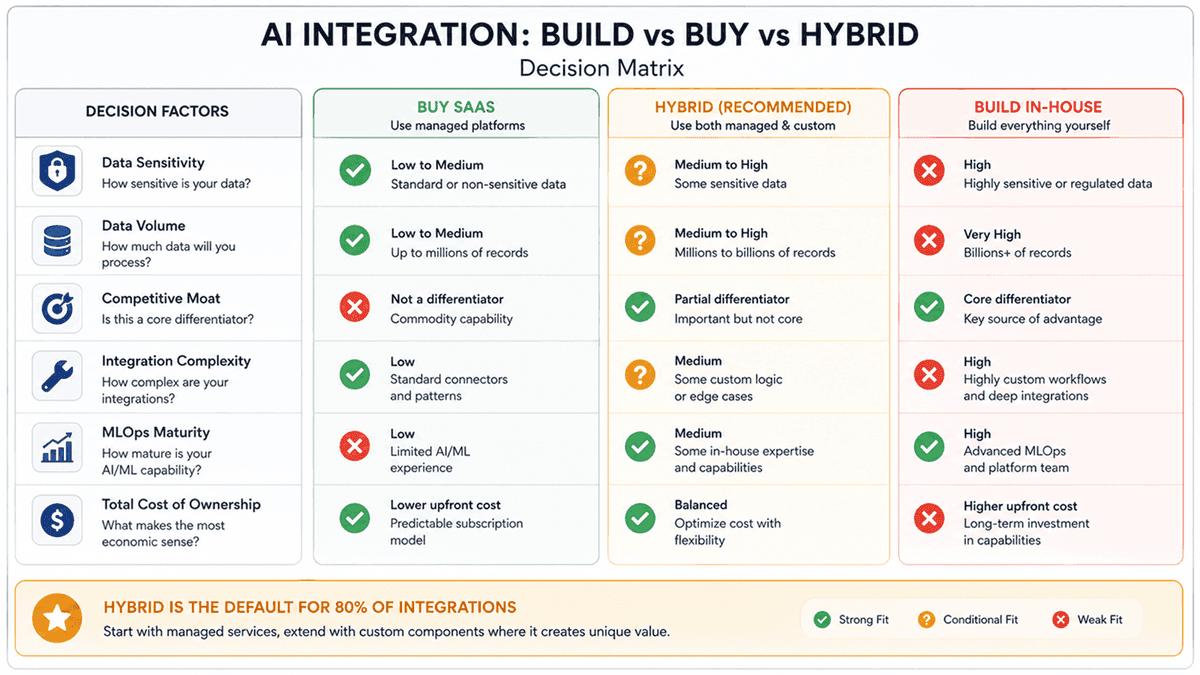
Once the audit, pattern, and KPI are clear, the build-versus-buy decision becomes mechanical. Use this matrix:
| Factor | Buy a SaaS AI | Hybrid (API + custom) | Build in-house |
|---|---|---|---|
| Use case is generic (email summarization, transcription) | Yes | Maybe | No |
| Data is regulated (PHI, financial, government) | Rarely | Yes | Often |
| Workflow is core to your competitive moat | No | Maybe | Yes |
| Volume is high enough that API costs hurt | No | Maybe | Yes |
| You have an MLOps team | Not required | Helpful | Required |
| Time to first value < 90 days | Yes | Yes | No |
Most production integrations end up hybrid: a foundation model accessed by API (OpenAI, Anthropic, or Gemini), wrapped in your own retrieval layer, governed by your own routing logic, and fronted by your own API gateway. This is the architecture that gives you control without the cost of training a frontier model from scratch.
Citation Capsule: Agentic AI systems are projected to add $2.6 to $4.4 trillion annually to global GDP by 2030 (Goldman Sachs Research). The enterprises capturing that GDP will run hybrid architectures: foundation models accessed by API, wrapped in proprietary retrieval and routing layers built between now and 2027.
What Does a Safe Rollout Timeline Look Like?
A realistic timeline for integrating AI into an existing production system, from kickoff to a stable live feature, runs 10 to 16 weeks for a focused pilot. Compressing it below 8 weeks usually means cutting the audit or the MLOps wrapper, which is where the post-launch outages come from.
A typical schedule:
- Weeks 1-2: Audit. Stack inventory, data audit, KPI definition, success criteria.
- Weeks 3-4: Architecture and pattern selection. API contracts written. Fallback paths defined.
- Weeks 5-7: Data cleanup and pipeline build. This often runs longer than planned. Build the buffer in.
- Weeks 8-10: Model integration and shadow deployment. AI runs alongside the existing system, scored against baseline.
- Weeks 11-12: Human-in-the-loop and monitoring. Review surface live, audit trail logging.
- Weeks 13-14: Canary rollout. 5% of traffic, then 25%, then 100%.
- Weeks 15-16: Stabilize and document. Runbooks, on-call procedures, retrain schedule.
If you are working with an external partner, ask them to commit to this timeline before any code is written. At Empiric, every AI integration engagement begins with a 7-day risk-free trial so you can evaluate code quality, architecture decisions, and communication before committing to the full 10-to-16-week scope.
Work With a Team That Has Shipped AI Into Production Systems
Empiric Infotech has integrated AI into mobile apps, fintech platforms, healthcare tools, and SaaS products across 24+ production deployments. Our work includes HIPAA-compliant clinical AI for Daxor Corporation, smile-detection wellness apps, AI-powered therapy products, and agentic workflow automation built on n8n.
Three ways to engage:
- Hire AI developers by the hour from $15/hr for short-cycle work and audits
- Monthly dedicated AI developer from $2,000/mo for ongoing integration projects
- Full AI integration team with project management and QA built in for end-to-end builds
Every engagement starts with a 7-day risk-free trial. Talk to our team about your AI integration project or browse AI agent development services.
Frequently Asked Questions
How long will it take to integrate AI into an existing system in 2026-2027?
A focused pilot integration will take 10 to 16 weeks from kickoff to stable production, including audit, architecture, data cleanup, MLOps, and canary rollout. With 40% of enterprise applications expected to feature task-specific AI agents by end of 2026 (Gartner), the enterprises that compress below 8 weeks will be the same ones rebuilding in 2027.
What will the safest way to add AI without breaking existing systems look like through 2028?
The safest pattern will remain an API gateway in front of an independent AI microservice, with circuit breakers and a deterministic fallback path. As one-third of agentic AI implementations combine multi-skill agents by 2027 (Gartner), this pattern is what will let you plug in those multi-agent systems without rewriting your stack.
Should I build AI in-house or use an API like OpenAI, Anthropic, or Gemini?
Most production integrations through 2028 will be hybrid: a foundation model accessed by API, wrapped in your own retrieval layer and governance. With enterprise AI spending climbing to $632 billion by 2028 (IDC), pure in-house builds will make sense only for regulated data, high-volume use cases, or workflows core to your competitive moat. Otherwise the API plus custom layer will win on time to value.
Why will so many AI integration projects fail through 2027?
Gartner forecasts over 40% of agentic AI projects will be canceled by end of 2027 due to escalating costs, unclear business value, and inadequate risk controls (Gartner). The forward root causes will be the same as today's: unclear KPIs, weak data foundations, missing human-in-the-loop processes, and no MLOps layer. Model choice will rarely make the shortlist.
How will I handle compliance for AI in regulated industries through 2027?
You will need a full audit trail (input, model version, output, human action), defined human-in-the-loop processes, and a documented model retraining and rollback procedure. By 2027, fragmented AI regulation will cover 50% of the world's economies and drive $5 billion in compliance investments (Gartner Strategic Predictions). The EU AI Act high-risk obligations take effect August 2026 with full compliance required by August 2027. Build the audit trail from day one.
Where will the AI integration market be by 2030?
Global AI software spending is projected to reach $467 billion by 2030 at a 25% CAGR (NextMSC), and agentic AI systems are forecast to add $2.6 to $4.4 trillion annually to global GDP by 2030 (Goldman Sachs). IDC expects AI to drive 50% of new economic value from digital businesses in Asia-Pacific by 2030 (IDC FutureScape 2026). The integration patterns built in 2026-2027 will define which enterprises capture that value.
Conclusion: The Integration Decisions of 2026 Will Define the Winners of 2030
The next 36 months will decide which enterprises ride the AI curve and which spend that time rebuilding. By 2028, 33% of enterprise software applications will include agentic AI (Gartner). By 2029, AI agents will exceed $1.3 trillion and 26% of worldwide IT spending (IDC). By 2030, agentic AI will add $2.6 to $4.4 trillion annually to global GDP (Goldman Sachs).
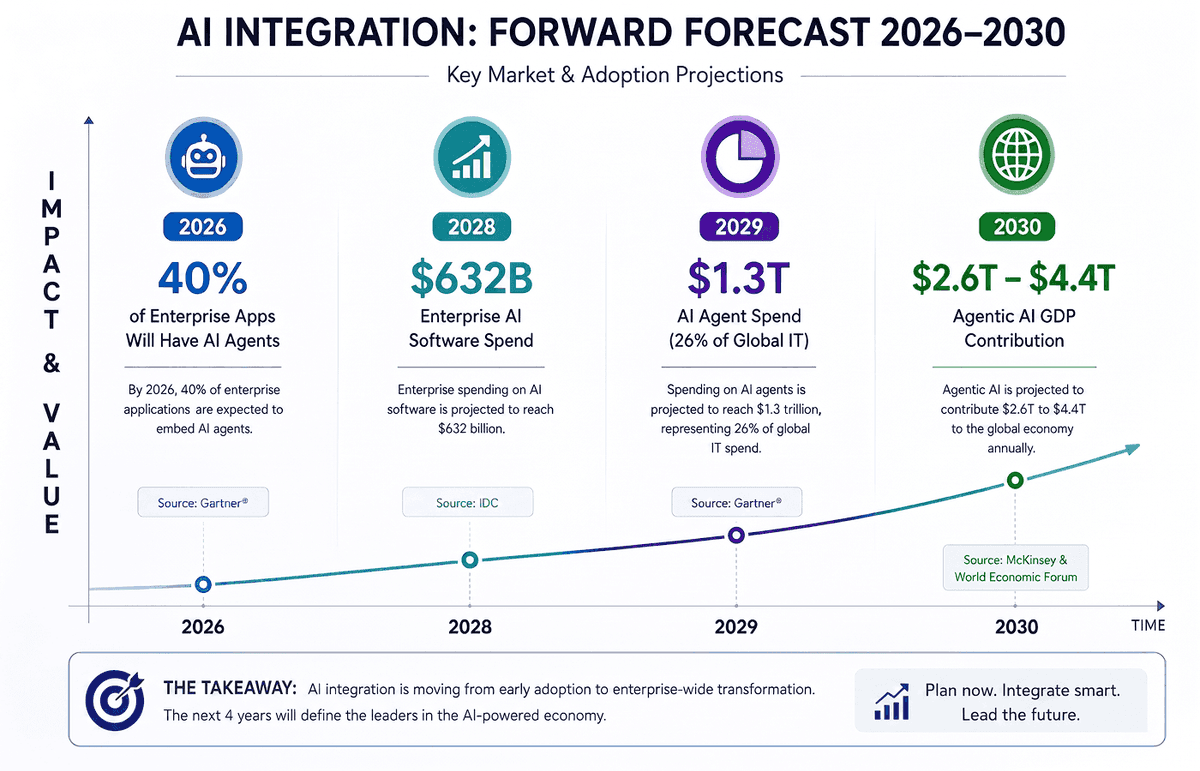
The enterprises that capture that value will share six habits, and all six are integration habits, not model habits. They audit before they architect. They keep AI on its own side of an API contract. They fix data before they fine-tune. They pick narrow pilots with measurable KPIs. They build human-in-the-loop early. And they wrap it all in MLOps from day one.
If you are weighing your first AI integration or restarting one that stalled, the highest-leverage move is the data audit in Step 1. Most teams discover within a week that their data layer needs work, and that single insight reshapes the entire roadmap. From there, the pattern in this guide will get you from pilot to stable production in 10 to 16 weeks, in time to be on the right side of the 2026-2028 adoption curve.
Ready to start? Book a discovery call with Empiric Infotech and we will run the Step 1 audit on your stack within the first week of engagement.