



 Front-end
 Back-end
 Full Stack Developer
 Mobile
 Other


 Company
 Contact Us

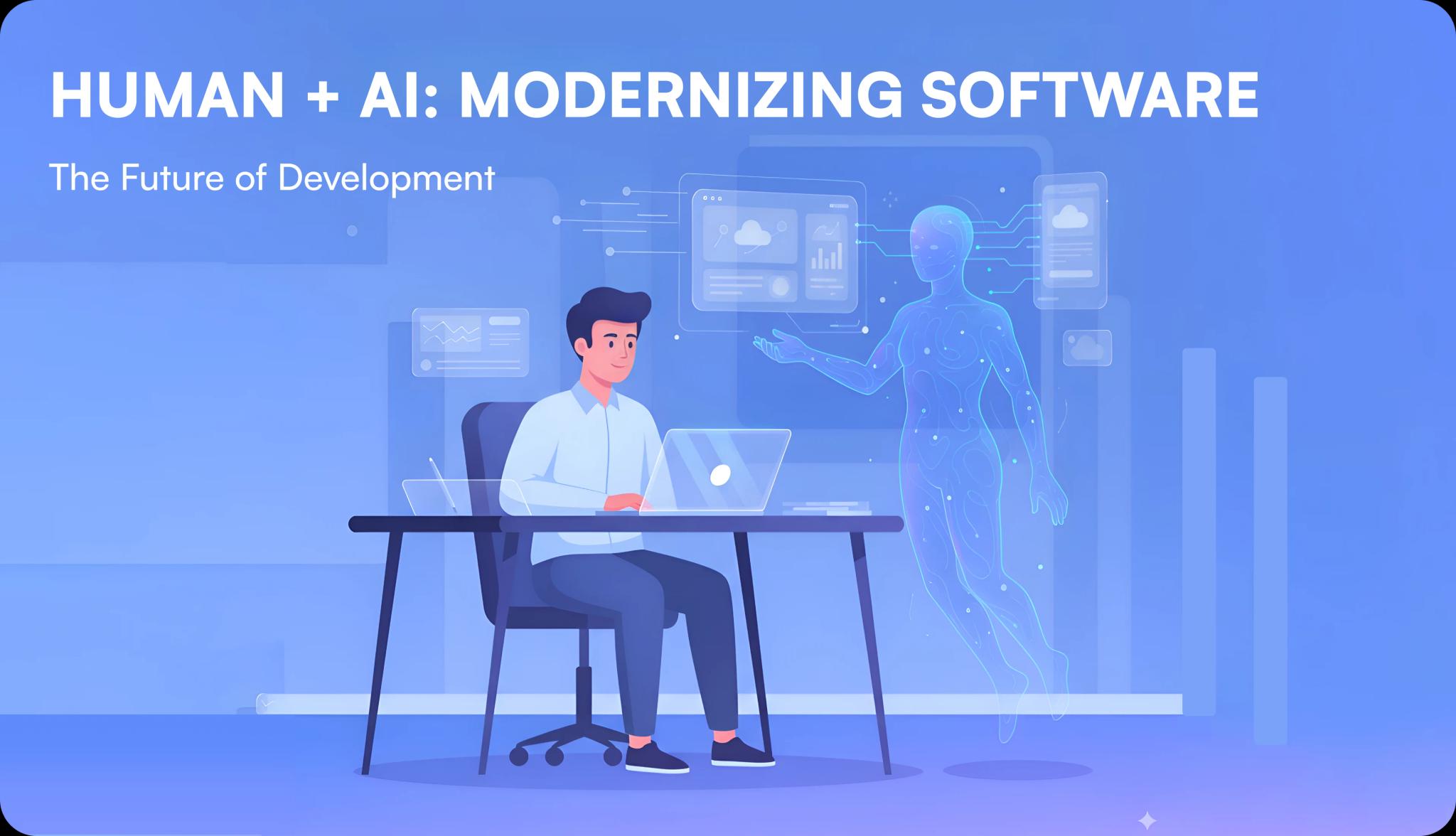
Agentic AI is AI that works toward a goal in several steps: it reads, plans, uses tools and checks its own results, instead of answering a single prompt. In agentic application modernization, that means agents that read legacy code, propose a migration plan, refactor in small steps and run the tests. Used well, they shorten the slow, repetitive parts of a modernization. Used without review, they produce large changes nobody fully understands.
This guide covers what agents do well in a modernization project, where they go wrong, and how to start in 2027 without becoming one of the cancelled projects.
The short answer
- What agents do well: read and summarise large legacy codebases, write missing tests, and make repetitive changes such as framework and library upgrades.
- What still needs people: choosing the target architecture, reviewing every change, and owning the migration of data and integrations.
- The risk is real: Gartner expects more than 40% of agentic AI projects to be cancelled by the end of 2027, mostly because of cost and unclear value.
- Start small: one application, a fixed scope, tests first, and a person who approves every merge.
What is agentic AI?
Traditional AI assistants answer a question or suggest a line of code. Agentic AI takes a goal, breaks it into steps, calls tools such as a code search, a test runner or a cloud API, and adjusts based on what happens. In software work, the agent's tools are usually the repository, the build and the test suite.
Why agentic application modernization matters in 2027
Legacy systems keep costing more to run. The usual pressures are:
- Maintenance cost for infrastructure and code few people still understand.
- Unsupported frameworks that no longer receive security fixes.
- Scaling limits as customer demand grows.
- Compliance: HIPAA and GDPR already apply, and the EU Cyber Resilience Act adds security obligations for software sold in the EU from 11 December 2027.
Modernization has always been slow because so much of it is reading, mapping and repetitive change. That is the part agents speed up.
What agents do in a modernization project
1. Code analysis and documentation
An agent can read a large codebase, map its modules and dependencies, and write the documentation that was never written. This is often the most valuable step, because every later decision depends on knowing what the system actually does.
2. Tests before changes
Legacy code often has few tests. Agents can write characterisation tests that record what the current system does, so later changes can be checked against them. Without these tests, nobody can tell whether a refactor kept the behaviour.
3. Refactoring in small steps
Agents handle repetitive changes well: moving to a newer framework version, replacing a deprecated library, splitting a large module. The safe pattern is many small pull requests, each reviewed by a person, rather than one large rewrite.
4. Migration planning
Agents can inventory workloads, list what each service depends on and draft a migration order. People still choose the target architecture and the cloud provider, because those decisions depend on cost, contracts and the team that will run the system.
5. Continuous testing and deployment
Inside a CI pipeline, agents can run the tests on every change, explain failures and propose fixes. They make releases faster to verify. They do not make them error-free, so a person still approves each release.
Where agentic modernization goes wrong
- Large changes that pass weak tests. If the tests do not cover a behaviour, an agent can change it without anyone noticing.
- Invented APIs and dependencies. Agents sometimes call functions or packages that do not exist, or exist in a different version.
- Data and integrations. Moving data, keeping integrations working and switching traffic over are still the riskiest steps, and they need people who know the business.
- Access. An agent with production credentials can do production damage. Keep agents in development and test environments.
Developers see the same risks. In the Stack Overflow 2025 survey, 87% of respondents were concerned about the accuracy of AI agents and 81% had security or privacy concerns. And Gartner's forecast that more than 40% of agentic AI projects will be cancelled by the end of 2027 points to cost and unclear value as the main reasons (Reuters).
Where it helps most
- Banking and finance: documenting and testing core systems before moving them to modern platforms with minimal downtime.
- Healthcare: modernizing patient data systems while keeping HIPAA controls and audit trails in place.
- Retail and ecommerce: upgrading the platforms that have to scale for seasonal peaks.
How to start with agentic AI for modernization
- Pick one application with a clear owner, a test environment and a known pain, such as an unsupported framework.
- Let the agent document and write tests first, before it changes any behaviour.
- Refactor in small, reviewed pull requests, with a senior developer approving every merge.
- Measure the result: time per change, defects found after release and cost, against how the team worked before.
- Set a stop date. If the pilot does not beat the old way by then, stop or change the scope.
Our AI agent development and AI implementation teams run modernization pilots this way, and our custom software development team takes on the parts that still need people. If a codebase was already changed in a hurry with AI tools, see vibe coding cleanup.
Frequently asked questions
What is agentic AI?
Agentic AI is an AI system that works toward a goal in several steps, using tools and checking its own results, rather than answering one prompt at a time.
How does agentic AI help in application modernization?
It speeds up the reading, testing and repetitive changes that make modernization slow: documenting legacy code, writing tests, upgrading frameworks and drafting migration plans.
Is agentic AI safe for enterprise systems?
Yes, with limits. Keep agents out of production, review every change they make, and test against the current system's behaviour before anything is merged.
Which industries benefit most from agentic modernization?
Banking, healthcare and retail, and any business running important systems on old frameworks that need upgrading without long downtime.
Can a mid-sized company start with agentic AI?
Yes. One application, a fixed scope and a stop date is the right size for a first pilot, whatever the size of the company.
Will agentic AI replace a modernization team?
No. It speeds up the repetitive work, but people still choose the architecture, review the changes and own the migration of data and integrations.