



 Front-end
 Back-end
 Full Stack Developer
 Mobile
 Other
Other


 Company
 Contact Us
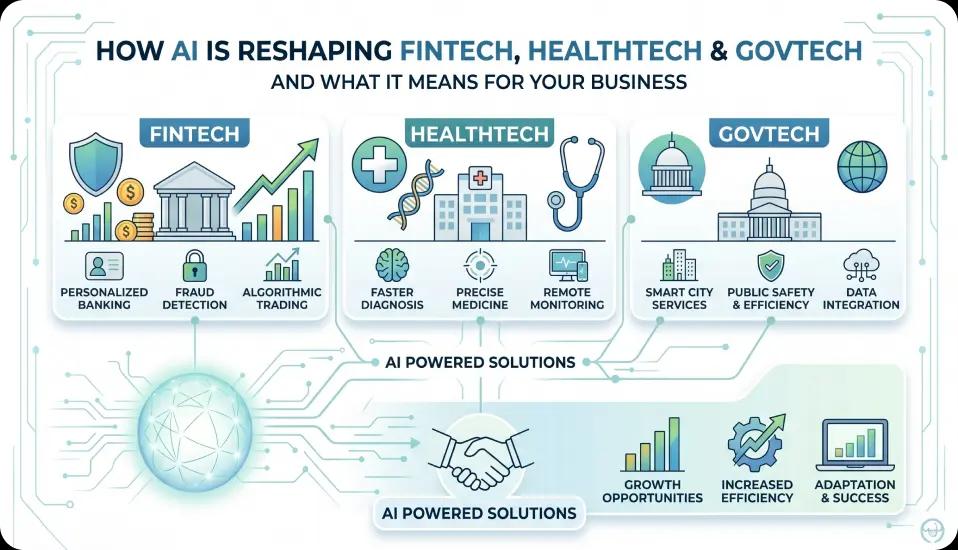
AI in regulated industries is no longer a roadmap item. It is the engine. Loan decisions at JPMorgan, radiology scans across most US hospitals, and citizen-services chatbots answering millions of public queries already run on it. The next 36 months are when the curve goes vertical.
The forward numbers tell the story. The AI in fintech market is projected to hit roughly $66.5 billion by 2030, growing at over 30% CAGR (CTO Magazine). The AI in healthcare market is on track to reach $505.59 billion by 2033 at a 38.9% CAGR (Grand View Research). And global agentic AI spending is forecast to hit $155 billion by 2030, triple most analyst estimates (Bank of America via Fortune).
If your business sits anywhere near banking, healthcare, or the public sector (as a vendor, a partner, or a regulated entity itself) the choices you make in the next 12 to 24 months will decide whether you ride this wave or get flattened by it. This guide breaks down what is happening across all three sectors right now, what the 2027-and-beyond compliance landscape looks like, and how to act on it without burning capital on hype.
For a deeper look at the AI agent layer powering most of these deployments, our piece on agentic AI and application modernization is a useful companion read. You can also explore our full range of AI agent development services for production builds.
Key Takeaways
- The global AI in fintech market is projected to reach ~$66.5 billion by 2030 at 30%+ CAGR, with AI today intercepting 92% of fraud attempts before approval (CTO Magazine, CoinLaw)
- The AI in healthcare market is on track for $505.59 billion by 2033 at a 38.9% CAGR (Grand View Research), with the EU AI Act's high-risk obligations for medical AI taking effect August 2026 and full compliance required by August 2027
- 89% of government leaders see a hybrid AI-plus-human workforce by 2030, and 71% of agencies plan to expand agentic AI use through 2027 (Federal News Network)
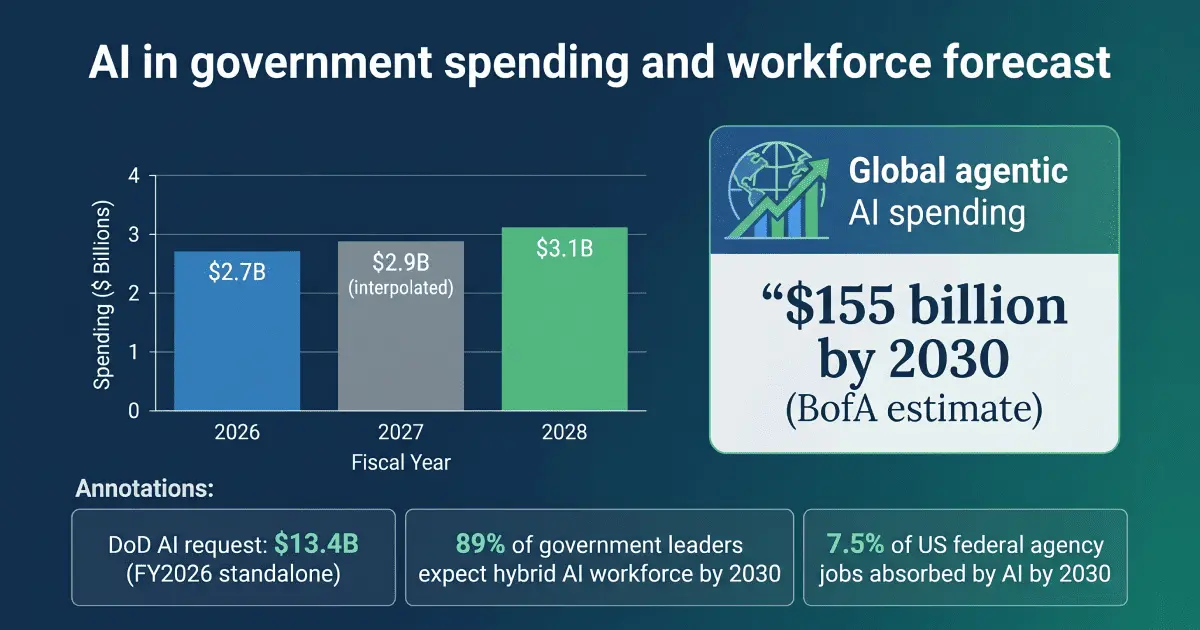
- Federal AI spending will rise from $2.7B in 2026 to $3.1B in 2028, with the DoD alone requesting $13.4B for AI in FY2026
- Agentic AI spending will reach $155 billion globally by 2030 (Fortune, BofA estimate), with enterprise AI ROI averaging 171% today and US firms hitting 192%
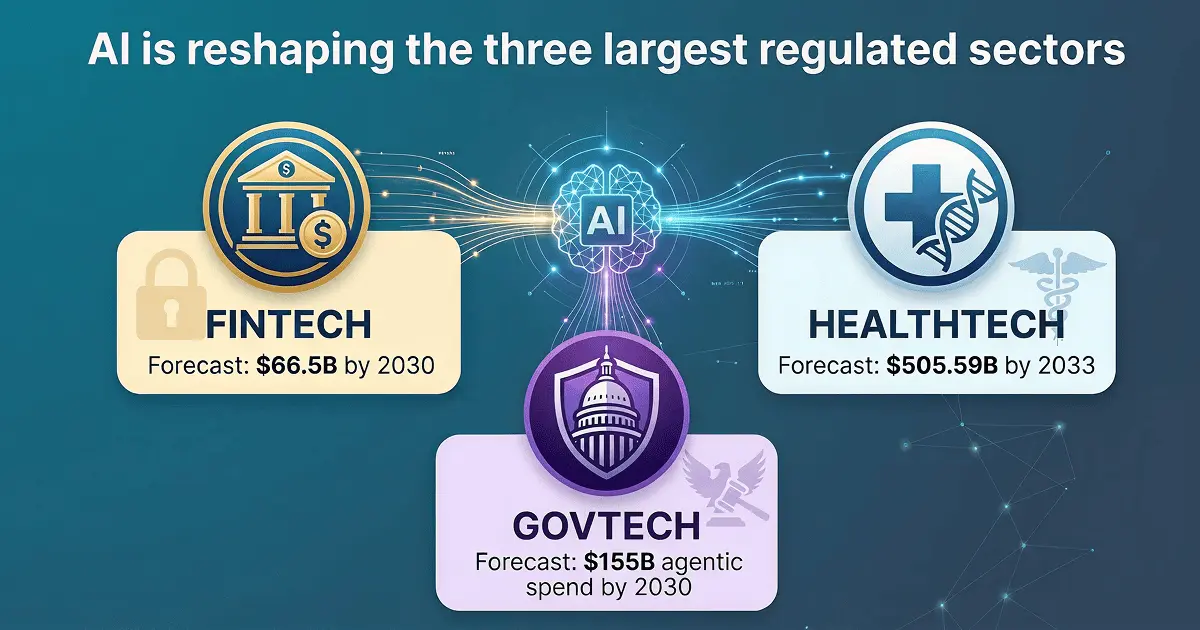
Why FinTech, HealthTech, and GovTech Are Converging on AI
These three sectors look different on the surface. Banks chase margin, hospitals chase outcomes, and agencies chase mission delivery. But they share three structural traits that will make them the largest AI buyers through 2030.
First, all three drown in unstructured data. Loan applications, electronic health records, and citizen service requests are messy, inconsistent, and have always needed a human to read every page. Large language models will close that gap permanently within the next 24 months.
Second, all three operate under strict accountability. A wrong answer costs real money, real lives, or real public trust. That sounds like a barrier, but it accelerates the right kind of AI: traceable, audited, and human-in-the-loop. Vendors who solve that problem are positioned to win the long contracts coming in 2027 and beyond.
Third, the talent gap is widening, not closing. Hospitals will not hire enough radiologists. Banks will not hire enough fraud analysts. Agencies will not hire enough caseworkers. 89% of government leaders already expect a hybrid AI-plus-human workforce by 2030, and AI is forecast to absorb 7.5% of US federal agency jobs by 2030 (Forrester via Federal News Network). The same pattern will play out in private regulated sectors.
Citation Capsule: 71% of government agencies plan to expand agentic AI use in 2026-2027, and federal AI use cases grew 70% year-over-year in the most recent OMB inventory, with 3,611 disclosed AI use cases going into 2026 (FedScoop). The trajectory points to an order-of-magnitude expansion before 2030.
AI in FinTech: From Pilot Projects to Profit Engines
The financial sector is past pilots. AI in fintech has moved from experiment to infrastructure, and the next 24 months will decide which banks operationalize AI for fintech workloads as line-of-business systems and which fall behind. Agents that move money, deny fraud, and approve credit without a human in the loop on routine cases are now the default architecture for new product development across fintech and AI teams alike.
The Forward Numbers
- ~$66.5 billion: projected size of the global AI in fintech market by 2030, growing at over 30% CAGR from current levels (CTO Magazine)
- $53.30 billion by 2030 in another widely cited forecast at 23.82% CAGR (Mordor Intelligence)
- $500 billion: projected annual savings AI will deliver to the global financial industry by 2030 (McKinsey and Accenture analyses, aggregated by CoinLaw)
- 92%: fraudulent transactions AI-driven systems intercept before approval in production today
- 85%: share of financial firms now using AI in some capacity, with 60% using it across multiple business functions
- 78%: banks running AI-powered chatbots; 64% of US banks using AI for anti-money laundering (Electroiq)
What Banks Are Building Right Now
The headline use cases are no longer experimental. They are line-of-business systems with measurable P&L impact, expanding fast through 2027.
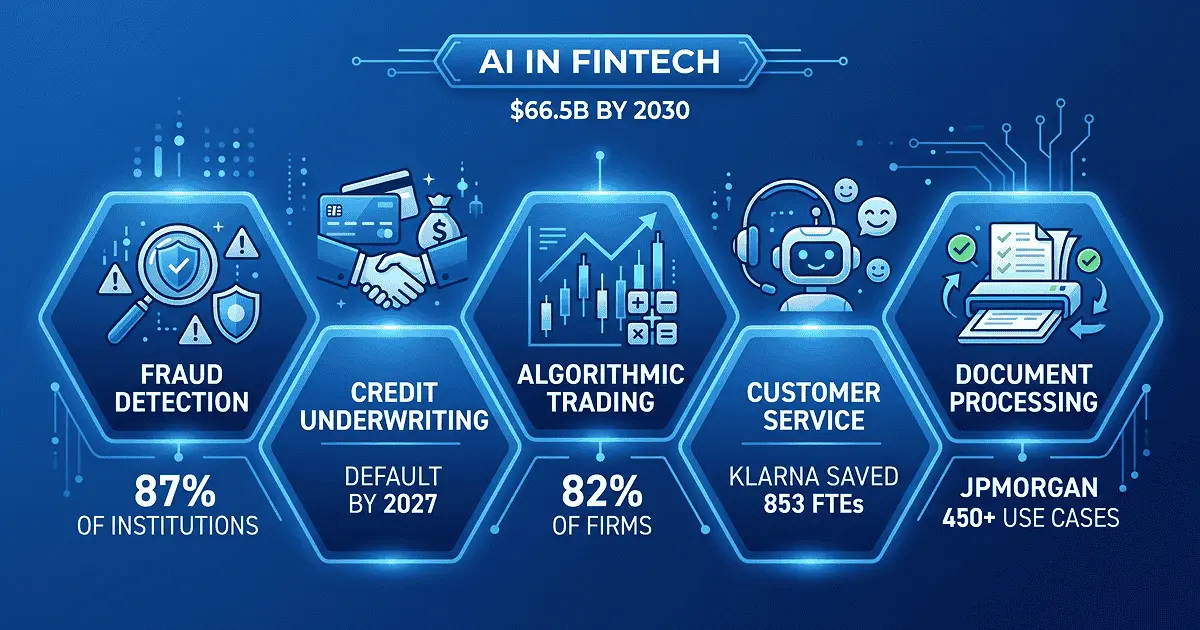
- Fraud detection: Real-time models score every transaction in milliseconds. Roughly 87% of global financial institutions now run AI-driven fraud systems, and 42% of card issuers will save over $5 million in any given two-year window through this work alone.
- Credit underwriting: AI evaluates thin-file borrowers using cash flow, payment history, and behavioral signals, expanding the addressable market without raising default rates. Expect this to become the default underwriting path for sub-$25K consumer credit by 2027.
- Algorithmic trading: 82% of firms run AI-driven trading or execution. The race ahead is about speed-of-inference and data freshness, not whether to deploy.
- Customer service: AI agents resolve 70% or more of routine queries end-to-end. Klarna's AI agent now handles the workload of 853 customer service employees, and that pattern is replicating across consumer fintech (Master of Code).
- Document processing: Loan packages, KYC files, and trade confirmations flow through agentic pipelines. JPMorgan runs 450+ AI use cases in production, with that figure projected to multiply as the bank's agentic platform scales (AI Monk).
What This Means for FinTech Builders
If you are building AI and fintech products in 2026, you are not competing against your incumbent's product team. You are competing against their AI roadmap. Three things separate winners from also-rans:
- Latency matters more than features. Sub-200ms decisions feel magical. Two-second decisions feel broken.
- Explainability is a regulatory requirement, not a UX nicety. Every AI-driven credit or fraud decision needs an audit trail a regulator can read.
- Hybrid agents beat monolithic models. The pattern that wins is a small reasoning model orchestrating specialist tools (fraud scorer, KYC checker, ledger writer), not one giant LLM doing everything.
For teams scaling fintech infrastructure, our deeper guide on AI in fintech 2026 breaks down architecture choices, compliance patterns, and build-vs-buy math in detail.
AI in HealthTech: The FDA Floodgates Are Open
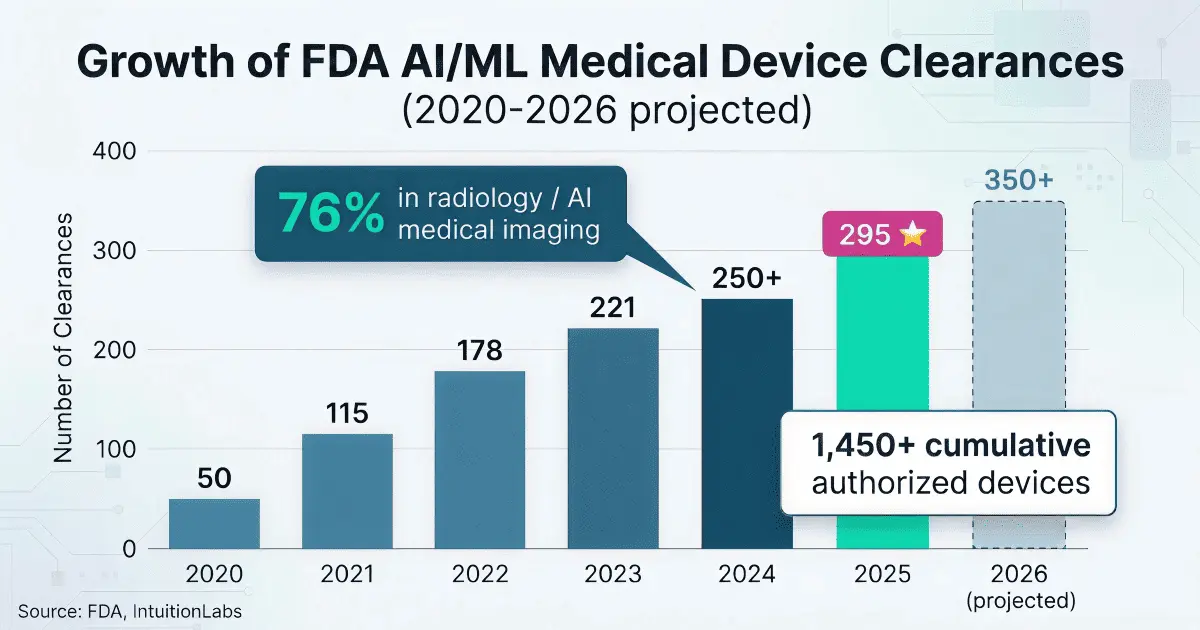
If fintech is in the operationalization phase, AI in healthcare is in the explosion phase. AI medical imaging drives the bulk of the wave, with machine learning in healthcare systems now embedded across radiology, cardiology, and pathology workflows. The FDA approval pipeline accelerated past 295 AI/ML device clearances in a single recent year, with the cumulative authorized total now climbing past 1,450 devices and projected to compound through 2027 as predetermined change-control plans (PCCPs) reshape regulatory submission patterns (IntuitionLabs, Innolitics). The story of AI in medicine through the rest of the decade is no longer "will it work" but "how fast can hospitals operationalize it."
The Forward Numbers
- $505.59 billion: projected size of the global AI in healthcare market by 2033 at a 38.9% CAGR (Grand View Research)
- $222.9 billion: projected size of the US AI healthcare market alone by 2033 at a 36.9% CAGR (Grand View Research, US Report)
- 54%: North America's projected share of the global market through 2033
- 1,450+ and climbing: cumulative FDA-authorized AI-enabled medical devices, with annual clearance volume on a steep upward curve (IntuitionLabs)
- 76%: share of those clearances concentrated in radiology, with AI medical imaging the leading specialty for AI deployment
- 74%: US hospitals using AI-powered AI medical diagnosis tools in radiology departments today
- 42%: reduction in clinical documentation time for clinicians using AI scribes, saving roughly 66 minutes per day (OneReach.ai, citing Microsoft/Nuance DAX research)
- $150 billion: projected annual industry savings from AI in healthcare by 2026 (Accenture estimate), with savings scaling further as adoption deepens through 2030
Where AI Is Actually Plugged In
| Use Case | Real-World Impact | Example |
|---|---|---|
| AI medical imaging | Earlier detection, fewer missed cases | AI flags strokes on CT scans in under 60 seconds |
| Clinical documentation | 42% less time on charting | Ambient scribes generate SOAP notes from patient visits |
| Predictive risk scoring | Reduces hospital readmissions | Sepsis risk alerts in ICUs |
| Drug discovery | Cuts target identification by months | AI-screened molecules reach trials faster |
| Operations and scheduling | Reduces no-shows and OR idle time | Demand-aware appointment optimization |
| Patient-facing agents | Triage, intake, and follow-up automation | Symptom-checkers integrated with EHR |
The Regulatory Wave Coming Through 2027
The compliance picture in healthcare is the most complex of the three sectors. The next 18 months bring a stack of binding rules:
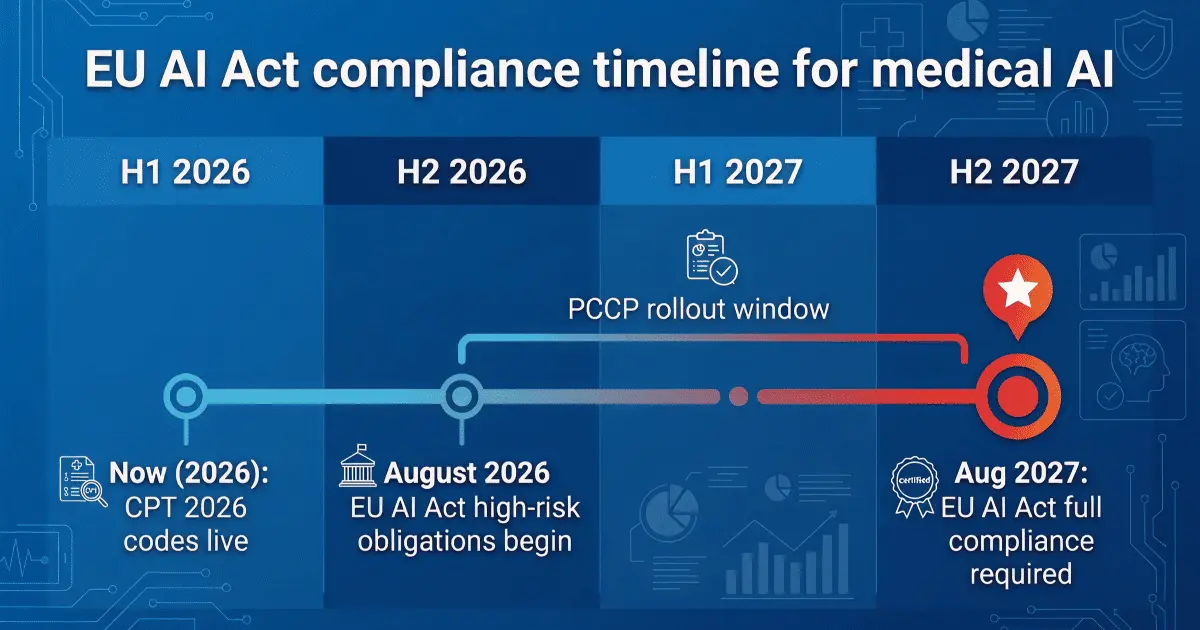
- EU AI Act high-risk obligations for AI-enabled medical devices take effect August 2026, with full compliance required by August 2027 including comprehensive technical documentation, risk management systems, and transparency provisions (Akerman LLP)
- Predetermined Change Control Plans (PCCPs) become standard practice during H2 2026 to H1 2027, alongside hardened cybersecurity requirements (MD+DI)
- CPT 2026 introduced 288 new codes covering digital health and AI-enabled services, with CMS expanding payment policies for digital mental health treatment devices
- California's AI Transparency Act and AB 2013 require disclosure of training data for AI used in clinical decision support
- State-by-state variation means multi-region health systems will need a per-jurisdiction compliance posture by 2027
Citation Capsule: 46% of US healthcare organizations are implementing generative AI, but the majority of clinical AI is never reviewed by a federal regulator, creating significant liability exposure that the EU AI Act's August 2026 deadline is designed to close (Bipartisan Policy Center).
What This Means for HealthTech Builders
The bar for shipping AI in medicine just rose. If your product touches a clinical decision (whether it is AI medical diagnosis, AI medical imaging, or general machine learning in healthcare workflows) you need three things designed in from day one: traceable training data lineage, structured human-in-the-loop checkpoints, and post-market monitoring. Bolted-on compliance after launch is no longer viable.
For teams building patient-facing or clinician-facing tools in the AI in medical field, integrating a generative AI development workflow with explainability and audit trails will save months of remediation later.
AI in Government: The Quiet Revolution Will Get Loud by 2030
GovTech is the surprise story heading into the back half of the decade. The conventional wisdom that government always lags 5 to 10 years behind the private sector has flipped. Searches for "AI gov" and "govt AI" are climbing as procurement teams race to evaluate vendors, and 60% of agency heads now believe they outpace the business community on AI adoption (Government Executive). The spending curve is steepening, and artificial intelligence in government has shifted from pilot programs to procurement priorities.
The Forward Numbers
- $3.1 billion: projected US federal AI spending by 2028, up from $2.7 billion in 2026 (a 15% increase in two years) (Federal News Network)
- $13.4 billion: standalone AI and autonomous systems budget the DoD requested for FY2026
- $155 billion: projected global agentic AI spending by 2030, triple most analyst estimates (Bank of America via Fortune)
- 89%: government leaders who expect a hybrid AI-plus-human workforce by 2030
- 7.5%: forecast share of US federal agency jobs that AI will absorb by 2030 (Forrester)
- 71%: agencies planning to expand agentic AI deployments through 2026-2027
- 3,611: disclosed federal AI use cases entering 2026, up nearly 70% year-over-year (FedScoop)
- ~90%: US federal agencies using or planning AI deployments today (Google Cloud Blog)
- 48%: of agencies cite security and adversarial risk as the biggest blocker to wider rollout, the gap that GovTech vendors will compete to close
Where the Spend Will Land
- Singapore's VICA platform (Virtual Intelligent Chat Assistant), built by GovTech Singapore, powers chatbots across dozens of government agencies using a hybrid NLP plus generative AI architecture, scaling up to handle citizen inquiries on passports, healthcare, and housing (GovTech Singapore)
- USAi, the US federal shared AI platform, lets agencies benchmark top models without upfront cost and will see expanded usage as more agencies onboard through 2027
- State revenue departments are scaling AI fraud detection to absorb growing return volumes through 2027 tax cycles
- City permitting offices will move document-extraction agents from pilots to default workflow by 2027, cutting application turnaround from weeks to days
What This Means for GovTech Builders
Selling AI for government agencies is no longer about education. Procurement officers know what large language models do. The new gating questions are about FedRAMP authorization, FISMA compliance, ATO timelines, and data residency. If you are building AI in government products, your engineering roadmap and your accreditation roadmap are now the same document.
The teams that win government contracts in 2026 and beyond are the ones that ship audit logs, role-based access, and explainability dashboards as product features, not as compliance afterthoughts. Our AI automation services page covers the build patterns we use for regulated workflows.
The Compliance Reality That Will Define 2026 to 2028
Across fintech, healthtech, and govtech, one shift will define the next two years: regulators are moving from aspirational ethics statements to demonstrable controls. They will demand documentation of training data sources, risk assessments, bias testing, incident response plans, and human-in-the-loop processes (Holland & Knight).
Three rules are becoming table stakes for any AI product touching a regulated workflow through 2027:
- Provenance is not optional. You must know where your model's training data came from and prove the data was lawfully obtained. California's AB 2013 already requires this for clinical decision support. The EU AI Act will enforce it across the bloc by August 2027.
- Bias testing is a deliverable. Pre-deployment testing for protected classes, with documentation, will be the expected standard. Post-market monitoring extends that obligation indefinitely.
- Human override must be designed in. Fully autonomous decisions in credit, clinical, or benefits-eligibility contexts will invite the highest regulatory scrutiny through the rest of the decade. The winning pattern is agents that recommend, with humans deciding on edge cases.
If your team treats compliance as something the legal department will sort out post-launch, you are building a product that will not survive 2027. The architecture has to carry the controls.
What This Means for Your Business: A Decision Framework
Whether you are running a fintech startup, a hospital network, a SaaS vendor selling into agencies, or a non-tech business looking at AI for the first time, the practical questions reduce to four.
1. Where in your workflow is AI a 10x improvement, not a 10% one?
Sprinkle AI on top of an existing process and you get marginal gains. Redesign the process around an agent and you get the kind of leverage Klarna, JPMorgan, and Singapore demonstrated. The first project should be the one where automating end-to-end (not just one step) unlocks a step-change.
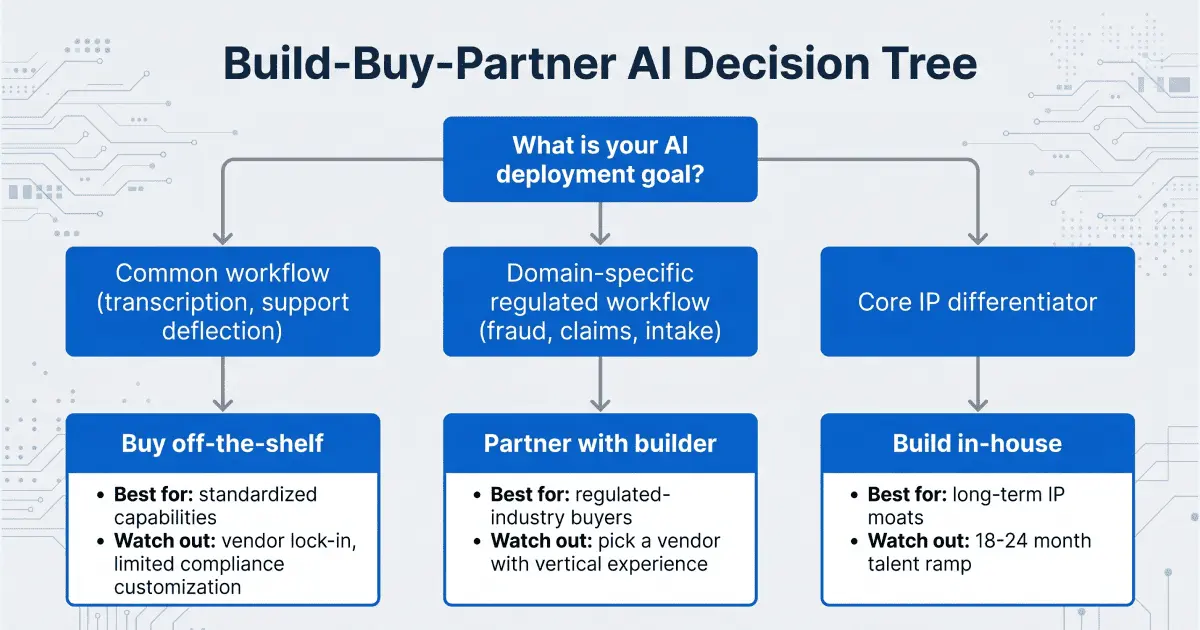
2. Build, buy, or partner?
| Path | Best For | Watch Out For |
|---|---|---|
| Buy off-the-shelf | Common workflows like meeting notes, support deflection | Vendor lock-in, limited compliance customization |
| Partner with a builder | Domain-specific workflows in regulated industries | Need a partner with vertical experience |
| Build in-house | Core IP that differentiates the business | Long timeline, talent scarcity, model maintenance burden |
For most regulated-industry buyers, the winning pattern through 2027 will be a thin off-the-shelf layer for generic capabilities (transcription, search) plus a partner-built agent layer for the workflows that touch revenue, patient care, or citizen services.
3. What is your data and compliance posture today?
If you cannot answer "where did this answer come from?" for any production workflow, you are not ready to deploy AI in a regulated context. Fix the observability layer first. Our team has shipped this for fintech and healthcare clients using audit-ready agent architectures, which we cover in our AI automation services.
4. How fast can you iterate?
The biggest predictor of AI ROI is iteration speed. 5% of enterprises capture nearly all the AI value in their sector (Master of Code). What separates them is not budget. It is the ability to ship, measure, and rebuild monthly. Visual builders, n8n workflows, and modular agent frameworks all reduce the cost of being wrong, which is the only way to find what works.
If you are evaluating tooling, our n8n workflow automation and voice AI agent development practices show how Empiric stitches off-the-shelf models into production-grade automations for regulated clients.
Common Pitfalls in Regulated-Industry AI Projects
Most AI projects in fintech, healthtech, and govtech fail for the same handful of reasons. Avoiding them is half the battle.
- Treating AI as a feature instead of a system. Production AI needs monitoring, retraining, drift detection, and incident response. Plan for the operations cost from day one.
- Skipping the data-quality investment. Garbage in, garbage out is more dangerous in regulated contexts because the garbage is now auditable.
- Underestimating accreditation timelines. FedRAMP, HIPAA, SOC 2, and equivalent frameworks add 4-9 months on average. Start early.
- Picking the wrong model size for the job. A 70B parameter model is overkill for fraud labeling. The cost-per-decision math kills projects that ignore this.
- Ignoring the human side. Every successful deployment we have shipped includes change-management work for the staff who used to do the task. Skip this and adoption stalls.
How Empiric Infotech Helps Companies Ship AI in Regulated Industries
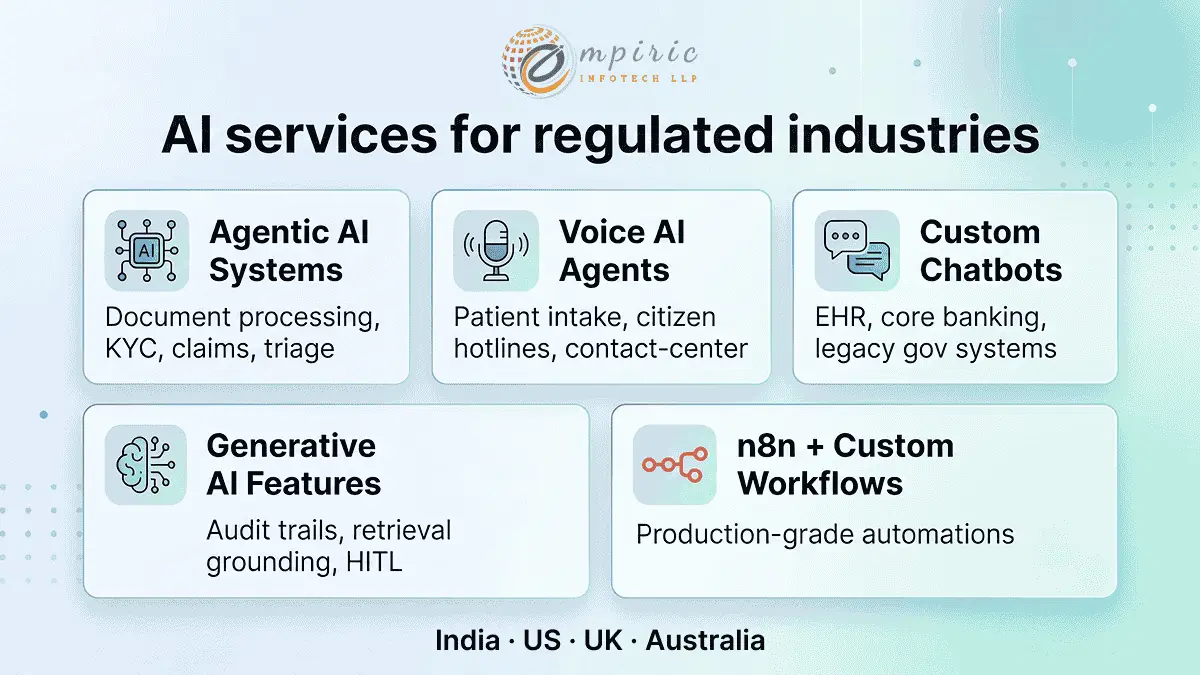
We have shipped AI agents, automations, and full-stack AI products for fintech, healthcare, and public-sector adjacent clients across India, the US, the UK, and Australia. Recent work includes Laughly, an emotional-wellness Flutter app rebuilt with Firebase and a custom admin CMS, featuring Smile to Unlock content access and a Laughing Score Meter that measures laugh intensity in real time, as well as fintech and healthcare integrations from our portfolio of 24+ shipped mobile and web products. Our work spans:
- Agentic AI systems for document processing, KYC, claims adjudication, and triage workflows
- Voice AI agents for patient intake, citizen-services hotlines, and contact-center deflection
- Custom chatbots integrated with EHR, core banking, and legacy government systems
- Generative AI features with audit trails, retrieval grounding, and human-in-the-loop checkpoints
- n8n and custom workflow automations that connect AI models to real production systems
We pair vertical knowledge (regulatory patterns, integration constraints, audit requirements) with deep engineering execution (Flutter, Next.js, Python, Node, Postgres, vector databases). The result is AI that ships fast and survives a regulator's review.
If you are exploring an AI initiative in a regulated industry, book a free consultation and we can map out a realistic 90-day plan for your first or next deployment.
Frequently Asked Questions
Is AI in fintech, healthtech, and govtech really mature, or is it still hype?
It is genuinely mature in narrow workflows and still maturing in others. Fraud detection, radiology triage, and document processing are production-grade today. General-purpose autonomous agents that act without human review are not. The right framing is "where is AI better than a human at this specific task?" not "is AI ready overall?"
Which regulations matter most for AI in healthcare in 2026?
The EU AI Act's high-risk obligations for medical devices (effective August 2026), the FDA's Software as a Medical Device guidance, HIPAA, California's AI Transparency Act and AB 2013, and CPT 2026 coding updates from CMS. Multi-state US health systems also need to track state-specific AI laws, which now diverge meaningfully (Jimerson Firm).
How much will banks realistically save with AI through 2030?
Industry-wide, AI is projected to save the global financial sector $500 billion annually by 2030 (CoinLaw, aggregating McKinsey and Accenture analyses). Individual results vary widely. Klarna's AI agent now handles the workload of 853 customer service employees. JPMorgan runs 450+ AI use cases in production with that figure projected to multiply. Smaller banks typically capture 15-30% cost reduction in target workflows like fraud, KYC, and contact center within 12 to 18 months of deployment.
Are government agencies really ahead of the private sector on AI?
In adoption breadth, often yes. Nearly 90% of US federal agencies report current or planned AI use, 89% of government leaders expect a hybrid AI-plus-human workforce by 2030, and federal AI spending will rise to $3.1 billion by 2028 (Google Cloud Public Sector Research, Federal News Network). The depth of deployment varies by agency. Document processing and constituent-facing chatbots are widespread. Mission-critical decision support is still scaling.
What is the realistic ROI of an AI agent project in 2026 and beyond?
Across enterprises, the average reported ROI is 171%, with US firms hitting 192% (OneReach.ai). Cost savings of 26-31% are common in finance, supply chain, and customer operations, with returns expected to widen as agentic platforms mature through 2027. The catch: only about 5% of enterprises capture most of the value. The differentiator is iteration speed, not budget size.
Should we build AI in-house or hire a development partner?
For core IP that differentiates your business, build in-house. For domain-specific automation in regulated workflows (fraud, claims, patient intake, license processing), partner with a vendor who has shipped that exact pattern before. The hidden cost of in-house builds is the 18-24 month talent ramp, which most projects cannot absorb.
How do I know if my organization is ready to deploy AI?
Three readiness signals: (1) you can describe your workflow end-to-end with metrics on each step, (2) your data is in a queryable, governed location (not stuck in PDFs and inboxes), and (3) you have a named owner who will run the post-deployment monitoring. If any of these are missing, fix them first. AI on top of broken process is just expensive broken process.
The Bottom Line
The window for treating AI as a competitive option in fintech, healthtech, and govtech is closing fast. By 2027, fraud detection, clinical documentation, and citizen-services automation will be baseline expectations, not differentiators. The next 24 months will sort businesses into two groups: those who shipped real AI workflows that survive regulatory scrutiny, and those still drafting their first pilot proposal.
If you are in the second group, the most important step is the smallest one. Pick a single workflow where AI will change the economics by a factor of 5 or more, ship a measurable version of it in 90 days, and use what you learn to plan the next three. Empiric helps regulated-industry clients run exactly that loop.
Ready to map your first or next AI deployment? Talk to our team or book a free 30-minute consultation to walk through the options.