

 Front-end
 Back-end
 Full Stack Developer
 Mobile
 Other


 Company
 Contact Us

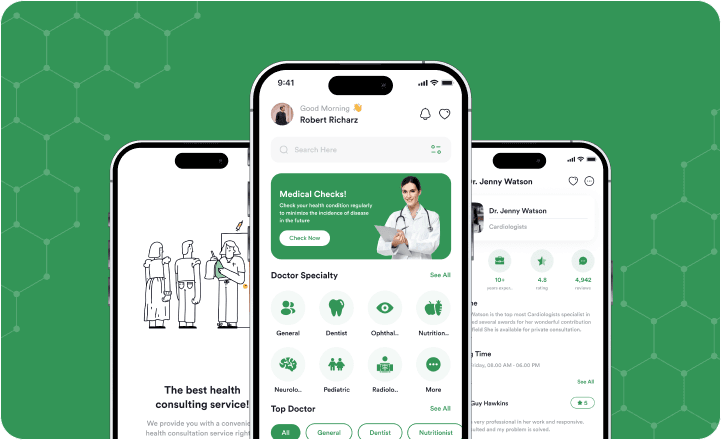
This guide is for founders, product leaders, clinics and hospital IT teams planning a healthcare, medical or digital health app in 2026, for patients, for clinicians or for both. It covers the main types of healthcare apps, the features most of them need, the privacy and medical device rules in the US, the UK, the EU and Australia, the development steps, what drives timeline and cost, and how to choose a development partner.
It reflects the rules as they stood in October 2026, including FDA's updated guidance on wellness products and clinical decision support from January 2026, the EU AI Act's new high-risk dates and NHS England's new DTAC form, and it marks the questions that your own counsel should settle for your product.
The short answer
- Intended use and data come first. What your app claims to do, and on whose behalf it handles health data, decides whether it is a wellness product, a HIPAA-covered tool or a regulated medical device, and your counsel makes that call for your product.
- Most healthcare apps share one core: secure sign-in, a patient profile with consent, scheduling, video or secure messaging, records and reminders, integration with electronic health records (EHRs) through HL7 FHIR, payments and an audit trail.
- Each region has its own rulebook: HIPAA and the FTC's Health Breach Notification Rule in the US, GDPR, the MDR and the AI Act in the EU, UK GDPR with NHS England's DTAC and DSPT in the UK, and the Privacy Act with TGA rules in Australia, and your counsel confirms which of them reach your app.
- Cost follows people and months. Team size, integrations, regulatory class and security testing move the total more than the number of screens. Sourced in-house and outsourcing benchmarks are in the cost section below.
- Choose a partner you can check: live healthcare case studies, your code in your own repository, a trial period before a long commitment, and a business associate agreement (BAA) or data processing agreement (DPA) signed on terms your counsel approves.
What is healthcare app development?
Healthcare app development, also called healthcare application development, is the design, build and ongoing running of software for health and care: patient apps, clinician tools, telehealth platforms, remote monitoring, hospital and clinic operations software, and the web portals behind them. Most products have at least two front ends, one for patients and one for the care team, plus an admin panel and an API that connects to the systems a clinic already runs. Healthcare mobile app development gets most of the attention, but plan the web side with the same care, because the clinician dashboard, the admin panel and the patient portal are part of the product too.
Healthcare app vs medical app
"Healthcare app" is the broad term for any software that supports health or care, from booking a visit to paying for it. "Medical app" usually means an app with a clinical purpose, so medical app development starts with one extra question, whether the app is also a medical device in law, which your counsel answers.
- In the US, FDA describes mobile medical apps as apps whose software meets the legal definition of a device and that are an accessory to a regulated medical device or turn a phone into one, and your counsel decides whether your app fits that definition.
- In the EU, the Medical Device Regulation (MDR) counts software as a medical device when the manufacturer intends it for purposes such as diagnosis, prevention, monitoring, prediction, prognosis, treatment or alleviation of disease, and your counsel makes that call for your product.
- Software intended only for maintaining or encouraging a healthy lifestyle, and unrelated to diagnosing, curing, mitigating, preventing or treating a disease or condition, sits outside FDA's device definition, and your counsel confirms that your claims stay on that side of the line.
The practical difference is the work around the code. A medical device app adds a route to market, clinical evaluation and post-market vigilance, and your counsel scopes each of them for your product.
The market in 2026
Grand View Research values the global mHealth apps market at USD 37.5 billion in 2024 and projects USD 49.9 billion in 2026 and USD 86.4 billion by 2030, a compound annual growth rate of 14.8% from 2025 to 2030. Medical apps, as opposed to fitness apps, took 73.0% of that revenue in 2024, and North America took 37.7% (Grand View Research).
Patients are moving to apps as well. In 2024, 65% of US individuals were offered and accessed their online medical records or patient portal, and 57% of those who accessed a portal used an app to do it, up from 38% in 2020 (ASTP/ONC data brief no. 77). The same brief found that 59% of people had more than one online record or portal, while only 7% used an app that brings them together in one place.

Types of healthcare and medical apps
Most healthcare apps fall into one of the groups below, and many products combine two or three, for example telehealth with e-prescribing and payments.
| App type | Main users | Typical features | First regulatory question |
|---|---|---|---|
| Telemedicine and virtual care | Patients, doctors, therapists | Video visits, secure chat, intake forms, e-prescribing, payments | Is it run for a provider or a health plan? |
| Patient portal and engagement | Patients, caregivers | Records, test results, scheduling, messages, bill pay | Whose data is it, and where does it come from? |
| Remote patient monitoring | Patients, care teams | Device and wearable data, thresholds, alerts, care team dashboard | Does it monitor a disease or a vital sign? |
| Chronic condition management | Patients, nurses, coaches | Care plans, logs, reminders, coaching, reports | Does it give specific treatment suggestions? |
| Mental health and therapy | Clients, therapists, counselors | Guided programs, journaling, session tools, clinical notes | Does it treat a diagnosed condition? |
| Clinical and provider tools | Doctors, nurses, practice staff | Documentation, AI note drafting, decision support, EHR companion views | Is it decision support or a device? |
| Hospital and clinic operations | Administrators, staff | Scheduling, bed and staff management, inventory, intake | Which systems and data does it touch? |
| Medication and pharmacy | Patients, pharmacists | Reminders, refills, adherence tracking, e-prescriptions | Does it calculate doses? |
| Fitness, nutrition and wellness | Consumers | Activity, sleep, meals, goals, coaching | Does it stay a general wellness product? |
| Software as a medical device (SaMD) | Clinicians, patients | Diagnosis, triage, dosing, image analysis | Which class, and which route to market? |
| Payer and insurance | Members, plan staff | Coverage, claims, digital ID cards, member wellness | Is it built for a health plan? |
The last column is a first screen to take to your counsel, who makes the call for your product.
Telemedicine has its own guides: telemedicine app development and how to develop a telemedicine app like Teladoc. For consumer fitness and nutrition products, see fitness app development.
Must-have features for healthcare apps
The features below show up in most healthcare apps. Build the ones your first workflow needs, then add the rest as the product grows.
Features for patients
- Secure sign-up and sign-in. Email or phone verification, multi-factor sign-in for clinicians and admins, and session timeouts on shared devices.
- Profile, consent and preferences. A record of what each person agreed to, when and for which purpose, so consent can be shown and withdrawn.
- Appointment scheduling. Real-time availability, reminders, rescheduling and cancellation, with time zones handled correctly.

- Video visits and secure messaging. In-app video, chat with attachments, and a clear record of what was said and shared.

- Records, results and care plans. Lab results, visit summaries and care plans that the patient can read, download or share.
- Reminders and notifications. Medication, appointment and follow-up reminders that keep sensitive details off the lock screen.
- Payments and insurance. Card payments, receipts and insurance details where the product needs them. On iOS, Apple lets apps that sell real-time person-to-person services, such as medical consultations, collect payment through methods other than in-app purchase.
- Provider search and filters. Search by specialty, language, location, rating and availability.

- Feedback after a visit. Ratings and short reviews that feed quality reporting.

Features for clinicians and administrators
- Clinician dashboard. The day's schedule, patient lists, tasks, messages and alerts on one screen.
- EHR integration. Read and write through the EHR's HL7 FHIR API, and through HL7 v2 feeds where a hospital provides them. In the US, ONC's Cures Act Final Rule called on health IT developers to adopt secure, standards-based APIs so that patients can use a smartphone app of their choice, and your counsel confirms how those rules apply to your integration.
- e-Prescribing and orders. Prescriptions, refills and lab orders sent to the systems that fulfill them.
- Roles, permissions and an audit trail. Each user sees only what their role allows, and every read and change of health data is logged with who, what and when.
- Admin, reporting and exports. Clinic setup, staff accounts, usage reports and data exports.
Platform features
- Wearables and device data. Apple HealthKit on iOS and Health Connect on Android. Google says its Google Fit APIs will be deprecated in 2026 and recommends Health Connect for mobile-first Android apps or the Google Health API for cloud integrations, so new builds start there.
- Accessibility. Build to the Web Content Accessibility Guidelines (WCAG) 2.1 at level AA from the first screen, with readable contrast, large tap targets and screen reader labels. The US accessibility date for organizations funded by HHS is in the compliance section below.
- AI features with a human in the loop. Note drafting, summaries, triage support and patient chat, with a clinician reviewing anything that affects care. In the EU, the AI Act's transparency rules apply from August 2026, so people chatting with an AI system should be told they are talking to a machine, and your counsel confirms how that applies to your product.
- Security in every layer. Encryption in transit and at rest, secrets kept out of code, backups you have restored at least once, and logs that show who opened which record. HHS reports that more than 167 million people were affected by large breaches reported to it in 2023, a record at the time, so security work belongs in every sprint.
- App store rules for health data. Apple's guidelines bar using health data from HealthKit and similar sources for advertising, marketing or data mining, and bar storing personal health information in iCloud. Google Play requires every developer with a published app to complete its Health apps declaration.
Healthcare app compliance by region in 2026
Rules attach to what your app does and whose data it holds, not to the technology you pick, so use this section as a map for the conversation with your counsel, who makes the call for your product.
United States: HIPAA, FTC and FDA
- HIPAA scope. HIPAA applies to health plans, health care clearinghouses and health care providers that transmit health information electronically in transactions covered by HHS standards, plus the business associates that handle protected health information for them, and your counsel confirms whether that includes you.
- Business associates. If you create or offer an app on behalf of a provider or a health plan, you may be a business associate, and the covered entity must have a written business associate agreement with you, while an app you offer only to consumers, and not on behalf of a provider or plan, is not likely to be subject to HIPAA, a line your counsel draws for your product.
- Cloud hosting. HHS treats a cloud provider that stores electronic protected health information (ePHI) for a covered entity or business associate as a business associate even when it holds only encrypted data without the key, so a BAA with your cloud provider is part of the setup, and your counsel reviews its terms.
- Breach notice. Covered entities must notify affected individuals without unreasonable delay and no later than 60 days after discovering a breach of unsecured protected health information, with notice to HHS and, for larger breaches, the media, and your counsel runs that decision when it happens.
- Security Rule update. In December 2024, HHS proposed the first update to the HIPAA Security Rule since 2013; as of October 2026 it is still a proposal and the current rule remains in effect, and your counsel tracks whether and when a final rule lands.
- Apps outside HIPAA. The FTC's Health Breach Notification Rule covers many health apps and connected devices that HIPAA does not, its July 2024 amendments make clear that makers of health apps must comply, and notice to affected people is due within 60 calendar days of discovering a breach, which your counsel applies to your product.
- Medical device software. FDA focuses its oversight on device software functions whose failure could put patients at risk, and it uses enforcement discretion for low-risk functions such as helping patients self-manage a condition without specific treatment suggestions or automating simple tasks for providers, so your counsel decides where your features fall.
- 2026 guidance updates. FDA issued updated final guidance on general wellness products and on clinical decision support software in January 2026, while its guidance on AI-enabled device software functions is still a January 2025 draft, and your counsel reads each one against your claims.
- Ask early. FDA encourages software developers to email the agency as early as possible about their software, its level of risk and whether a premarket application is required, and your counsel decides when to make that contact.
- Substance use records. Anyone subject to 42 CFR Part 2, the rule on the confidentiality of substance use disorder patient records, had to comply with the updated rule by February 16, 2026, and your counsel confirms whether your app touches those records.
- Accessibility. HHS's Section 504 rule requires recipients of HHS financial assistance with 15 or more employees to make their web content and mobile apps meet WCAG 2.1 Level A and AA from May 11, 2027 (May 10, 2028 for recipients with fewer than 15 employees), and your counsel confirms whether it reaches your app or your client's.
- A free first check. The FTC's Mobile Health Apps Interactive Tool, which the FTC updated together with HHS's Office for Civil Rights, ONC and FDA, asks about your app's function and data and points to the federal laws that might apply, and your counsel makes the final call.
European Union: GDPR, MDR, AI Act and EHDS
- Health data under GDPR. Data concerning health is a special category under Article 9, and processing it is prohibited unless an exception applies, such as explicit consent or the provision of health care on the basis of EU or member state law or a contract with a health professional, so your counsel chooses the condition you rely on.
- Impact assessments. GDPR Article 35 requires a data protection impact assessment before processing special categories of data on a large scale, and your counsel decides whether your processing reaches that threshold.
- Medical Device Regulation. Under the MDR's Rule 11, software that provides information used to take diagnostic or therapeutic decisions is class IIa, or class IIb or III when those decisions could lead to serious deterioration, surgery, irreversible harm or death, and your regulatory counsel confirms the class.
- Qualification guidance. The Medical Device Coordination Group's MDCG 2019-11, revised in June 2025, explains how to qualify and classify software under the MDR and the In Vitro Diagnostic Medical Devices Regulation (IVDR), and your counsel applies it to your product.
- AI Act. An AI system that is a medical device, or a safety component of one, and needs a third-party conformity assessment counts as high-risk; after the 2026 AI Omnibus, those rules apply from 2 August 2028, and the rules for Annex III high-risk uses from 2 December 2027, and your counsel maps your AI features to them.
- European Health Data Space. The EHDS Regulation entered into force on 26 March 2025, key parts start applying in March 2029, and it requires manufacturers of EHR systems to certify that they meet its security and interoperability criteria, which your counsel tracks for your product.
- Germany's DiGA route. Germany runs a fast-track process under Section 139e SGB V for listing digital health applications in the directory of reimbursable DiGA kept by BfArM, its Federal Institute for Drugs and Medical Devices, and your regulatory counsel judges whether your product fits it.
- App stores. Google Play requires apps regulated under the EU MDR or IVDR and offered in the EEA and Northern Ireland to publish extra medical device information to be allowed on the Play Store, and your counsel confirms what applies to your listing.
United Kingdom: UK GDPR, DTAC, DSPT and MHRA
- UK GDPR. Health data is special category data, so you need both an Article 6 lawful basis and a separate Article 9 condition, plus a data protection impact assessment if you process it on a large scale, and your counsel picks the basis and the condition.
- Data (Use and Access) Act 2025. The Act received Royal Assent on 19 June 2025, the Information Commissioner's Office (ICO) says all of its provisions affecting data protection law are now in force and is reviewing its guidance as a result, and your counsel checks what changed for your app.
- DTAC. NHS England's Digital Technology Assessment Criteria are the assessment framework that care commissioners and providers use to assure digital health technology for the NHS and adult social care, across clinical safety, data protection, technical security, interoperability, and usability and accessibility; a new form with 25% fewer questions arrived in February 2026, the previous form should not be used from 6 April 2026, and your counsel signs off your answers.
- More than DTAC. DTAC sits alongside other approvals, so a product may still need medical device certification or registration with the ICO, and your counsel lists what applies to you.
- DSPT. Every organization with access to NHS patient data and systems must use the Data Security and Protection Toolkit, a self-assessment against the National Data Guardian's 10 data security standards, and your counsel confirms whether your access triggers it.
- Clinical safety standards. DCB0129 helps manufacturers of health IT software evidence the clinical safety of their products, and DCB0160 covers deployment and use. NHS England opened a consultation on revising both in June 2026, health and care bodies must still have regard to the current versions, and your counsel and clinical safety officer decide how they apply to your build.
- MHRA. Many software products are regulated as medical devices in the UK, and every device must be registered with the Medicines and Healthcare products Regulatory Agency (MHRA) before it is placed on the Great Britain market. CE-marked devices are accepted there until 30 June 2028 or 30 June 2030, depending on the type of device and the EU legislation it meets, and the MHRA consulted in 2026 on recognizing EU MDR and IVDR devices indefinitely, so your counsel confirms your route.
Australia: Privacy Act, NDB scheme and TGA
- Privacy Act coverage. The Privacy Act covers private sector health service providers even when their annual turnover is AUD 3 million or less, and the examples from the Office of the Australian Information Commissioner (OAIC) include health services provided over the internet and telehealth, so your counsel confirms whether your app counts as one.
- Sensitive information. Health information is sensitive information under the Act and you generally need consent to collect it, and your counsel decides how consent works in your flows.
- Data breaches. Under the Notifiable Data Breaches scheme, covered organizations must notify affected individuals and the OAIC when a data breach is likely to result in serious harm, and your counsel makes that assessment.
- Automated decisions. From 10 December 2026, privacy policies must explain where a computer program makes or informs decisions that significantly affect people's rights or interests, and your counsel decides whether your AI features meet that test.
- TGA. For the Therapeutic Goods Administration, software, including mobile apps, is a medical device if it fits the definition in section 41BD of the Therapeutic Goods Act 1989 and is not excluded, and software that is a medical device must be included in the Australian Register of Therapeutic Goods (ARTG) before supply unless it is excluded or exempt, which your counsel confirms for your product.
- TGA exclusions. Since 25 February 2021, some groups of software have been excluded from TGA regulation, including consumer health software for prevention, management and follow-up, enabling technology for telehealth, and digital mental health tools based on established clinical practice guidelines that are referenced and displayed in the software. A product is excluded only if every one of its functions meets the criteria, and the TGA is reviewing how digital mental health tools are regulated, so your counsel tests your feature list against the rules in force when you launch.
How to develop a healthcare app in 9 steps
These steps apply to healthcare and medical apps alike, and steps 1, 7 and 9 carry extra regulatory work for an app that your counsel classes as a medical device.
1. Write down the intended use and the first users
One page: who uses the app, the problem it solves, what it claims and the outcomes you will measure. Regulators read your claims, since the MDR's device definition turns on what the manufacturer intends, and your counsel reviews the wording before it appears on your website or store listing.
2. Map the data and the rules before design
List every data item, where it comes from, where it is stored, who can see it and how long you keep it. The output is a data flow diagram, the list of rules that apply and the agreements to sign, such as a BAA with your cloud provider or a DPA with your processors, which your counsel confirms.
3. Scope the first release around one workflow
Pick one complete journey, for example booking, video visit and follow-up, and make it work end to end for real users. A narrow first release with full security and privacy controls teaches you more than a wide one with gaps.
4. Design with patients and clinicians
Test clickable prototypes with the people who will use the app before you write production code. Patients may open the app once a week, while clinicians may live in it all day, so design each side for its user, and build accessibility in from the start.
5. Choose the architecture and the stack
Good choices include Flutter for iOS and Android from one codebase, native Swift or Kotlin for apps that lean on device hardware, React or Next.js for web portals and dashboards, Node.js or Python for APIs, PostgreSQL for data and a FHIR layer for EHR exchange. EndoDNA, a clinic platform in our portfolio, runs on React, TypeScript, Supabase and PostgreSQL with Stripe billing. Keep protected health data apart from operational data, encrypt sensitive fields, and write an append-only audit log from day one. If you need mobile engineers, see hire Flutter developers.
6. Build in short sprints, with security in every sprint
Threat-model each feature, have a senior engineer review every pull request, scan dependencies, keep secrets out of the codebase and test with synthetic data rather than real patient records. Ship to a staging environment that mirrors production.
7. Test usability, accessibility, clinical safety and security
Run usability sessions with real users, an accessibility audit and a penetration test before launch. For NHS buyers, clinical safety evidence under DCB0129 is part of the package, and for software that is a medical device, verification and validation follow your regulatory plan, both of which your counsel and clinical safety lead sign off.
8. Launch on the app stores
Apple says medical apps that could provide inaccurate data or be used to diagnose or treat patients may be reviewed with greater scrutiny, and asks apps that have regulatory clearance to submit a link to that documentation. Apple typically reviews at least 50% of submissions in less than 24 hours and 90% in less than 48 hours. On Google Play, complete the Health apps declaration in Play Console. Keep your store listing claims identical to your intended use, a point your counsel checks before release.
9. Run, monitor and improve
Watch uptime, errors and access logs, and rehearse your incident response before you need it. Plan platform migrations early, such as moving from Google Fit to Health Connect. Device software also carries post-market duties, such as vigilance reporting to the MHRA in the UK, which your counsel maps for your product. Keep the same engineers on the product after launch so the knowledge stays with it.
How long does healthcare app development take?
Scope and the regulatory path set the timeline more than coding speed does. These are the drivers to ask any vendor to estimate one by one:
- Intended use and regulatory class. A wellness or scheduling app needs privacy and security work, while a medical device adds clinical evaluation, documentation and a route to market, which your counsel scopes.
- User types and platforms. Each extra role (patient, clinician, admin, caregiver) and each platform (iOS, Android, web) adds design, build and test work.
- Integrations. EHRs, labs, pharmacies, payments, video and wearables each bring their own sandbox, credentials and test cycles.
- AI features. Evaluation, guardrails and human review take time to get right.
- Data migration. Moving records out of an older system is a project of its own.
- External clocks. Apple typically reviews 90% of submissions in less than 48 hours, and FDA says its decision on a 510(k) is usually made within 90 days, if your counsel concludes that you need one.
Run the regulatory work in parallel with the build, not after it. A first release that covers one workflow reaches real users soonest, and every later feature then builds on proven ground.
How much does it cost to build a healthcare app?
The cost of a healthcare app is mostly people multiplied by months, plus compliance, integration and running costs.
What drives the cost
- Regulatory class. Device software needs more documentation, testing and evidence than a wellness app.
- Platforms and user types. A patient app on iOS and Android plus a clinician web dashboard is three surfaces to design and test.
- Integrations. EHR, lab, pharmacy, payment, video and wearable integrations.
- AI features. Model usage, evaluation and human review.
- Security and privacy work. Threat modeling, penetration tests, audit logging and cloud services covered by your BAA.
- Accessibility. Design, testing and an audit against WCAG 2.1 AA.
- Running costs. Cloud hosting, monitoring, video minutes, SMS, store accounts, support and updates for each new iOS and Android release.
What a developer costs per month
| Option | Cost | Basis |
|---|---|---|
| In-house developer, US | $15,298 a month | BLS median wage of $135,980 a year (May 2025) plus 35% employer costs |
| In-house developer, UK and EU | EUR 7,875 a month | EUR 70,000 planning salary plus 35% employer costs |
| In-house developer, Australia | AUD 13,455 a month | ABS median for ICT professionals of AUD 2,300 a week (August 2025) plus 35% employer costs |
| Outsourced agency, Asia | $24 to $31 an hour junior, $31 to $41 senior | Accelerance 2026 rates |
| Outsourced agency, Latin America | $33 to $45 an hour junior, $60 to $75 senior | Accelerance 2026 rates |
| Outsourced agency, Europe | $31 to $39 an hour junior, $64 to $76 senior | Accelerance 2026 rates |
The in-house rows come from our software development cost benchmark, which adds a 35% allowance for payroll taxes, benefits, recruiting, equipment and overhead to public salary data from the US Bureau of Labor Statistics and the Australian Bureau of Statistics; the UK and EU salary is a planning figure, not an official statistic. Agency rates are from Accelerance's 2026 rate survey of software development partners.
To turn rates into a plan, multiply people by months. For example, three developers for six months is 18 developer-months: about $275,000 at the US in-house figure, or about $89,000 to $118,000 at Accelerance's senior rates for Asia, counting 160 hours a month. Then add security testing, integration fees and hosting.
How to choose a healthcare app development partner
- Healthcare work you can open. Case studies that name the product, the client's country and the team size.
- Paperwork before code. An NDA and IP assignment before work starts, and a BAA or DPA signed on terms your counsel approves.
- Your code, your cloud. Work happens in your repository and your cloud account from day one, so there is nothing to hand back later.
- Security habits you can see. Senior code review, multi-factor sign-in on every admin account, least-privilege access, audit logs and tested backups.
- Integration experience. FHIR APIs, HL7 v2 feeds, labs, pharmacies, payments and wearables.
- Clear roles on compliance. The partner builds to your compliance regime and documents what it built, while your counsel and regulatory advisers own the decisions and any certification.
- Working hours that overlap. A daily window for a standup and same-day answers.
- A low-risk start. A trial period or a first milestone you can judge, monthly terms and short notice.
Where Empiric Infotech fits
Empiric Infotech is a custom software development company, founded in 2020, with engineers in Surat, India, and a US office in Bridgeville, Pennsylvania. Its 75+ engineers and designers have delivered 375+ projects for 200+ clients in 25+ countries, and healthcare teams work with a dedicated remote developer or a dedicated team inside their own repository and cloud account.
Its health case studies include EndoDNA, a multi-tenant SaaS for functional medicine clinics built for a US client by a single dedicated developer, and TherapyCue, a clinical assistant that transcribes therapy sessions in real time and generates structured SOAP notes, built for a Canadian client by a single dedicated developer. Both case studies describe the platforms as HIPAA-compliant. Wellness work includes Nutrinova, an AI nutrition tracker for a Swiss client, and My Ayur, a wellness app for a client in Singapore.
Every engagement starts with an NDA and IP assignment, is billed monthly upfront with no annual lock-in, and comes with a 7-day risk-free trial and seven days' notice to stop. See healthcare software development services for how a healthcare engagement runs, or the mobile app development company page for app builds in other sectors.
Healthcare app trends for 2026
- AI that drafts the notes. In the AMA's 2026 physician survey, 72% of physicians said they use at least one AI tool in their practice, up from 38% in 2023, and most current use centers on documentation and summarization. Physicians named data privacy assurances (86%) and validation of safety and efficacy (88%) as the top factors for wider adoption (AMA).
- Apps as the front door to records. App-based access to online medical records in the US rose from 38% in 2020 to 57% in 2024, and few patients have one app that combines their portals.
- Interoperability by default. US patient-access APIs and the EU's European Health Data Space both rely on standard data exchange, so design your data model around HL7 FHIR resources early and let your counsel confirm which exchange rules bind you.
- Wearables on new APIs. Google is deprecating the Google Fit APIs in 2026 and points developers to Health Connect and the Google Health API, while HealthKit remains the route on iOS.
- Clearer lines for wellness and decision support. FDA's January 2026 guidance updates and the EU AI Act's new dates are covered in the compliance section above.
For the wider picture, see future trends in the healthcare industry.
How do healthcare apps make money?
- Clinic or enterprise subscriptions. Per clinic or per seat. EndoDNA, for example, was built to move from one-off lab and genetic fees to recurring per-clinic subscriptions billed through Stripe.
- Consumer subscriptions with a free trial. My Pocket Therapist, an AI therapy app in our portfolio, was delivered with a subscription model and a one-week free trial.
- Pay per consultation. Telehealth visits paid per session, which on iOS can use payment methods other than in-app purchase for real-time person-to-person services.
- Employer, payer and provider contracts. Programs paid for by employers, health plans or provider groups.
- Reimbursement routes. Germany's DiGA directory is one example, and your counsel judges whether a route like it fits your product.
Build revenue on subscriptions and contracts: Apple's guidelines bar using health data for advertising.
Frequently asked questions
How much does it cost to develop a healthcare app?
It depends on team size and duration, plus compliance and integration work. As a reference, one in-house US software developer costs about $15,298 a month once 35% employer costs are added to the BLS median wage of $135,980, and agency rates in Accelerance's 2026 survey run from $24 an hour (junior, Asia) to $76 an hour (senior, Europe). Multiply the monthly figure for your team by the months in your plan, then add security testing, integrations and hosting.
How long does it take to build a healthcare app?
Scope and the regulatory path set it. A first release built around one workflow moves fastest, and each integration, user type and AI feature adds time. External clocks count too: Apple typically reviews 90% of submissions in less than 48 hours, and FDA usually decides a 510(k) within 90 days, if your counsel concludes that you need one.
Does my health app need to be HIPAA compliant?
Only if HIPAA reaches you: it covers health plans, health care clearinghouses and health care providers that send health information electronically in transactions covered by HHS standards, and it can cover you as a business associate when you create or offer the app on their behalf, and your counsel confirms which applies. An app you offer only to consumers, and not on behalf of a provider or plan, is not likely to be subject to HIPAA but can still fall under the FTC's Health Breach Notification Rule, which your counsel checks for your product.
Is my healthcare app a medical device?
It can be when its intended use is medical, such as diagnosing, monitoring or treating a condition, and your counsel makes that call. FDA, the EU MDR, the MHRA and the TGA each have their own definitions and exclusions, so the exact words in your claims matter, and your counsel reviews them before launch.
What is the difference between a healthcare app and a medical app?
A healthcare app is any app that supports health or care, from booking to billing. A medical app has a clinical purpose, and some medical apps are regulated as medical devices, which your counsel determines for your product.
What features should a healthcare app have?
Secure sign-in, a patient profile with consent, scheduling, video or secure messaging, records and results, reminders, payments, EHR integration through HL7 FHIR, role-based access and an audit trail. Add wearables, e-prescribing and AI features when your first workflow needs them.
Which technology stack is best for healthcare apps?
The one your team can secure and maintain for years. Good choices include Flutter for iOS and Android from one codebase, native Swift or Kotlin for hardware-heavy apps, React or Next.js for web portals, Node.js or Python for APIs, PostgreSQL for data and a FHIR layer for EHR exchange, hosted with a cloud provider that signs a BAA or DPA on terms your counsel approves.
Can I add AI features to a healthcare app?
Yes. Documentation and summarization are where physicians use AI most, according to the AMA's 2026 survey, and triage support and patient chat are other options, with a clinician reviewing anything that affects care. AI that diagnoses or recommends treatment can make the software a medical device, and in the EU it can also be high-risk under the AI Act, which your counsel assesses for each feature.
What does a UK healthcare app need before the NHS will use it?
Expect a DTAC assessment from the NHS buyer, the Data Security and Protection Toolkit if you access NHS patient data or systems, clinical safety evidence under DCB0129, and UK GDPR work including a data protection impact assessment, and your counsel confirms the full list for your product.
Can a new team take over an existing healthcare app?
Yes. Start with a review of the code, the infrastructure and the compliance documents, then fix the riskiest gaps before adding features. Laughly, an emotional wellness app for a Swiss client, is one example: Empiric Infotech rebuilt the entire platform under a dedicated developer monthly engagement, and the client extended the engagement for three months.
Plan your healthcare app
Write the intended use, map the data and the rules, and scope one workflow you can ship and measure. When you want a team to build it, Empiric Infotech's healthcare software development services start with a 7-day risk-free trial.
Planning a healthcare app? Book a 30-minute call with our team for a scoping conversation and a project estimate.