



 Front-end
 Back-end
 Full Stack Developer
 Mobile
 Other


 Company
 Contact Us


The short answer
- Flutter lets one team ship one app to iOS, Android and the web. For a startup or a growing company, that means one codebase, one hiring plan and one release process instead of two native teams.
- It shortens the time to a first release. Hot reload, a large widget library and shared code across platforms cut weeks from the first version.
- It performs like a native app. Flutter compiles ahead of time to machine code and renders with its own engine, Impeller, on iOS and Android.
- It is proven at scale. Google Pay, eBay Motors, BMW and The New York Times run Flutter in production.
- It is not always the answer. Watch-first apps, heavy native AR, or a company with a large existing native team may be better served by native code.
Why do startups and growing companies choose Flutter?

One codebase, one team
A native approach means a Swift team for iOS and a Kotlin team for Android, each building and testing the same features. Flutter replaces that with one Dart codebase. Features ship to both stores together, bugs are fixed once, and the team can stay small while the product grows.
A faster path to the first release
Hot reload shows code changes in the running app within a second or two, which makes UI work and bug fixing much faster. Combined with a large library of ready-made widgets and packages, a focused team can reach a first release in weeks rather than months, then iterate on what users actually do.
A consistent brand on every device
Flutter draws every pixel itself instead of relying on each platform's native controls. The app looks and behaves the same on iPhone, Android phones, tablets and the web, which keeps the product and the brand consistent without separate design work per platform.
Room to grow
The same codebase can later target the web, desktop or embedded screens. Many teams start with mobile, add a web version for admins or customers, and keep everything in one project.
How fast is a Flutter app?
Flutter apps are compiled ahead of time to native machine code, so they start quickly and run without an interpreter. Rendering is handled by Impeller, which replaced Skia as the default engine on iOS and on Android (API 29 and above) as of Flutter 3.27. Impeller precompiles its shaders, which removes the first-run animation stutter that older Flutter apps were known for.
In practice, the performance limits of a Flutter app come from the same places as any app: heavy work on the main thread, unoptimised images and chatty network calls. Those are engineering habits, not framework limits.
Which companies use Flutter in production?
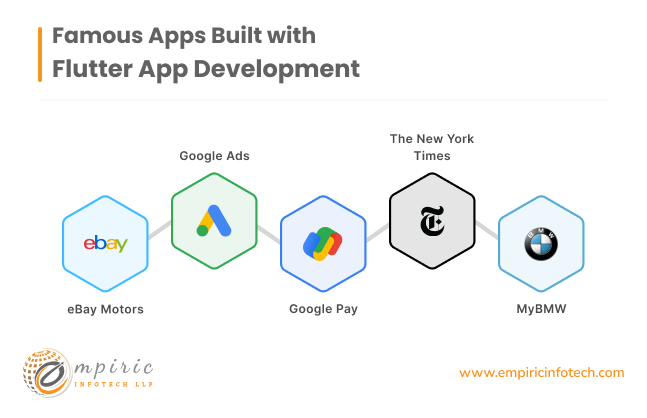
Flutter's own showcase lists hundreds of production apps. A few that show the range:
- Google Pay moved to Flutter to serve users across many countries from one codebase, with different payment methods and languages per market.
- eBay Motors built a feature-rich buying and selling app with search alerts, saved searches and in-app chat.
- BMW rebuilt the My BMW app in Flutter to give iPhone and Android owners the same experience.
- The New York Times used Flutter for its KenKen puzzle game across phones and the web.
If Flutter can carry payments, commerce and connected-car apps at that scale, it can carry a business app.
When is Flutter the wrong choice?
Flutter covers most business apps, but be honest about these cases:
- Watch-first or deeply platform-specific apps, such as products built around Apple Watch or widgets, are easier in native code.
- Heavy native AR or 3D that depends on ARKit or ARCore features beyond what plugins expose.
- A large existing native team with a mature Swift and Kotlin codebase may gain less from a rewrite than from improving what it has.
- Very small app-size limits, for example instant apps, where Flutter's engine adds a few megabytes.
What to plan before you start a Flutter project
- The backend. Firebase and Supabase get a first release out fastest; a Node.js, Django or Laravel API suits complex business logic.
- State management. Agree on one approach (Riverpod, Bloc or Provider) at the start, so the code stays consistent as the team grows.
- Ownership. The code should live in your GitHub organisation, and the App Store and Google Play accounts should be in your company's name from day one.
- Release process. Set up automated builds and store releases early, so shipping is routine rather than an event.
- Analytics and crash reporting. Decide what you will measure before launch, not after.
Frequently asked questions
Is Flutter good for business apps?
Yes. Flutter is used in production by companies such as Google, BMW and eBay, and it handles the typical needs of a business app well: authentication, payments, offline data, notifications and integrations with your existing systems.
How long does it take to build a first version in Flutter?
A focused first version of a typical business app usually takes 8 to 16 weeks with a small dedicated team, depending on the number of screens, integrations and the backend. Shipping one codebase to both stores is a large part of the time saved.
Does Flutter cost less than building two native apps?
In most cases, yes. One codebase means one team building and testing each feature once, instead of two teams doing the same work in Swift and Kotlin. Maintenance follows the same pattern.
Can a Flutter app scale as the business grows?
Yes. How well an app scales depends mostly on its backend and architecture. A clean state-management approach, a well-designed API and automated testing let a Flutter app grow from a first release to millions of users.
Hire Flutter developers with Empiric Infotech
Empiric Infotech's remote Flutter developers work full time on one client's product, in the client's repository and sprint, with a senior team lead reviewing every release. If you are still deciding who to bring on, our guide on how to hire Flutter developers walks through the skills and checks that matter, and our overview of Flutter app development covers what the framework does well.
Planning a Flutter app? Book a 30-minute call with our team to talk through scope, timeline and the team you need.