



 Front-end
 Back-end
 Full Stack Developer
 Mobile
 Other
Other


 Company
 Contact Us
AI Development Cost: The Monthly Run Rate Behind Every Quote
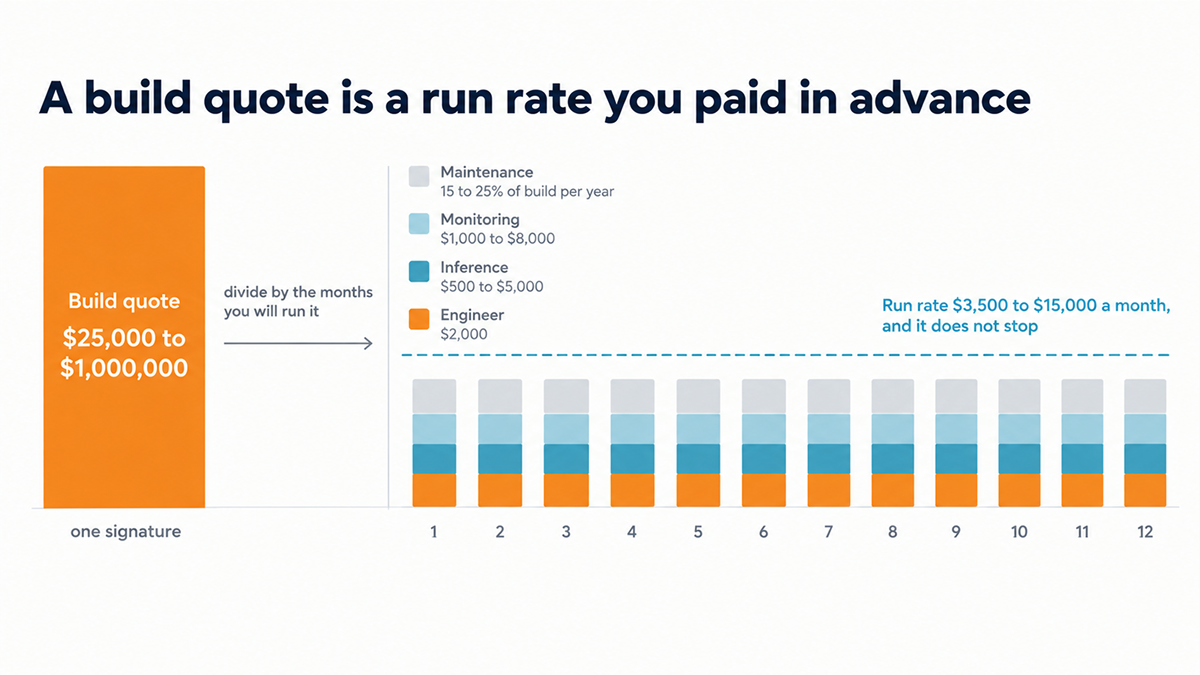
AI development cost is quoted at $25,000 to $1,000,000 for a build, but the number that decides whether the work survives is the monthly run rate: roughly $3,500 to $15,000 a month for one engineer plus inference, monitoring and hosting. At Empiric Infotech the engineer inside that figure is $2,000 a month for 160 to 172 hours.
Published 17 September 2026. Every price band and survey figure below is attributed inline.
The short answer
- The build quote spans 40 times top to bottom, so alone it says nothing. Azilen's 2026 AI development cost guide puts a proof of concept at $25,000 to $80,000 and an enterprise AI platform at $400,000 to $1,000,000 and up.
- The run rate is the number to approve. One engineer plus inference, monitoring and hosting is roughly $3,500 to $15,000 a month, and that bill starts on launch day, not on payback day.
- Maintenance is neither optional nor small. CloudZero's 2026 AI cost guide puts annual maintenance at 15 to 25 percent of build cost, so a $200,000 system carries $30,000 to $50,000 a year before anyone adds a feature.
- Most companies already spend more per month than they planned. CloudZero's State of AI Costs, a March 2025 survey of 500 US software engineering managers and above, found average monthly AI spend of $62,964 in 2024 rising to an expected $85,521 in 2025, with only 51 percent strongly agreeing they can track AI ROI.
- Inference costs fall every year, integration costs do not. Stanford HAI's 2025 AI Index Report found the cost of querying a model at GPT-3.5 level fell from $20.00 per million tokens in November 2022 to $0.07 in October 2024.
- What Empiric Infotech charges: a flat USD 2,000 a month, the same as any other service, one named mid-to-senior engineer, 160 to 172 hours, billed monthly upfront. See generative AI development.
How much does AI development cost?
AI development costs $25,000 for a scoped proof of concept and $1,000,000 or more for an enterprise platform, and the useful move is to divide whichever band applies to you by the months you plan to live with it. The ranges and durations below are Azilen's published 2026 figures. The final column is arithmetic, not a quote.
| What you are building | Published build range | Published duration | Divided over 12 months |
|---|---|---|---|
| Proof of concept | $25,000 to $80,000 | 4 to 10 weeks | $2,100 to $6,700 a month |
| One AI feature, such as a chatbot or an automation | $60,000 to $180,000 | 8 to 16 weeks | $5,000 to $15,000 a month |
| Custom ML system | $120,000 to $400,000 | 3 to 8 months | $10,000 to $33,000 a month |
| Generative AI application | $150,000 to $500,000 | 4 to 10 months | $12,500 to $41,700 a month |
| Enterprise AI platform | $400,000 to $1,000,000 and up | 8 to 18 months | $33,000 to $83,000 a month |
Upsilon's competing 2026 guide brackets the same work lower, at $20,000 to $80,000 for a chatbot and $80,000 to $300,000 for a generative AI application. Two experienced shops reading the same brief disagree by a factor of two, because "AI development" describes a shape rather than a scope. Agent work has its own price structure, covered in what an AI agent costs to build and to run.
What is the monthly run rate for an AI project?
The monthly run rate for one live AI feature with one engineer on it is roughly $3,500 to $15,000, and unlike a build quote it does not end.
| Monthly line item | Typical range | Where the figure comes from |
|---|---|---|
| One mid-to-senior engineer, 160 to 172 hours | $2,000 | Empiric Infotech's published monthly rate |
| Model API inference, low to moderate volume | $500 to $5,000 | Azilen, 2026 AI development cost guide |
| Managed ML platform, monitoring and tracing | $1,000 to $8,000 | Azilen, 2026 AI development cost guide |
| Self-hosted GPU serving, A10G class, if you leave the API | $1,200 to $3,600 | Azilen, 2026 AI development cost guide |
| Maintenance and retraining, amortized monthly | 15 to 25 percent of build cost per year | CloudZero, 2026 AI cost guide |
Two notes. The GPU line replaces the API line rather than adding to it, so self-hosting does not automatically cost less once an engineer must keep it alive. And maintenance is the line teams leave out: on a $300,000 build it is $3,750 to $6,250 a month, more than the engineer costs.
Which AI cost lines fall over time and which never do?
Model spend falls, and everything wrapped around the model holds or grows. Stanford HAI's 2025 AI Index Report measured a fall from $20.00 to $0.07 per million tokens for GPT-3.5 level performance between November 2022 and October 2024, with hardware costs declining about 30 percent annually alongside it.
That is also the trap. If inference is the only line in your forecast, it improves every quarter while the invoice does not. The lines that hold are integration maintenance when a downstream API changes, eval upkeep when the provider ships a new model version, human review of escalated cases, and compliance work once the system touches customer data.
Aggregate spending confirms it. Menlo Ventures' "2025: The State of Generative AI in the Enterprise" put enterprise generative AI spending at $37 billion for the year against $11.5 billion in 2024. Per-token prices collapsed and total spend still tripled, because usage grew faster than unit cost fell.
Does a fixed-price AI build or a monthly engineer cost less?
A fixed-price build costs less only when the scope genuinely cannot move, which in AI work is rare, because the first two weeks of real usage almost always change the specification.
| Engagement model | What you commit to | What moves the price | The failure mode |
|---|---|---|---|
| Fixed-price build | A signed scope document | Nothing, until a change order | Every discovery becomes a change order |
| Time and materials | An hourly rate and a soft cap | Hours logged | Nobody can forecast next month's invoice |
| Monthly dedicated engineer | A named person, cancellable | Only headcount | Poor fit if the work really is a one-off |
| In-house senior AI hire | Salary, equity, notice period | Market rates and retention | Months to hire, and the cost stays if the roadmap stalls |
What Empiric Infotech charges. The monthly rate is the same flat $2,000 whether the work is AI or not: one named mid-to-senior engineer, exclusive to you, 160 to 172 hours, billed monthly upfront, with a senior team lead reviewing and testing every release. In Europe that is EUR 2,000, in Australia AUD $3,000. The AI premium sits on the hourly option instead, $25 an hour against $15 standard, because agent and eval work is high-iteration expert work. You keep the repository, the cloud account and the model keys. The same terms cover AI agent development.
How do I convert a build quote into a monthly number I can approve?
Score the proposal in front of you on the ten items below, four points each, forty available. At 28 or above you have a cost line you can defend. Below 28 you have an estimate, and it will move.
- The quote separates one-off build cost from recurring run cost, in writing. (4)
- The monthly inference estimate comes from a measured token count on real traffic, not a guess. (4)
- An eval set is named and sized, and one person owns it. (4)
- Monitoring, tracing and alerting appear as their own line rather than as "included". (4)
- A retraining or prompt-refresh cadence is stated, with who pays for it. (4)
- Data cleanup and pipeline work are scoped separately from model work. (4)
- A named human owns wrong answers, with review time planned in hours per week. (4)
- Rollback is defined, including how many minutes it takes to switch the system off. (4)
- You hold the repository, the cloud account and the model keys from day one. (4)
- One baseline metric is written down with its current value before build starts. (4)
The items carry equal weight deliberately. The omissions that look like savings, no eval set, no owner for wrong answers, no rollback, generate the largest invoices in month six.
Where does AI spend actually get lost?
AI spend is usually lost after launch, not during the build, on systems that work in a demo and have nobody attached to them once real traffic arrives.
MIT NANDA's "The GenAI Divide: State of AI in Business 2025", built on 150 leader interviews and 300 public deployments, found roughly 95 percent of organizations seeing no measurable P&L impact from generative AI spending, and blamed a workflow gap rather than model quality. Deloitte's State of AI in the Enterprise 2026 found only 21 percent of surveyed leaders have a mature governance model for agentic AI.
Neither finding argues against building. Both argue for attaching one named engineer and one measured number to one workflow, and treating the monthly cost of keeping it alive as the commitment.
What should you do next?
Take the quote you have, divide it by the months you intend to run the system, and compare it with the run rate table above. If it implies $12,000 a month for a feature one engineer could build and operate, the gap is scope you have not seen yet.
The monthly alternative is specific: one named mid-to-senior engineer, exclusive to you, 160 to 172 hours at $2,000, cancel on 7 days notice, first 7 days a risk-free trial. Start with generative AI development if a product feature needs a model behind it, or AI agent development if you already know the workflow you want automated.
Sources: Azilen, "AI Development Cost in 2026". Upsilon, "AI Development Cost: A Comprehensive Overview for 2026". CloudZero, "How Much Does AI Cost? The Complete Guide For 2026" and "The State of AI Costs in 2025". Stanford HAI, "2025 AI Index Report". Menlo Ventures, "2025: The State of Generative AI in the Enterprise". MIT NANDA, "The GenAI Divide". Deloitte, "State of AI in the Enterprise 2026".