



 Front-end
 Back-end
 Full Stack Developer
 Mobile
 Other
Other


 Company
 Contact Us
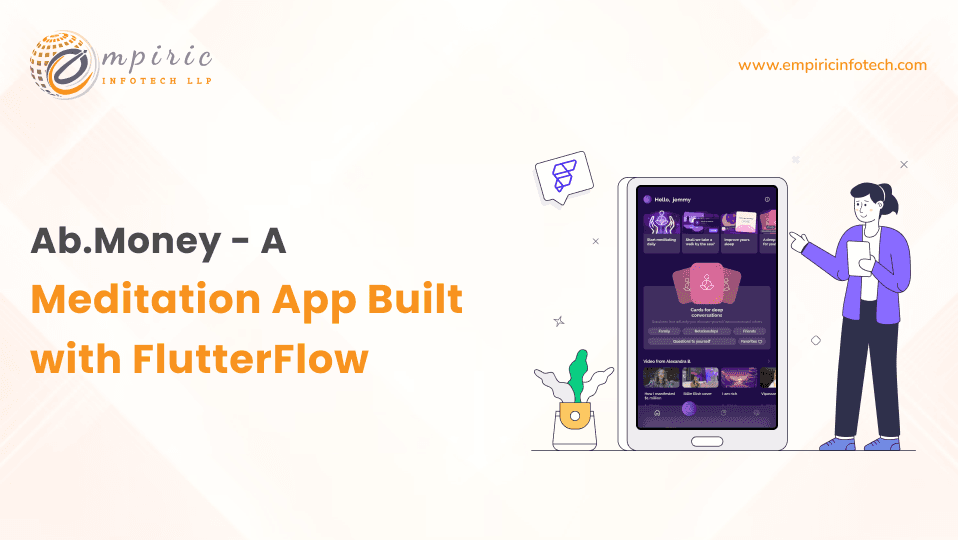
Ab.Money Case Study: Rebuilding a Meditation App in FlutterFlow
Quick answer: why did Ab.Money move to FlutterFlow? The app was originally built on a different visual development tool and hit scalability limits as its audience grew. The team rebuilt it in FlutterFlow over roughly two months, from February to March 2022. Most functionality was implemented with native FlutterFlow capability, and custom actions and widgets covered the rest, including a custom audio player, video courses and bilingual content. The rebuild resolved the scaling constraints while keeping the product's distinctive features intact.
This is a useful case to study if you are weighing a visual development platform for a content-heavy product, because it covers the situation most articles skip: what happens when the first tool stops fitting and you have a live audience you cannot disrupt.
The product
Ab.Money is a free meditation and mindset app created by Alexandra Belliakova, known as Sasha Belaire. It helps users work on mental well-being through guided meditations and mindset exercises, and it ships on both the App Store and Google Play.
The product serves an audience across two languages, English and Russian, with some content produced specifically for each. That bilingual requirement runs deeper than interface translation, since the content library itself differs by language.
The problem with the first build
The app was first released on a different visual development tool. It worked, and it validated the product. As the user base grew, the team ran into scalability limits: the constraints of the original platform started dictating what the product could do, rather than the roadmap doing so.
This is the common failure pattern with visual builders, and it is worth naming precisely. The issue is rarely that the tool cannot build the current feature. It is that each new feature costs progressively more to add, and eventually a feature arrives that the platform simply will not support. At that point the choice is to drop the feature or to leave the platform.
Why FlutterFlow
FlutterFlow was chosen because it addressed the specific constraint without giving up the speed the team was used to.
It generates real Flutter code. The output is a Flutter project the team can export and maintain conventionally. That converts platform lock-in from a permanent risk into a decision the team controls.
It has a genuine escape hatch. Custom functions, custom actions and custom widgets mean an unsupported requirement becomes a piece of Dart rather than a dead end. For a product with a custom audio player and video courses, this mattered immediately.
It kept the iteration speed. The team was accustomed to changing the app quickly. Moving to a conventional Flutter build would have solved scalability at the cost of that speed. FlutterFlow kept both.
The rebuild
The app was rebuilt and relaunched across roughly two months, from February 2022 to March 2022.
The split of work is the most instructive detail. The large majority of the app's functionality was built using FlutterFlow's native capabilities, with custom actions and widgets handling the remainder. That ratio is what a good fit looks like: the visual layer carries the conventional work, and custom code is reserved for the parts that are genuinely specific to the product.
Features delivered in the rebuild included:
- A custom audio player, central to a meditation product and beyond what a stock component provides.
- Video courses, with content served to the Russian-language audience.
- Conditional visibility, so content and features could be tailored to specific user groups without shipping separate builds.
- Daily tarot cards and affirmations, recurring content surfaces that needed their own scheduling behaviour.
- Multiple diaries for tracking emotions and goals, each with its own data model.
- Bilingual content delivery across English and Russian.
What this case demonstrates
Migrating between platforms is a real option, not a last resort. A live app with an existing audience was rebuilt and relaunched in about two months. If your product is currently constrained by its platform, the migration cost may be lower than the cost of continuing to work around the constraint.
The escape hatch is the feature that matters. Ab.Money needed a custom audio player, which is exactly the kind of requirement that ends a project on a closed platform. The ability to drop into Dart is what made FlutterFlow viable here, and it is the first thing to test when you evaluate any visual tool.
Content-heavy apps are a strong fit. The difficulty in this product is the content model, the media handling and the personalisation rules, not custom rendering or deep native integration. That is the profile where FlutterFlow performs best. We cover the boundaries of that fit in more detail in our guide to FlutterFlow app development.
Plan the second build during the first. The teams that migrate smoothly are the ones who kept a clean separation between content and presentation. Those that struggle have business rules scattered through the interface layer.
If you are in the same position
If you have a working product on a platform you are outgrowing, the useful first step is to identify precisely which constraints are binding. "We are hitting limits" is not actionable. "We cannot build a custom audio player, and we cannot control caching behaviour" points directly at whether a given target platform solves your problem.
Then rebuild the hardest feature first as a proof, before committing to a full migration.
Empiric builds and migrates production apps in FlutterFlow and Flutter. See more of our work in the portfolio, read about hiring FlutterFlow developers, or get in touch to discuss a migration.