



 Front-end
 Back-end
 Full Stack Developer
 Mobile
 Other
Other


 Company
 Contact Us
Choosing the right database for your full stack project is important. It’s like picking the right pair of shoes for a long walk—one size doesn’t fit all! The database is the backbone of your project. It decides how data is stored, accessed, and scaled as your app grows.
With so many options like SQL, NoSQL, and graph databases, how do you decide which one to use? Your choice will affect your app’s performance, scalability, and how quickly you can build it. It’s not about picking the trendiest option—it’s about finding the one that fits your needs.
In this guide, we’ll explain what to think about when choosing a database. We’ll look at the strengths and weaknesses of different types and help you make the right choice for your project. Let’s solve the database puzzle together!
What is a Database?
A database is a system that stores and manages data for applications. It organizes data into structured formats (like tables and records) or flexible ones (like collections and documents). Databases ensure that data can be stored, retrieved, and updated efficiently.
Types of Databases
Databases play a crucial role in managing data for applications. They are generally divided into two main types: SQL (relational) and NoSQL (non-relational). Each type has its own strengths and is suited to specific types of data and project requirements.
Relational Databases (SQL)
- These databases use structured tables to store data.
- Examples include MySQL, PostgreSQL, and SQLite.
- They are suitable for scenarios where data relationships and integrity are critical.
Non-Relational Databases (NoSQL)
- These databases store data in flexible formats, such as documents, key-value pairs, or graphs.
- Examples include MongoDB, DynamoDB, and Cassandra.
- They are ideal for applications that require scalability and flexibility in data structure.
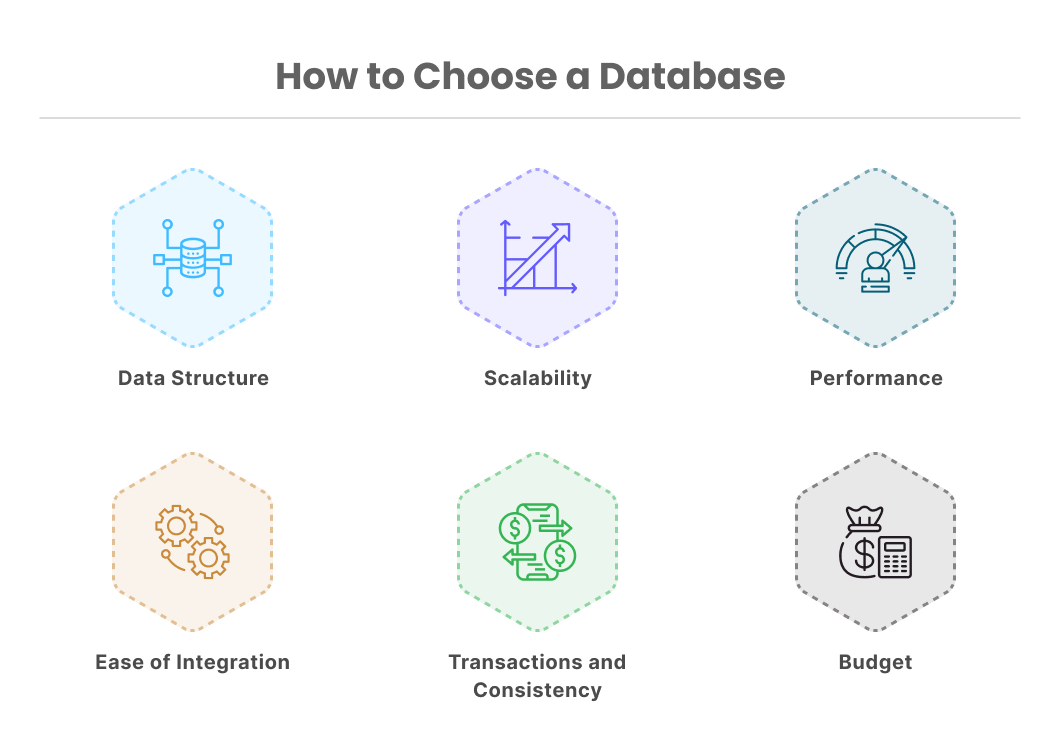
How to Choose a Database
Selecting the right database involves evaluating factors like the structure of your data, scalability needs, and the kind of workload your application will handle. Understanding these aspects ensures your database supports your project effectively.
1. Data Structure
Consider whether your data has a fixed format or a more flexible one. For example:
- Use a relational database like MySQL if you have a clear structure, such as customer records or inventory data.
- Use a NoSQL database like MongoDB for unstructured or semi-structured data, like user-generated content.
2. Scalability
Evaluate how your application’s data will grow:
- SQL databases scale vertically (adding more power to a single server).
- NoSQL databases scale horizontally (adding more servers).
3. Performance
Identify whether your application needs to process a high number of reads, writes, or both:
- Relational databases often perform better for read-heavy workloads with complex queries.
- NoSQL databases handle large write volumes and real-time processing efficiently.
4. Ease of Integration
Choose a database compatible with your back-end technology. For example:
- If you’re using Node.js, MongoDB integrates well with its JavaScript-based ecosystem.
- If you’re using PHP, MySQL integrates seamlessly due to PHP’s native MySQL extensions like mysqli and PDO, offering robust support for database interactions and making development faster and more efficient.
5. Transactions and Consistency
Decide if your application needs strict data integrity:
- Use a relational database for ACID compliance (banking or e-commerce systems).
- Use a NoSQL database if eventual consistency suffices (real-time analytics or social media feeds).
6. Budget
Some databases are open-source and free, like MySQL or PostgreSQL, while others may require licenses or usage fees, like Oracle DB or Firebase.
SQL vs. NoSQL: When to Choose
SQL databases are structured and enforce data relationships, making them ideal for scenarios requiring precision and consistency. NoSQL databases offer more flexibility and are better suited for handling large-scale, rapidly changing data.
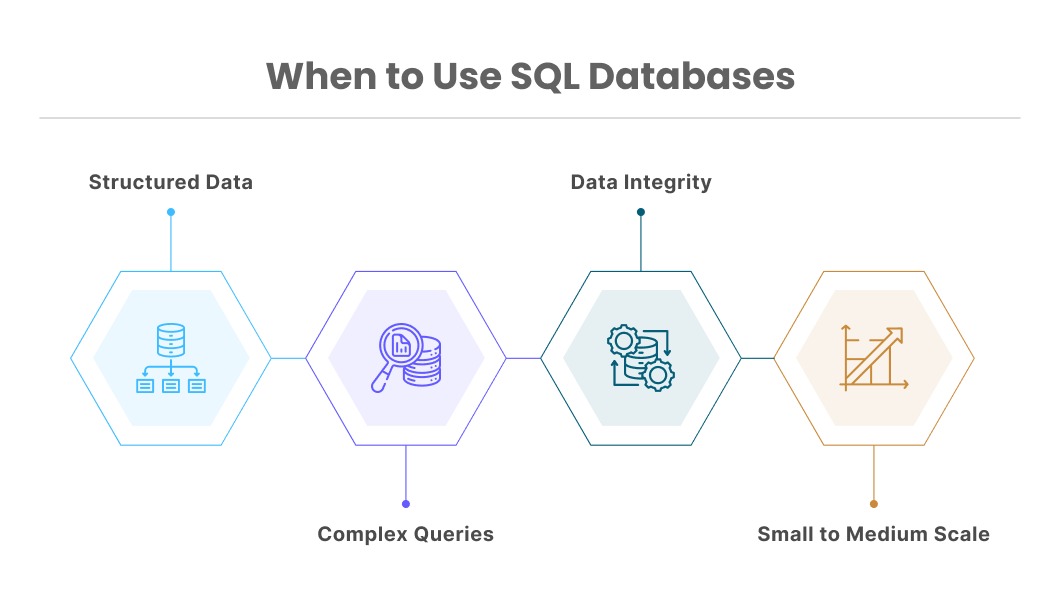
When to Use SQL Databases
SQL databases are the best choice for applications that require:
-
Structured Data
If your data has a clear, predefined schema, SQL databases are ideal. Examples include systems that manage employee records, product inventories, or order details.
-
Complex Queries
SQL databases support powerful querying capabilities, making them suitable for analytical tasks and applications that need to retrieve data based on complex relationships.
-
Data Integrity
When data accuracy and consistency are critical, SQL databases excel due to their ACID (Atomicity, Consistency, Isolation, Durability) compliance. For example, financial applications, where transaction accuracy is paramount, benefit greatly from SQL databases.
-
Small to Medium Scale
SQL databases can handle moderate scaling needs by upgrading hardware (vertical scaling). They are often used in applications with predictable growth rates.
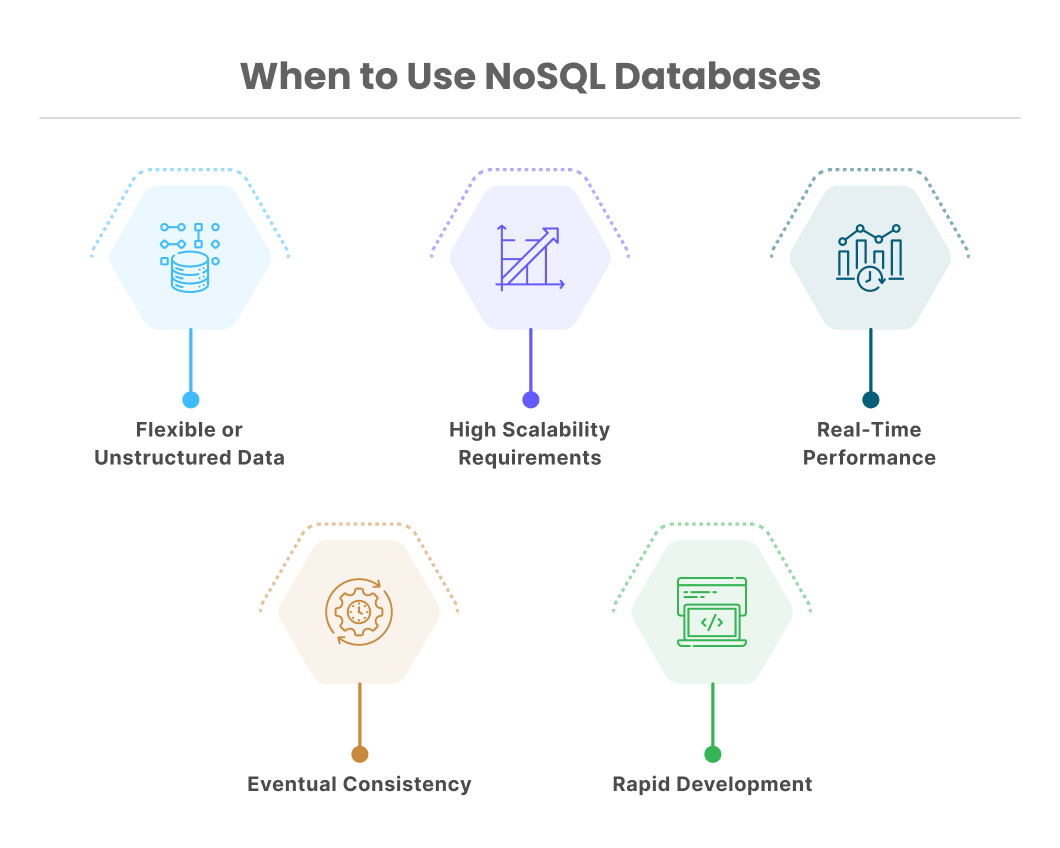
When to Use NoSQL Databases
NoSQL databases are a better fit for projects with:
-
Flexible or Unstructured Data
If your data does not follow a fixed schema, such as user-generated content or sensor data from IoT devices, NoSQL databases can handle this with ease.
-
High Scalability Requirements
NoSQL databases are designed for horizontal scaling (adding more servers), making them ideal for applications with rapidly increasing data and traffic, such as social media platforms.
-
Real-Time Performance
Applications that need fast data reads and writes, like real-time analytics, chat applications, or gaming leaderboards, benefit from the performance of NoSQL databases.
-
Eventual Consistency
In scenarios where immediate consistency is not critical, such as maintaining likes or views on a post, NoSQL databases provide better performance and flexibility.
-
Rapid Development
NoSQL databases often require less setup and allow developers to adjust the schema on the fly, which is useful for agile and iterative development models.
6 Popular Databases and Their Use Cases
Each database has unique features and is optimized for certain tasks. Understanding their strengths can help you choose the best one for your project. Some databases excel in handling structured data, while others are designed for flexibility and scalability.
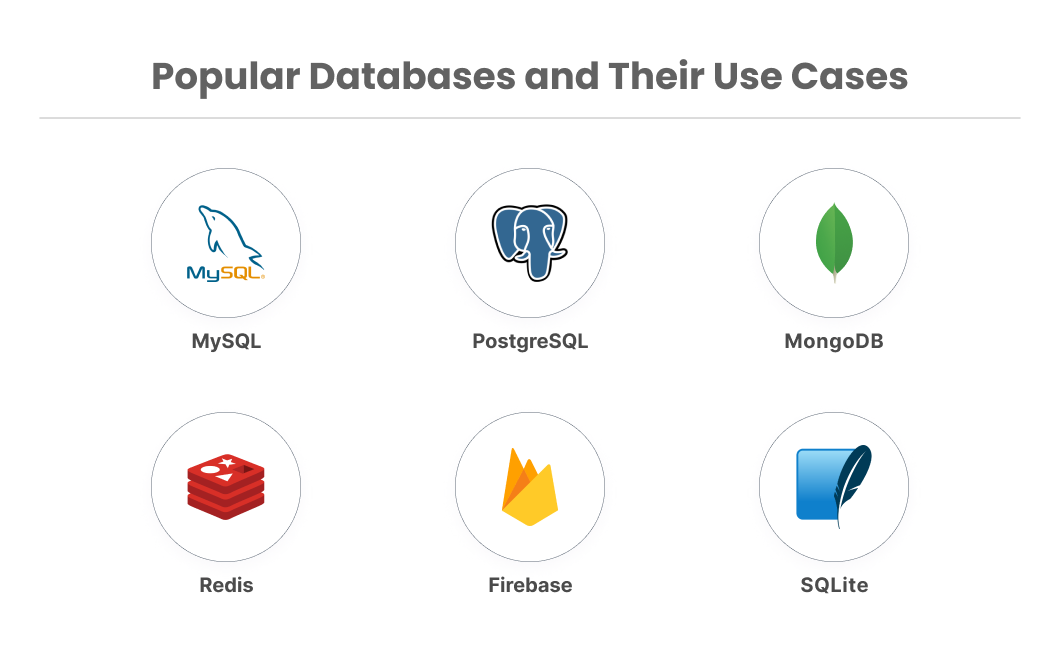
1. MySQL
Features MySQL is an open-source, relational database management system known for its reliability and performance. It supports structured data and ACID compliance.
Use Cases Ideal for applications requiring robust transaction handling, such as e-commerce platforms, content management systems (CMS), and websites with structured data, like blogs or forums.
2. PostgreSQL
Features PostgreSQL is a powerful, feature-rich relational database that supports advanced data types like JSONB, making it suitable for hybrid use cases involving both structured and semi-structured data. It also offers strong support for complex queries and data analytics.
Use Cases Commonly used in enterprise applications, data warehouses, and applications needing advanced functionalities like geospatial data handling. Examples include financial systems and large-scale business applications.
3. MongoDB
Features MongoDB is a NoSQL, document-oriented database that stores data as JSON-like documents. It is highly scalable and suitable for applications with flexible schemas.
Use Cases Best for handling unstructured or semi-structured data, such as user-generated content, product catalogs, and IoT data. Popular for dynamic applications like social media platforms and content management systems.
4. Redis
Features: Redis is an in-memory, key-value store database known for its extremely fast performance. It is often used as a caching layer in applications.
Use Cases Suitable for real-time use cases like leaderboards, session management, message queues, and live analytics dashboards.
5. Firebase
Features Firebase offers a cloud-hosted NoSQL database with real-time synchronization capabilities. It is provided as a Backend-as-a-Service (BaaS) solution.
Use Cases Ideal for mobile and web applications that require real-time updates, such as chat applications, collaborative tools, and lightweight apps developed quickly.
6. SQLite
Features SQLite is a lightweight, file-based relational database that requires minimal setup. It operates directly from a file without needing a server.
Use Cases Ideal for mobile applications, embedded systems, and small-scale applications with low to moderate data requirements, such as personal productivity apps or small websites.
Confused about which database to choose for your project? Our expert full-stack developers are ready to help you. Book a free consultation call with one of our experts.
Tools and Resources to Compare Databases
To make an informed decision, use tools like DB-Engines Ranking and read official database documentation. Developer forums and benchmarking tools can also provide insights into how a database performs under specific conditions.
DB-Engines Ranking: A website that ranks databases based on popularity.
Documentation: Reading the official documentation of a database helps understand its features.
Community Support: Join forums or communities to learn from experienced developers.
Testing and Benchmarking: Try a database under simulated conditions to see if it meets your needs.
Common Mistakes and Best Practices
Mistakes like choosing a database based on popularity or neglecting scalability can hinder your project. Following best practices, such as planning your data model and optimizing database performance, can help you avoid these pitfalls and ensure success.
Mistakes
- Choosing a database based on popularity rather than project needs.
- Ignoring future scalability and performance.
Best Practices
- Design a clear data model before choosing a database.
- Optimize your queries and indexing for better performance.
Still connected with us?
You might interested to read our article on how to choose the best technology stack for your project.
Conclusion
Choosing the right database for your full stack project is a critical decision that can shape the success of your application. By understanding your project’s requirements like data structure, scalability needs, and performance goals you can narrow down your options and make a confident choice.
The key is to align your database with your app's needs, your team’s expertise, and your long-term vision. With the right database in place, you’ll not only streamline development but also set your project up for success as it grows.
![Roles of Web and Mobile App Developers [Complete Guide]](/_next/image?url=%2Fapi%2Fimage%2Fapp%2Fmedia%2Fblog%2F1735549950884_Roles%20of%20Web%20and%20Mobile%20App%20Developers.png&w=2048&q=75)