



 Front-end
 Back-end
 Full Stack Developer
 Mobile
 Other
Other


 Company
 Contact Us
Choosing the right technology stack is crucial for building successful web applications. The "stack" refers to the combination of programming languages, frameworks, and tools developers use to create the front-end (user interface) and back-end (server-side logic) of your application. Selecting the best technology stack impacts development efficiency, performance, scalability, and ultimately, the user experience.
This blog post dives into three popular choices for web development in 2025: Full-Stack development, the MEAN stack, and the MERN stack. We'll explore the strengths and weaknesses of each approach, along with key considerations to help you pick the technology stack that perfectly aligns with your project's specific needs.
Significance of Choosing the Right Technology Stack
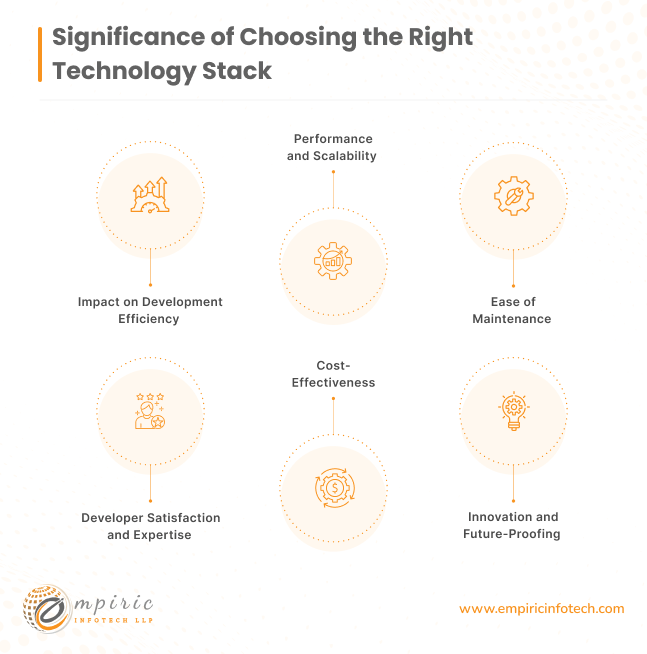
Impact on Development Efficiency
The right stack provides tools and frameworks well-suited to your project type. This streamlines the development process, prevents roadblocks due to mismatched tools, and helps meet project deadlines.
Performance and Scalability
Your tech stack directly influences how your web application handles traffic, data processing, and future growth. Choosing technologies known for scalability and performance ensures a seamless experience, especially as your application's user base or complexity increases.
Ease of Maintenance
A well-chosen stack often uses popular technologies with strong community support and extensive documentation. This makes troubleshooting, updates, and finding developers to maintain the application easier over the long term.
Developer Satisfaction and Expertise
Aligning the tech stack with your team's skills maximizes their efficiency and enjoyment. A mismatch can lead to frustration, a slower development process, and a higher likelihood of errors.
Cost-Effectiveness
While open-source stacks don't have direct licensing costs, factors like developer availability, time to market, and long-term maintainability influence project costs significantly. Choosing the right stack can optimize these indirect costs.
Innovation and Future-Proofing
An appropriate tech stack allows you to easily integrate new features and technologies. This ensures your application stays competitive and adaptable to evolving user needs and industry trends.
What is Full-Stack Development?
Full-stack development is a comprehensive approach to web application development, encompassing both front-end (client-side) and back-end (server-side) technologies.
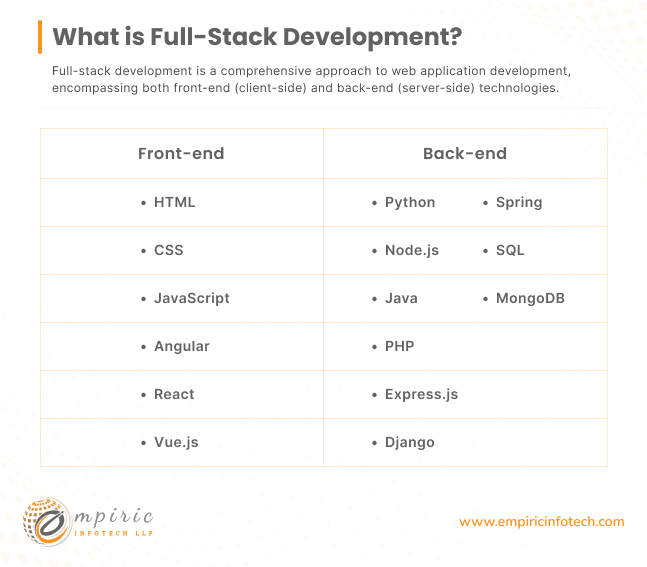
A full-stack web developer possesses the versatile skill set to manage all aspects of the development process, from crafting the user interface and its interactions to architecting server-side logic and data management. This end-to-end expertise enables them to contribute holistically to the creation of a complete web application.
They have a working knowledge of the following areas:
Front-end Technologies
HTML (HyperText Markup Language)
The fundamental building block of web pages, HTML provides structure and defines the content elements (headings, paragraphs, images, etc.).
CSS (Cascading Style Sheets)
CSS controls the styling and visual presentation of a web page, including layout, colors, fonts, and visual effects.
JavaScript
A versatile programming language that brings web pages to life. It handles dynamic interactions, user input, animations, and communication with the back-end.
Front-end Frameworks (React, Angular, Vue.js)
These frameworks offer structured approaches to building complex user interfaces. They provide components, templating systems, and data management tools to simplify the development of large, interactive web applications.
Back-end Technologies
Server-side Languages (Python, Node.js, Java, PHP, etc.)
These languages execute on the web server, handling the core logic, business rules, and decision-making processes of the application.
Frameworks (Express.js, Django, Spring)
Frameworks associated with specific server-side languages provide blueprints, toolkits, and conventions for building the "skeleton" of a web application. They streamline tasks like routing, database interactions, and request handling.
Database Technologies (SQL, NoSQL like MongoDB)
Databases store and manage the application's data. Full-stack developers work with both traditional relational databases (SQL) and more flexible document-oriented databases (NoSQL) based on the project's needs.
Advantages and Disadvantages of Full-Stack Development

Advantages of Full-Stack Development
Versatility and Control
Full-stack developers can independently handle various aspects of the development process. This gives them greater control over the project and the ability to identify and address potential issues across the application.
Streamlined Communication and Project Management
Since full-stack developers understand both front-end and back-end requirements, communication is greatly simplified. There's less need to coordinate between separate teams, which can accelerate project timelines and minimize miscommunication.
Potential Cost-Effectiveness
For smaller projects or startups, hiring a full-stack developer (or a small team of them) can be more cost-effective than assembling a larger.
Want to take the benefits of Full-Stack Development to transform your business? Schedule a 30-mins call with our expert Full-Stack developers!
Disadvantages of Full-Stack Development
Difficulty Finding True Experts
While many developers claim full-stack proficiency, finding someone with true in-depth expertise in all areas is challenging. True "full-stack mastery" often requires years of experience across diverse technologies.
Longer Development Times for Complex Projects
While full-stack developers are versatile, large and complex projects could still benefit from specialized developers (front-end, backend, database experts) working in tandem. A full-stack developer might take longer to achieve the same level of optimization as a team of specialists.
What is the MEAN Stack?
What MEAN Stands For:
MongoDB
A flexible and scalable NoSQL database that excels in handling diverse and changing data structures. It stores data in JSON-like documents, offering ease of development and the ability to evolve your data model as your application requirements change.
Express.js
A lightweight Node.js web framework designed to provide essential features for building server-side applications and REST APIs. Its minimalist nature grants you flexibility in architecting your back-end while offering core functionalities like routing, middleware, and templating support.
Angular
A powerful and comprehensive TypeScript-based front-end framework created by Google. Angular is known for its well-structured approach, ideal for building complex single-page applications (SPAs). It provides features like dependency injection, two-way data binding, and a component-based architecture to manage large projects effectively.
Node.js
A cross-platform JavaScript runtime environment that brings JavaScript execution to the server-side. Node.js uses an event-driven, non-blocking I/O model. That makes it exceptionally well-suited for building real-time, data-intensive, and highly scalable web applications that can handle many concurrent connections efficiently.
Advantages and Disadvantages of MEAN Stack Development

Advantages of MEAN Stack
All JavaScript-Based
The entire MEAN stack uses JavaScript and JSON. This means developers proficient in JavaScript can work seamlessly across both the front-end and the back-end, reducing context switching and streamlining development time.
Angular's Robust Framework
Angular is a powerful framework designed for building complex, enterprise-scale single-page applications (SPAs). It provides features like dependency injection, two-way data binding, and a well-defined structure, which helps manage complexity in large-scale projects.
Node.js's Asynchronous Nature
Node.js uses a non-blocking, event-driven I/O model, making it ideal for handling high traffic scenarios. It can process multiple requests concurrently without slowing down, which is essential for applications with many users.
Good Choice for Enterprise-Level Applications
The combination of Angular's structure for large projects and Node.js's performance makes the MEAN stack a suitable choice for enterprise-level applications that require scalability, robustness, and maintainability.
Need a scalable and efficient web app? Let our MEAN Stack development team bring your vision to life. Contact us for a free consultation!
Disadvantages of MEAN Stack
Angular's Steeper Learning Curve
Compared to React, Angular has a more complex structure and a steeper learning curve. Developers without prior Angular experience might need more time to become proficient and might face a slower initial development pace.
Potential Performance Limitations
While Angular is generally performant, highly dynamic and data-intensive real-time features might be better suited to React's more flexible approach to updates and its Virtual DOM. Angular's change detection system can sometimes lead to slightly less predictable
What is the MERN Stack?
What MERN Stands For:
MongoDB
A flexible and developer-friendly NoSQL database that uses JSON-like documents for data storage. MongoDB's document model aligns seamlessly with JavaScript development. It's renowned for its ease of use, horizontal scalability, and ability to handle evolving data structures– characteristics vital for modern, dynamic applications.
Express.js
A popular and minimalist Node.js web framework known for its simplicity and flexibility. It provides the essential tools for building robust APIs and server-side web applications without enforcing rigid structures. Developers value its ability to integrate seamlessly with various front-end technologies and other back-end libraries.
React.js
A powerful and widely adopted JavaScript library created by Facebook for building dynamic and reusable user interfaces. React's focus is on components that encapsulate both UI and logic. Its efficient virtual DOM optimizes updates, enabling the creation of complex, data-driven interfaces that deliver a smooth and responsive user experience.
Node.js
A cross-platform JavaScript runtime environment that empowers Node.js developers to write server-side applications in JavaScript. Node.js's non-blocking, event-driven I/O model makes it exceptionally efficient in handling high-concurrency scenarios – a crucial advantage when building scalable, real-time applications with a substantial user base.
Advantages and Disadvantages of MERN Stack Development

Advantages of MERN Stack
All JavaScript-Based
Just like the MEAN stack, this means developers proficient in JavaScript can work seamlessly across the entire application stack. This reduces the need to learn different programming languages and can create a more streamlined development workflow.
React's Popularity and Extensive Ecosystem
React is one of the most popular front-end libraries with a massive community of developers, extensive learning resources, and a vast library ecosystem. This translates to readily available support and pre-built components for various functionalities, speeding up development.
Well-Suited for Dynamic, Data-Driven Applications
React's component-based architecture and efficient Virtual DOM (Document Object Model) make it ideal for building applications with frequent UI updates and complex data interactions. It handles updates smoothly, providing a responsive user experience.
Want to leverage the power of MERN Stack? Book a 30-Mins call to learn more about our MERN development services!
Disadvantages of MERN Stack
React's Different Mindset
React takes a different approach to rendering UI compared to traditional templating languages (like Angular's templates). Understanding concepts like the Virtual DOM, JSX (React's syntax extension), and component lifecycles might require an adjustment for developers new to React.
May Require Additional Libraries
While React itself is powerful, building complex applications often involves integrating additional libraries for functionalities like state management (e.g., Redux), routing, and styling. Careful choice of libraries is needed to avoid project bloat.
How to Choose the Right Stack for Your Project
Here is a table to help you choose the best stack based on your project needs.
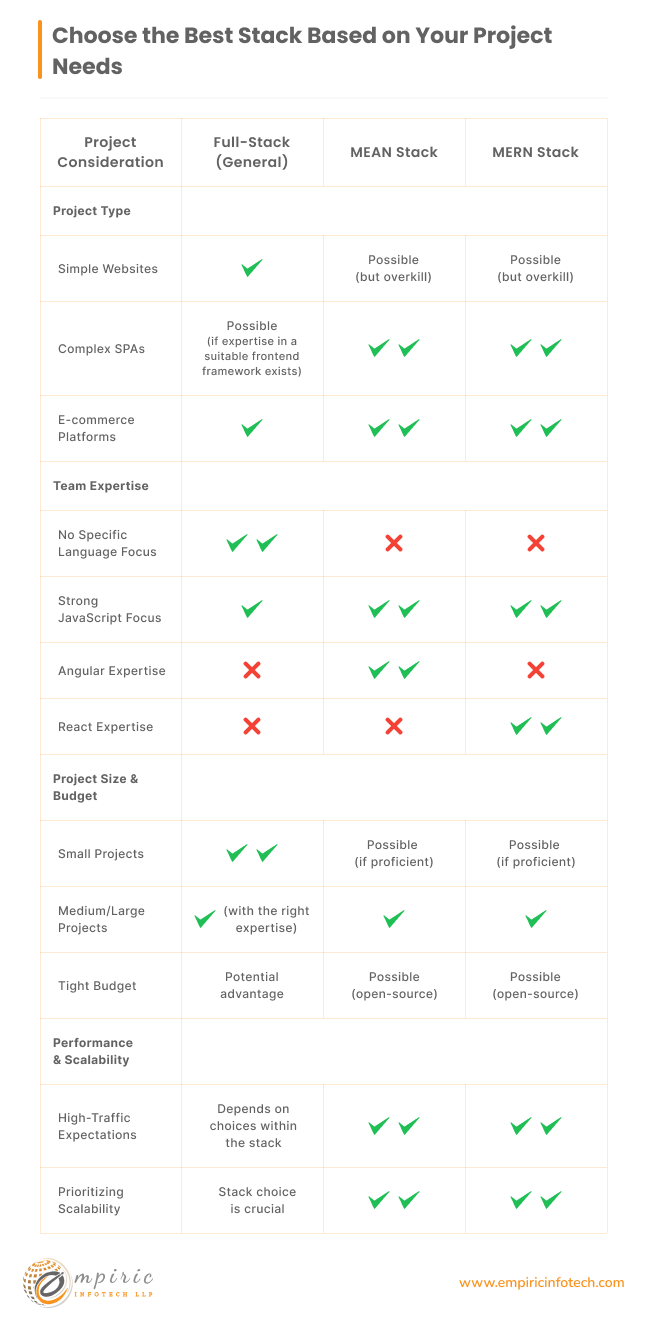
✔ - Well-suited
✔✔ - Highly suitable
✘ - Generally not the best fit
Choose the Best Technology Stack for Your Project with Empiric Infotech LLP
It’s understandable why you might be prompted to go for the most popular tech stack. However, you must choose the technologies that best suit your project needs. But with so many technologies and tech stacks, it might get confusing.
Don't let technology choices hold you back. Partner with Empiric Infotech for a customized technology stack designed to maximize your project's potential.