



 Front-end
 Back-end
 Full Stack Developer
 Mobile
 Other
Other


 Company
 Contact Us
.webp&w=2048&q=75)
What is Vibe Coding?
Vibe coding is the practice of building software using natural-language prompts.
Think of it as “talking to your computer” to create applications.
Instead of coding a login screen line by line, you might type:
“Build a login page with email + Google sign-in, dark mode, and error validation.”
In seconds, an AI-powered tool generates the underlying code and structure.
Popular Vibe Coding Tools in 2025
Here are some of the leading platforms making vibe coding mainstream:
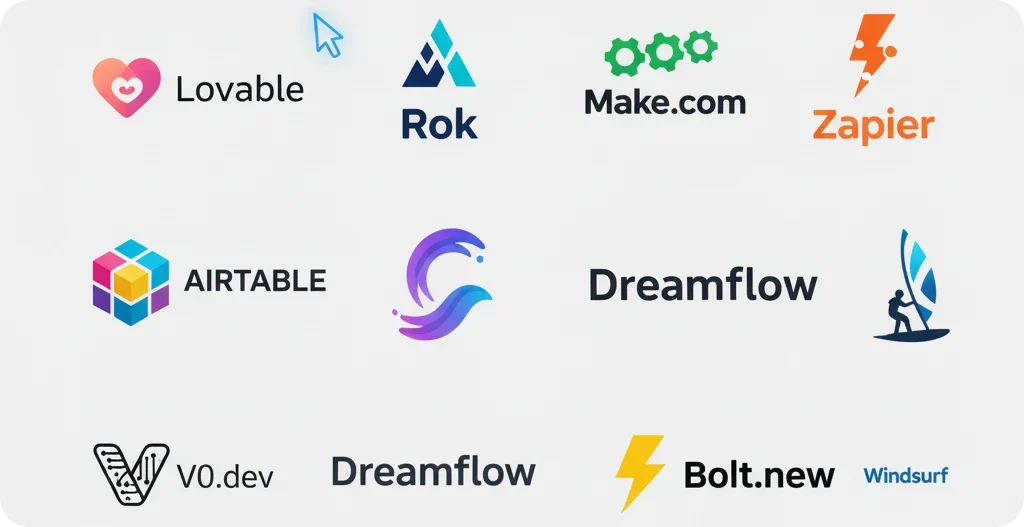
- Lovable – AI-powered app builder that turns prompts into production-ready apps.
- Cursor – An AI-first code editor designed for natural-language coding workflows.
- Rok – Emerging AI coding platform focusing on real-time collaboration.
- Make.com – AI-enhanced automation platform for creating workflows with prompts.
- Zapier – Natural-language automation for connecting SaaS apps instantly.
- Airtable – No-code database now integrated with AI to build workflows from prompts.
- V0.dev – AI-powered front-end builder that generates UI components from text.
- Dreamflow.com – A platform that combines AI and design prompts for app creation.
- Bolt.new – Rapid AI-driven coding environment for prototypes and MVPs.
- Windsurf – AI developer environment built for team collaboration and vibe coding.
These tools are pushing vibe coding beyond low-code/no-code limitations by enabling custom, flexible, and enterprise-ready applications.
How Vibe Coding Works
Here’s a simple breakdown:
-
Prompting – User describes requirements in natural language.
Example: “Create a project management tool with tasks, deadlines, and Slack integration.” -
AI Generation – Tools like Cursor, Lovable, or Bolt.new generate the code automatically.
-
Workflow Automation – Platforms like Make.com, Zapier, or Airtable connect the app with business workflows.
-
Refinement – Developers tweak the code in tools like Windsurf or Rok for optimization.
-
Deployment – The final app goes live, ready for testing and scale.
This workflow blends AI automation + human oversight, ensuring speed without sacrificing quality.
Benefits of Vibe Coding
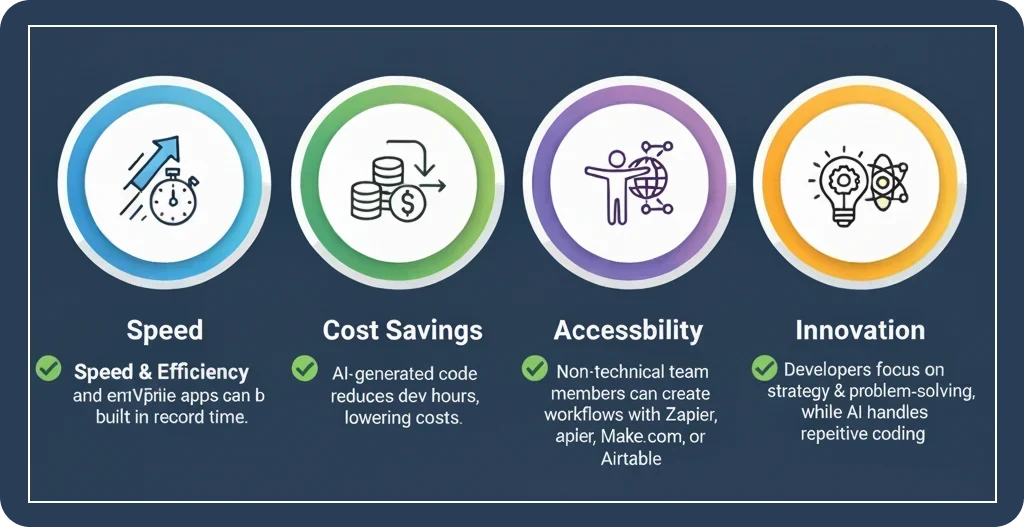
Speed & Efficiency – Prototypes, MVPs, and enterprise apps can be built in record time.
Accessibility – Non-technical team members can create workflows with Zapier, Make.com, or Airtable.
Cost Savings – AI-generated code reduces dev hours, lowering costs.
Innovation – Developers focus on strategy & problem-solving, while AI handles repetitive coding.
Limitations & Risks
While vibe coding is powerful, it comes with challenges:
- Prompt Sensitivity – Output quality depends heavily on the clarity of prompts.
- Security Risks – AI-generated code may have vulnerabilities if not reviewed.
- Complex Projects – Mission-critical enterprise systems still need expert oversight.
- Over-Reliance on Tools – Companies must maintain technical expertise to avoid lock-in.
Vibe Coding vs Low-Code / No-Code
- Low-code/no-code: Prebuilt templates, drag-and-drop workflows.
- Vibe coding: Flexible, AI-driven, capable of building enterprise-level solutions.
For startups, vibe coding is a faster way to test ideas.
For enterprises, it’s a hybrid approach—AI builds the foundation, while experts refine and scale.
Business Impact in 2025
Companies adopting vibe coding are seeing massive advantages:
- Startups – Build MVPs in days, launch faster.
- SMEs – Reduce costs by automating workflows with Zapier, Make.com, and Airtable.
- Enterprises – Use hybrid models (AI + developers) for speed and security.
Example Use Case
A SaaS startup uses Lovable to generate the core app, Zapier to connect billing + CRM, and Airtable for project tracking.
Within a week, they launch an MVP that would traditionally take months.
How Empiric Infotech Helps
At Empiric Infotech, we help businesses harness vibe coding by combining AI-powered tools and expert development practices.
Whether it’s:
- Automating workflows with Make.com & Zapier
- Building AI-powered apps with Cursor, Lovable, or Bolt.new
- Integrating enterprise systems securely
We ensure your solutions are future-ready and scalable.
Explore our AI Agent Development Services to see how we can help you unlock the potential of vibe coding.
Conclusion
Vibe coding isn’t about replacing developers - it’s about augmenting them.
By combining natural-language prompts with powerful AI tools, businesses in 2025 can:
- Build apps faster
- Reduce costs
- Scale smarter
Those who adopt vibe coding today will be tomorrow’s industry leaders.