



 Front-end
 Back-end
 Full Stack Developer
 Mobile
 Other
Other


 Company
 Contact Us
As your eCommerce business flourishes, you'll inevitably face challenges in managing increasing traffic, adding complex features, and effectively handling growing volumes of data. These scaling hurdles can slow down your site, make it difficult to manage products and inventory, and ultimately hinder customer experience.
The MERN stack (MongoDB, Express, React, Node.js) offers a powerful and scalable solution for building robust eCommerce platforms. MERN stack eCommerce development is particularly well-suited for eCommerce due to its ability to handle high traffic volumes, power dynamic features, and simplify data management as your business grows.
In this blog, we will discuss why the MERN stack is good for scaling your eCommerce business.
Why the MERN Stack is Ideal for Scaling eCommerce
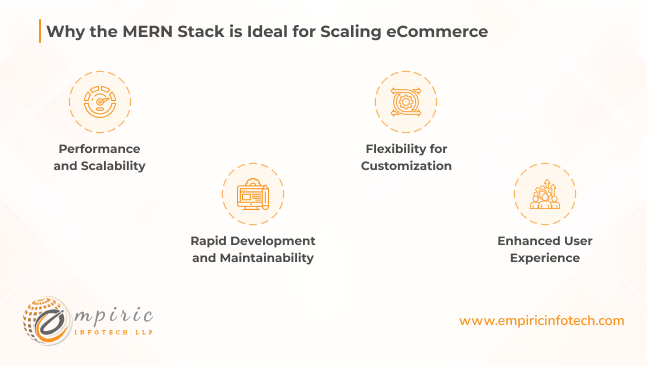
Performance and Scalability
Node.js
At the core of the MERN stack is Node.js, a JavaScript runtime environment known for its asynchronous, non-blocking I/O model. This means it can handle multiple requests concurrently without waiting for one to finish before processing the next.
This is crucial for eCommerce sites that experience high volumes of traffic. That is because it ensures a smooth and responsive user experience even during peak seasons or flash sales.
MongoDB
MongoDB is a NoSQL database that uses a flexible schema-less design. This allows you to store data in a document format that can easily evolve as your business grows and your data needs change.
Additionally, MongoDB's horizontal scalability lets you add more servers to your database cluster as your data storage requirements increase. This ensures your database can keep pace with the growing demands of your eCommerce platform.
React
React's component-based architecture is another factor that contributes to the MERN stack's scalability. By breaking down the user interface into reusable components, developers can build complex and dynamic eCommerce features efficiently. React's virtual DOM (Document Object Model) also plays a role in scalability.
The virtual DOM is an in-memory representation of the real DOM, and React only updates the actual DOM when necessary. This significantly improves rendering performance, especially for eCommerce sites with frequently updating content or a large number of products.
Rapid Development and Maintainability
Shared JavaScript Expertise
A significant benefit of the MERN stack for eCommerce is the fact that it uses JavaScript throughout the entire development process, from front-end development to back-end logic. This means that developers who are skilled in JavaScript can easily work on both the front-end (React) and back-end (Node.js) portions of the eCommerce application.
This reduces the need for context switching between different programming languages and allows developers to be more productive. Also, a shared codebase simplifies maintenance and updates, as changes can be made in one place and reflected throughout the application.
Extensive Community and Resources
The MERN stack is made up of popular and widely adopted technologies. This means there's a vast community of developers using and contributing to these technologies. This large community translates into a wealth of online resources, tutorials, code libraries, and forums available to developers building eCommerce applications with the MERN stack.
If developers encounter issues or need guidance, they can easily find solutions and best practices from the MERN community.
React's Virtual DOM for Smooth User Experience
As mentioned earlier, React's virtual DOM plays a crucial role in maintaining a smooth user experience for scalable eCommerce platform development. The virtual DOM acts as an intermediary between the actual DOM and the React components. When a component's state changes, React updates the virtual DOM efficiently.
React then determines the most efficient way to update the actual DOM to reflect the changes. This minimizes the number of manipulations required to the actual DOM. Therefore, it results in faster rendering and a smoother user experience, even as the eCommerce store scales and the complexity of the application grows.
Flexibility for Customization
Ease of Integration
Need to seamlessly integrate with a new shipping provider? React's component-based architecture lets you quickly add this feature without breaking your existing UI.
Want to introduce personalized product recommendations? Node.js allows you to tap into machine learning algorithms and MongoDB's flexible data structures easily store the necessary data.
As your eCommerce business grows, the MERN stack adapts to your evolving needs. This ensures you're not locked into a rigid system.
Easily Accommodate Changing Data Requirements
As your store grows, the types of data you manage evolve too. Maybe you start out with a basic product catalog, but then expand to include detailed customer reviews, loyalty programs, or inventory tracking across multiple warehouses.
MongoDB's document-oriented structure lets you easily add new fields and data types without needing complex schema migrations like with traditional relational databases. This ensures your database doesn't become a bottleneck as your eCommerce platform scales and you introduce new features.
Enhanced User Experience
Fast, Dynamic, Single-Page Application (SPA) Experiences
React allows developers to create user interfaces that feel like traditional desktop applications within a web browser. Unlike traditional websites where navigating between different pages requires a complete page reload, SPAs dynamically update content as the user interacts with the site.
This translates into reduced wait times, seamless page transitions, and a more fluid shopping experience for customers. Therefore, it minimizes friction and prevents potential drop-offs.
Personalized Shopping with Real-Time Updates
Modern consumers expect tailored experiences. The MERN stack lets you deliver personalization at scale using real-time data updates. With React and Node.js, you can track customer behavior and preferences, offering product recommendations, dynamic pricing based on user data, targeted promotions, and more.
Real-time inventory updates ensure customers never face the frustration of adding an out-of-stock item to their cart. Creating these personalized interactions drives customer loyalty and increases conversions.
Real-World Examples
While not their entire platform, Walmart has incorporated the MERN stack for specific features and applications, demonstrating its ability to handle the demands of a major retailer.
UberEats has components built on the MERN stack (mainly utilizing React on the front end). This indicates that this stack can handle complex, real-time applications often associated with large-scale food delivery platforms.
Key Considerations for Scaling Your eCommerce Platform with MERN

Performance Optimization
To maintain a fast and responsive eCommerce platform with MERN stack as you scale, consider several performance optimization strategies:

Caching
Employ caching techniques (e.g., browser caching, server-side caching with Redis) to store frequently accessed data for quicker retrieval. This reduces server load and improves page load times.
Load Balancing
Distribute incoming traffic across multiple servers using a load balancer to prevent any single server from becoming overloaded. This ensures your site remains responsive during surges in traffic.
Database Indexing
Create proper indexes on your MongoDB database collections to streamline data retrieval and improve query performance. This is crucial as your product catalog and customer data grow.
Security
Protecting sensitive customer data and adhering to industry security standards is non-negotiable. Here's what to keep in mind:

Data Encryption
Encrypt sensitive information like personal details and payment data both in transit and at rest.
Secure Coding Practices
Prevent vulnerabilities like SQL injections or Cross-Site Scripting (XSS) by implementing secure coding practices and input validation.
Regular Audits and Updates
Schedule routine security audits to identify potential vulnerabilities. Keep your MERN stack components and dependencies updated with the latest security patches.
Compliance
Ensure your eCommerce platform adheres to relevant industry standards like PCI DSS (Payment Card Industry Data Security Standard) if you process credit card payments.
DevOps and Deployment

As you expand, a streamlined development and deployment workflow becomes essential. You must focus on:
Continuous Integration and Delivery (CI/CD)
Set up CI/CD pipelines to automate the process of building, testing, and deploying code updates. This accelerates updates and features releases while minimizing errors.
Version Control
Use a robust version control system (like Git) for collaboration, tracking changes, and easier rollback if issues arise during deployment.
Monitoring and Logging
Implement monitoring tools to track performance metrics and identify potential bottlenecks. Proper logging is crucial for debugging and diagnosing errors quickly in a scaled environment.
Scale Up Your eCommerce Platform with Empiric Infotech
Choosing the right technology stack is just one piece of the scaling puzzle. To maximize the potential of the MERN stack for your growing eCommerce business, partnering with experienced MERN stack developers like those at Empiric Infotech is crucial.
Our team possesses deep expertise in building scalable and high-performance eCommerce applications using the MERN stack. We understand the intricacies of working with MongoDB, Node.js, React, and how to integrate them seamlessly to deliver a powerful and dynamic online store.
If you wish to discuss your project, contact us any time. Our experts will be happy to assist you!