



 Front-end
 Back-end
 Full Stack Developer
 Mobile
 Other
Other


 Company
 Contact Us

The world of robotics is rapidly evolving, pushing the boundaries of automation and innovation across diverse industries. As robots become increasingly sophisticated and perform more complex tasks, choosing the right programming language becomes critical.
In this arena, Python shines as a powerful and versatile tool, empowering businesses to bring their robotic creations to life.
This blog delves into the compelling reasons why Python has become the language of choice for robotics. We'll explore its inherent strengths, from rapid development and efficient data handling to seamless integration with hardware and machine learning capabilities.
But theory is only half the story.
We'll also showcase real-life examples of how Python has revolutionized robotics across various domains, from industrial automation and space exploration to educational programs and personal projects.
By the end, you'll understand why Python is the key to unlocking the full potential of your robotic aspirations.
Why Use Python for Robotics?
.png)
Efficiency and Rapid Prototyping
Interpreted Language
Unlike compiled languages that require separate compilation steps, Python is interpreted directly, eliminating the need for compilation.
This significantly reduces turnaround times between making code changes and observing their effects. This leads to faster testing, debugging, and overall development cycles.
This is crucial in robotics, where rapid iteration and experimentation are often necessary to refine robot behaviors and algorithms.
High-Level Abstractions
Python boasts a rich ecosystem of powerful libraries specifically designed for robotics tasks. These libraries handle complex routines like data manipulation, numerical computations, image processing, and sensor data analysis.
This frees developers from reinventing the wheel and allows them to concentrate on the core logic and functionality of their robots.
By leveraging these ready-made tools, developers can achieve faster development and avoid getting bogged down in low-level implementation details.
Kinematics and Control
Seamless Symbolic Manipulation
Libraries like PyKDL and Robotica are specifically designed for robotics applications. They provide specialized functionalities for the symbolic manipulation of robot kinematics and dynamics, crucial for accurately calculating robot motion characteristics.
These libraries handle complex mathematical representations of robot joints, links, and constraints, automating tedious calculations and simplifying development.
Advanced Motion Planning and Trajectory Control
Frameworks like MoveIt! go beyond basic robot control, offering advanced capabilities for motion planning and trajectory control.
These frameworks enable developers to specify desired robot movements and automatically generate collision-free, efficient paths for the robot to follow.
This ensures smooth and accurate robot movements while avoiding obstacles and adhering to safety constraints.
Simulation and Testing
Comprehensive Testing in Virtual Environments
Dedicated robotics simulation libraries like PyRoboSim, V-REP, and OpenAI Gym create virtual environments replicating real-world robot scenarios. This allows developers to rigorously test robot behaviors and algorithms before deployment on physical hardware.
Testing in simulation saves time and resources, minimizes potential damage, and facilitates controlled experimentation with various conditions and parameters.
Streamlined Design Iteration and Control Strategy Validation
Python's ability to seamlessly interact with these simulation tools empowers rapid design iteration and validation of control strategies.
Developers can make code changes, run simulations, and observe results efficiently, leading to faster optimization and refinement of robot behaviors.
This iterative testing loop within the simulation environment ensures robust control strategies tailored to specific situations before real-world deployment.
Sensor Data Processing
Powerful Libraries for Specialized Tasks
Libraries like NumPy, SciPy, and OpenCV offer robust functionalities for numerical computations, image processing, and data analysis.
These capabilities are critical for interpreting data from various sensors commonly used in robotics, such as LiDAR (Light Detection and Ranging), cameras, and Inertial Measurement Units (IMUs).
These libraries provide optimized algorithms and efficient data manipulation tools, facilitating accurate and timely processing of diverse sensor data.
Efficient Handling of Large Datasets
Python's ability to handle large datasets efficiently plays a vital role in real-time robotic decision-making. Robots often generate substantial data streams from multiple sensors, requiring efficient processing and analysis to extract meaningful insights.
Python's optimized data structures and libraries like Pandas enable developers to manage and analyze these large datasets effectively. That ensures timely responses to dynamic environments based on the latest sensor information.
Machine Learning Integration
Empowering Robots with Machine Learning Capabilities
Python allows the integration of powerful machine learning libraries like TensorFlow and PyTorch directly into robotic systems.
This opens doors to a wide range of intelligent behaviors, including object recognition, obstacle avoidance, and autonomous navigation.
Robots can leverage machine learning models to analyze sensor data, recognize patterns, and make informed decisions in real time. This significantly enhances their adaptability and performance in complex environments.
Fostering Rapid Experimentation and Development
Python's inherent flexibility caters perfectly to the iterative nature of machine learning development. Developers can swiftly experiment with different model architectures, training data, and hyperparameters within the Python environment.
This rapid prototyping ability significantly reduces development time and facilitates the creation of effective machine-learning models tailored to specific robotic tasks and operating conditions.
Interfacing with Hardware
Seamless Communication with Microcontrollers
Libraries like PySerial and RPi.GPIO facilitates efficient communication with popular microcontroller boards like Arduino and Raspberry Pi. These libraries establish reliable serial communication channels.
That enables Python code to send commands, receive sensor data, and control various aspects of the robot's hardware.
This bridges the gap between the virtual world of programming and the real-world actions executed by the robot.
Structured Management with Robotics Frameworks
Frameworks like Robot Operating System (ROS) provide a structured environment for managing interactions between diverse robot components and sensors.
ROS offers standardized communication protocols, device drivers, and software libraries, simplifying the task of integrating complex hardware setups.
This framework minimizes coding effort and streamlines the process of connecting individual elements, ensuring the smooth and coordinated operation of the robot system.
Do you know what can Python do for your business? Checkout our detailed article on What Can You Do with Python for Your Business Success?
Cross-Platform Robotics Development
Streamlined Collaboration and Deployment Across Diverse Environments
Python code written on one operating system, such as Windows, can seamlessly run on others like Linux or macOS without requiring major modifications.
This facilitates collaboration between developers using different platforms. It further eliminates compatibility hurdles and enables efficient code sharing.
Additionally, it simplifies deployment of robotic applications across diverse hardware setups, regardless of the underlying operating system, ensuring wider scalability and adaptability.
Enhanced Flexibility in Integrating with Various Robot Platforms
The cross-platform nature of Python opens doors to a wider range of robot platforms and operating systems. Developers are not restricted to specific hardware choices due to language limitations.
This flexibility allows them to select the most suitable robot platform based on factors like cost, capabilities, and development environment preferences.
Integrating Python code with different platforms becomes smoother, as the code itself adapts to the target environment.
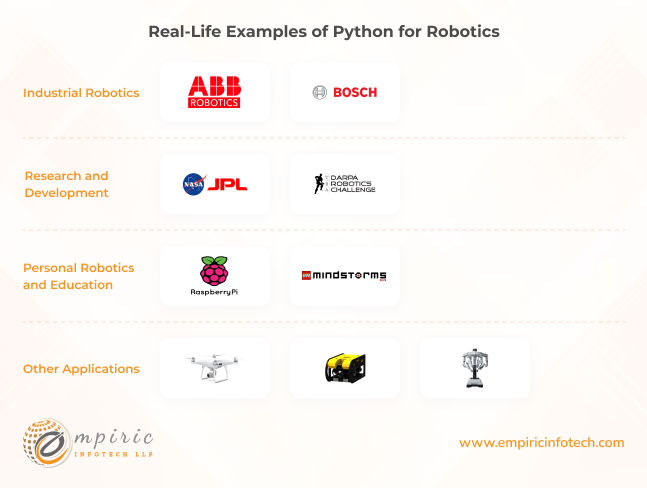
Real-Life Examples of where Python has been used in Robotics
Industrial Robotics
Python forms the foundation of their RobotStudio software, a comprehensive suite for robot programming, path planning, and simulation.
Developers leverage Python's libraries and scripting capabilities to create complex robot behaviors, optimize trajectories, and conduct virtual testing within the RobotStudio environment.
This adoption of Python streamlines development, facilitates robot programming for various tasks and ensures compatibility with their industrial robot systems.
Python plays a crucial role in their robot vision systems, empowering robots to perform sophisticated visual tasks within industrial automation solutions.
Libraries like OpenCV and scikit-image are harnessed for image processing, object recognition, and scene understanding, enabling robots to interact with their environment intelligently.
Python's integration with hardware and its efficient data handling capabilities make it ideal for real-time analysis of visual data captured by the robots, allowing for accurate and responsive actions.
Research and Development
Python forms the backbone for robot control, data analysis, and simulation at NASA's Jet Propulsion Laboratory, powering various space exploration projects like the Mars Rovers.
Its libraries like NumPy and SciPy provide robust tools for numerical computations and data analysis. It enables scientists to interpret sensor data, optimize robot control systems, and understand robot behavior in intricate Martian environments.
Python's scripting capabilities expedite simulation development. That allows researchers to test and refine robot control strategies before deployment on actual planetary missions. It ensures mission success and scientific discovery.
During the DARPA Robotics Challenge, multiple participating teams heavily relied on Python for programming their robots to perform complex tasks within challenging scenarios.
Its inherent readability and extensive libraries proved advantageous for rapid development and testing of algorithms for tasks like object manipulation, navigation, and obstacle avoidance in unstructured environments.
The success of Python-powered robots in this high-profile competition further underscored its suitability for tackling intricate research challenges and fostering innovation in the field.
Personal Robotics and Education
Countless hobbyist robots built with Raspberry Pi boards leverage Python for programming and control. This affordable and accessible platform, combined with Python's ease of use, empowers individuals to experiment, create, and learn hands-on about robotics principles.
Python's extensive libraries offer functionalities for motor control, sensor data processing, and even basic machine learning. This enables hobbyists to build robots with diverse capabilities, from simple line followers to more advanced object-avoiding robots.
This practical application fosters passion for STEM fields and allows individuals to gain valuable programming skills through engaging in personal robotics projects.
LEGO MINDSTORMS EV3
This popular educational robotics platform employs a language highly similar to Python, introducing students to core programming concepts in a familiar and fun context.
By utilizing Python-like syntax and functionalities for controlling robot motion, sensor data management, and decision-making, the platform provides a gentle introduction to programming principles while simultaneously teaching the fundamentals of robotics.
This exposure to Python-based concepts at an early stage sparks interest in programming and robotics, potentially nurturing future generations of engineers and innovators.
Other Applications
Drone Control
Python libraries like PX4 and MAVLink provide powerful tools for controlling and acquiring data from drones. These functionalities contribute to various applications, including:
Research: Python facilitates the programming of complex flight paths and data collection protocols for diverse research projects, from environmental monitoring to aerial photography.
Photography: Python scripts automate drone movements and camera controls. This enables professional photographers to capture high-quality aerial shots with precision and efficiency.
Delivery: Python plays a role in developing autonomous delivery drone systems. It allows for scripting of navigation, obstacle avoidance, and payload handling routines within various delivery services.
Underwater Robotics
Python proves valuable in programming underwater vehicles (AUVs) for exploration, search and rescue, and scientific research:
Exploration: By leveraging Python libraries for sensor data processing and path planning, AUVs can efficiently explore underwater environments, gathering valuable data for oceanographic research.
Search and Rescue: Python scripts enable AUVs to autonomously search for missing persons or objects underwater. It contributes to faster and more precise rescue operations.
Scientific Research: Python's integration with scientific computing libraries empowers researchers to program AUVs for specific tasks like water sample collection, environmental monitoring, and marine life observation.
Surgical Robotics
Certain surgical robots, like the da Vinci system, utilize Python for programming specific functionalities. It contributes to advancements in minimally invasive surgery:
Enhanced Control: Python scripts can be used to program precise instrument movements and provide surgeons with real-time feedback during complex procedures.
Automated Tasks: Specific surgical steps can be automated using Python, reducing surgeon fatigue and potentially improving surgical precision and outcomes.
Customization: Python's adaptability allows for tailoring scripts to specific surgical procedures and surgeon preferences. That enhances flexibility and personalization within the operating room.
Robotics with Empiric Infotech
As we've explored, Python empowers a spectrum of individuals and organizations to delve into the exciting world of robotics. From rapid prototyping to complex industrial applications, its versatility and vast resources fuel innovation across diverse sectors.
If you're ready to harness Python's power and embark on your own robotic journey, Empiric Infotech stands as your trusted partner. With our team of experienced Python developers and robotics enthusiasts, you have no need to worry about your dream project.
Looking to Contact us today to discuss your project and unlock the exciting future of robotics, driven by the power of Python.